
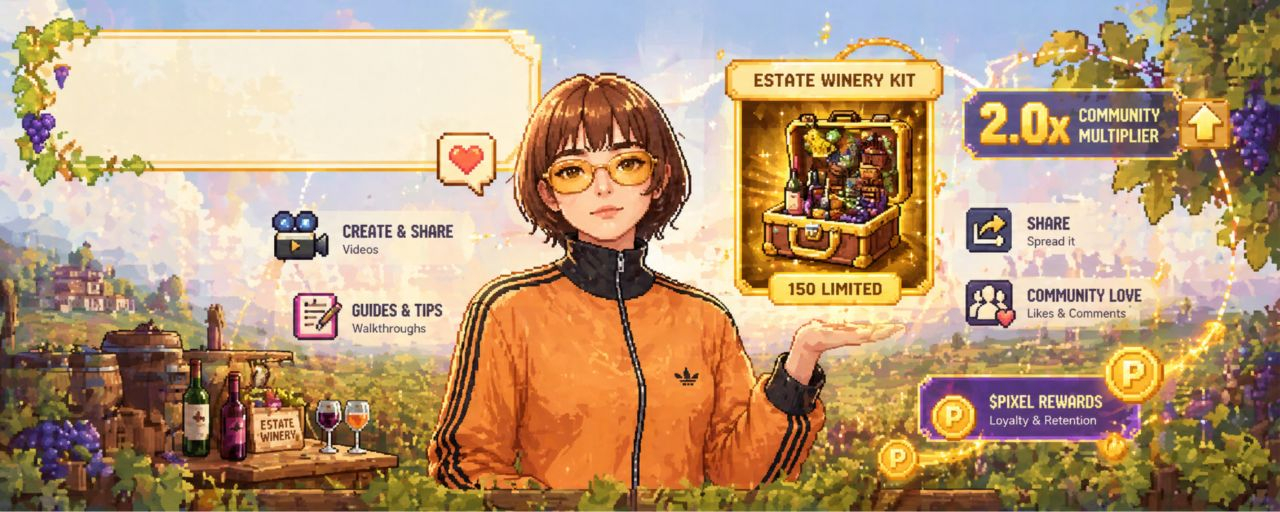
In the @Pixels space, scarcity has never been just a numbers game; it's the fuel for community viral spread.
When Tier 5 was just updated, the Estate Winery Kit—limited to only 150 across the server—quietly became the rarest crown jewel in the T5 industry.
It's a high-tier craft industry that can only be deployed on NFT land, representing a meticulous design experiment in game economics and community ecology—triggering players to spontaneously create standout content through extreme rarity, then leveraging the 2.0x Community Multiplier of the Stacked system for viral amplification. Ultimately, AI economists accurately track retention curves and inject $PIXEL loyalty rewards, forming a closed-loop positive feedback of 'rarity → sharing → cognitive explosion → $PIXEL demand surge.'
Estate Winery Kit -- Craftsmanship and economic positioning of the T5's rarest industry
The Estate Winery Kit is not just a regular crafting tool; it's the core of the 'winery-grade estate' industry designed specifically for NFT land.
It requires players to first acquire a T5 Slot Deed, then consume a Preservation Rune to maintain a 30-day validity. Once expired, the industry will automatically go offline, forcing holders to continuously invest resources and attention.
Winery functions focus on high-end brewing: T5 liquor formula grading requires multiple ingredients like glass bottles, premium fruits, Cooking Mix, Honey, etc. The finished wine can be sold directly or used for higher-tier tasks, cooking, or even cross-industry interactions. Early tests show that the output efficiency of T5 wineries and the drop rate of rare materials far exceed those of lower tiers, with potential daily $pixel equivalent earnings reaching several times that of regular players. More importantly, the 'estate specialty brew' produced has collectible attributes and social display value, becoming a symbol of player identity.
Compared to other T5 Kits like Master Sushi Kit, it requires long-term land management, raw material supply chains, formula optimization, and market insights, making it a complex asset.
This is the core of its viral seed—ordinary players find it hard to replicate, while top players, once they obtain it, immediately experience a unique sense of glory.
Strategic value: From FOMO to the driving force of content creation
With a hard cap of 150 across the server, limited to one per person, it creates extreme FOMO.
When Tier 5 just launched, the rush on channels like Seaside Stash sparked community discussions, with some players on X sharing screenshots of 'hoping to snag a T5 Winery'.
But what’s truly rare is the 'behavioral shift after acquisition': holders are likely to not just grind resources quietly but actively create & share highlight content.
The Estate Winery Kit is essentially a narrative vehicle—how to stand out among the 150 slots available, real testing of the T5 winery's first batch specialty formula, comparing the ROI of estate wineries vs standard wineries over 30 days...
These contents naturally possess scarce narrative tension: rare → exclusive → verifiable.
Players recording videos and writing guides essentially convert personal achievements into community assets.
Mainstream industries are accessible to everyone, but the Estate Winery Kit's barriers and complexity inherently filter for highly active, expressive core players.
They are content creators and opinion leaders, the KOLs of the pixel domain. Once they speak up, all players on the server take notice: these 150 will effectively become the 'winery dream team', and every share of theirs backs the $pixel ecosystem.
Stacked 2.0x Community Multiplier: Directly turning rarity into viral spread
The content from Estate Winery Kit holders perfectly aligns with this multiplier: rare topics + high production quality + verifiable authenticity = high viral potential.
Imagine a holder posts a 10-minute video (150 T5 wineries in action: how much $PIXEL did I earn in a day?). Stacked will automatically recognize their community contribution, stacking a 2.0x bonus that directly translates into higher $pixel rewards or Stacked points. This player gains exposure and economic incentives; viewers can also benefit through the Stacked task system, creating a win-win-win for creators, viewers, and the platform.
Moreover, the multiplier is not a one-off; it dynamically stacks—the more players interact with the content, the longer the multiplier effect lasts.
This instantly turns the original 150 Kits into 150 moving viral nodes. Rarity is systematically amplified into a server-wide topic through the multiplier mechanism.
I checked early data, and the ROI of Tier 5-related content on Stacked far exceeds that of regular tasks, validating the officials' predictions on viral seeds.
AI economists—precisely tracking retention curves and injecting differentiated $pixel loyalty rewards
AI will find that these Kit holders naturally have higher retention—rare assets bring psychological anchoring, complex gameplay brings a sense of achievement, and social displays foster a sense of belonging.
Thus, the system will prioritize allocating higher proportions of token loyalty rewards to them or customizing exclusive tasks.
Using minimal reward costs to maximize retention and reputation
Holders are more willing to run their wineries long-term and continuously produce content due to extra rewards; new players see that 'winery players are earning $pixel and are favored by the officials,' intensifying FOMO and actively seeking $pixel to boost their competitiveness.
In the long run, the 150 Estate Winery Kits have become the hidden demand engine for $pixel.
It enhances the game's long-tail value—elite players bleed into the whole ecosystem through high-end industries.
The staking pool becomes more stable with increased retention players, and the secondary market for NFT land appreciates due to T5 potential, with the overall economic health far surpassing games with uniform rewards.
More importantly, it validates Pixels' vision of 'real games, real economy': rarity is both content productivity + economic productivity.
*Disclaimer: This article is personal analysis and does not constitute investment advice. DYOR