

What's going on with Dogecoin? It's not moving up and is getting increasingly 'split'.
In the past week, the performance of #Dogecoin has been somewhat disappointing. As the recognized 'meme coin king', this recent market move seems to be lacking momentum. More critically, from a longer-term perspective, the price has dropped about 17% over the past 90 days, indicating a generally weak trend.
But more concerning than the price is the emerging 'split' within the market.

On one side, it's quiet: retail enthusiasm is clearly cooling.
Let's first look at the most straightforward signal: hype.
Both on-chain and off-chain data show that DOGE's social activity is clearly declining. Simply put, fewer people are discussing it on X (Twitter), forums, and search trends.
This indicator is quite crucial. For assets like Dogecoin, which rely on community culture and sentiment, buzz often equals demand.
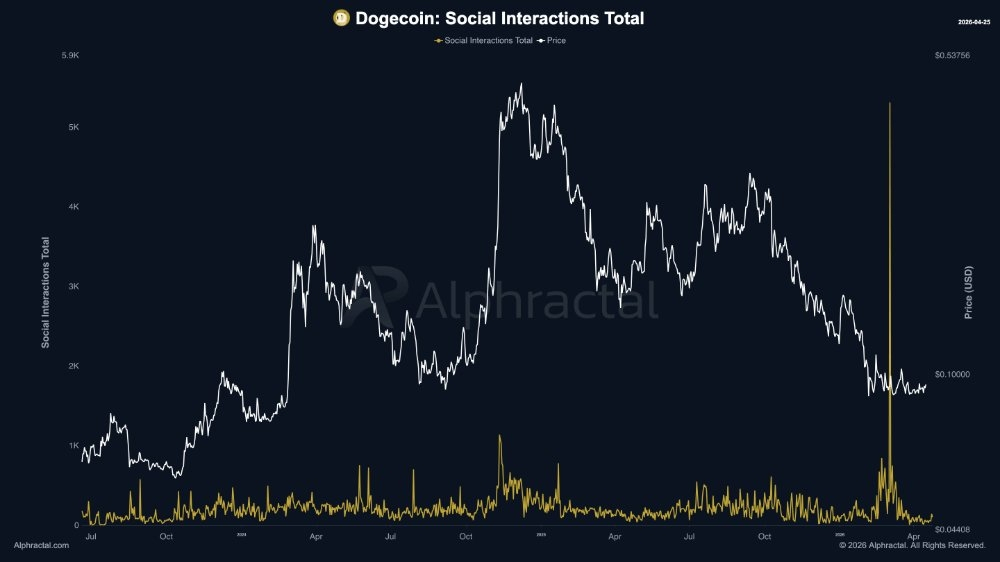
Historical experiences are quite consistent:
Once social volume continues to decline, the price is likely to either consolidate or face downward pressure.
In other words, the current #DOGE is losing its 'grassroots support.'
On the other side, the leverage funds are madly going long.
Interestingly, the other side presents a completely different picture.
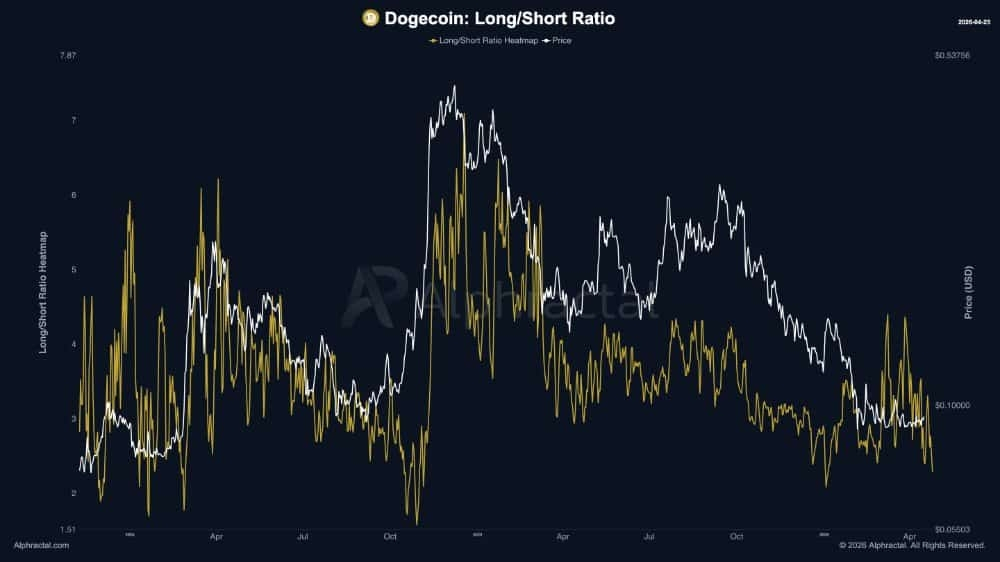
The derivatives market—especially perpetual contracts—is very active and clearly leaning long.
Currently, the long-short ratio for DOGE is about 2.6, meaning that long positions far exceed the shorts. This isn't just simple bullishness; it's got a hint of 'aggressive betting' to it.
Looking at the funding rate, it's continuously rising. Right now it's positive, meaning that the longs are consistently paying the shorts to maintain their positions.
What does this indicate?
In a nutshell:
Even though regular investors are backing off, the leveraged players are getting more excited.
Key issue: Spot isn't keeping up, risks are beginning to amplify.
The issue lies here—structural imbalance.
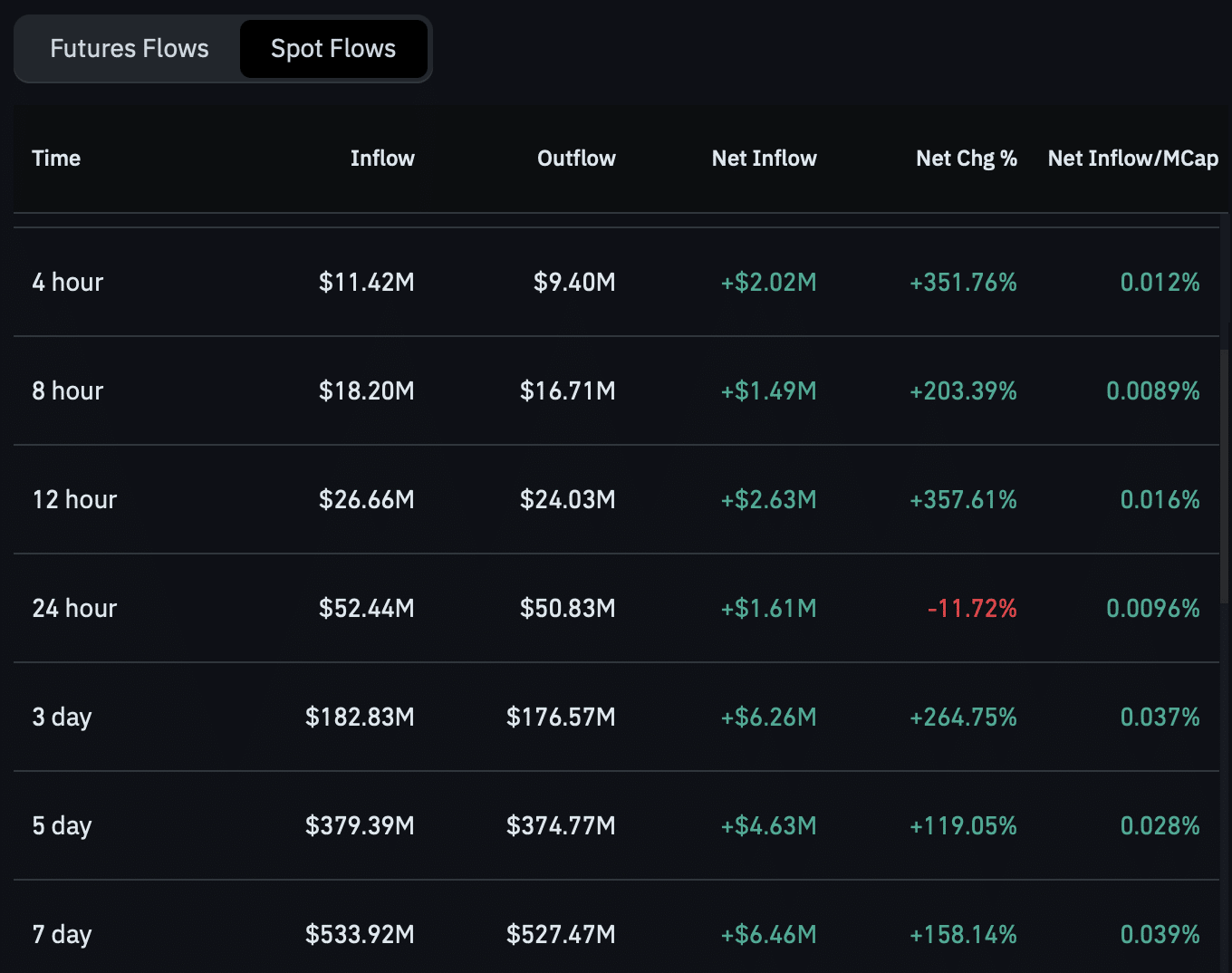
On one side, the spot market is getting increasingly quiet, even experiencing net outflows (more selling than buying);
On the other side, the contract market is heating up, with longs piling in higher and higher.
If these two can't sync up, it will create a very typical risk structure:
The price increase isn't driven by real buy orders, but rather by leverage pushing it up.
This market has a characteristic:
It seems to rise quickly, but is also particularly prone to crashing.
Because once the price doesn't meet expectations or market sentiment weakens even slightly, these high-leverage longs could get collectively squeezed, which would accelerate the downturn.
Current DOGE: it's not that it's not rising, but rather that it's 'unsteady.'
As it stands, Dogecoin isn't completely devoid of bullish power.
From the voting data, the overall market doesn't seem particularly pessimistic; there aren't many true bears out there.
But the problem is:
The real demand needed to support long-term increases is weakening, while short-term prices are becoming increasingly reliant on speculative funds.
This leads to a very subtle state—
There's neither a clear upward trend nor a solid bottom.
Simply put, it's:
Wanting to rise but with a shaky foundation; wanting to fall yet being propped up.
In conclusion: Beware of 'hype markets.'
The core contradiction surrounding DOGE right now can be summed up in one sentence:
Buzz is decreasing, but leverage is increasing.
This divergence often signifies that the market is entering an unstable phase.
If no new funds enter (especially spot buys), then the current long structure might struggle to hold.
And once leverage starts to loosen, the downside risks could actually be magnified.
So moving forward, what’s truly worth watching isn't the price itself, but two signals:
One is whether the social buzz can warm up again, and the other is whether spot funds will flow back in.
If these two points don't improve, this DOGE wave is likely just 'hype.'