
The crypto industry is undergoing a silent transformation.
Once, we talked about 'the next tenfold coin', 'revolutionary narratives', 'airdrop opportunities'. But now, institutional investors are asking: how much money can this project make?
This is not irony, but maturity.
The end of the narrative era
In 2024-2025, the crypto industry experienced a subtle turning point. The era of concept hype has officially ended, replaced by a more pragmatic era — we call it the cash flow era.
This transformation has traceable signs. Institutional investors in the primary market have clearly changed their investment direction, with funds no longer flowing to projects that boast grand visions, but rather to those with clear profit models: DeFi, CeFi, RWA, stablecoins.
In the secondary market, this signal is even more apparent. Projects that can generate stable cash flow and are willing to use that cash flow to buy back tokens—such as Hyperliquid, pump.fun, AAVE—have achieved valuations far above their peers.
Why? Because cash flow means commitment. It means the project is not just telling a story but making money.
The dilemma of token value
But here is a problem.
Traditional stock investors have dividend rights—this is natural. But what about crypto token holders? Their rights to income entirely depend on the project's token economic model design.
The reality is harsh: many crypto projects have tokens that are completely unrelated to the actual income of the protocol. The project makes money, but token holders see no returns. It's like you bought a 'membership card' for a company instead of stock—what the company earns has nothing to do with you.
This is a fundamental issue in the industry.
Two paths
To solve this problem, the industry mainly has two paths:
The first path: make the token a necessity. For example, the Gas fee mechanism of public chains—if you want to use the network, you must pay with the native token. This naturally creates demand for the token.
The second path: let the project's income directly benefit the token holders. This is usually achieved through buybacks or dividends.
Most DeFi projects follow the second path.
The problem with traditional buybacks
Currently, the conventional practice of DeFi projects is as follows:
The project makes money → the community initiates a governance proposal → voting decides whether to buy back → the buyback tokens are either destroyed, deposited into the treasury, or both.
Sounds good, right? But the problem is: this process is full of uncertainty.
When will the buyback happen? How much will be bought back? These are all decided by governance. For token holders, earning income is not guaranteed. This uncertainty leads to a subtle opposition: the community begins to doubt whether the project team is exploiting their informational advantage for profit, while the project team is easily surrounded by short-term speculators.
Long-term supporters have been overwhelmed. Community trust has been eroded.
Bifrost's answer: rigid buybacks
Bifrost 2.0 proposes a different solution: regular rigid buybacks.
What does this mean? Every month, Bifrost will automatically use the revenue in the treasury to buy back BNC tokens from the market. This is not optional, no voting is needed, just like an automatically executed contract.
How to handle the tokens after the buyback? According to the ratio of 10% destruction + 90% allocation:
10% destruction makes the token deflationary, reinforcing long-term value expectations
90% allocation to those who lock their tokens for the long term
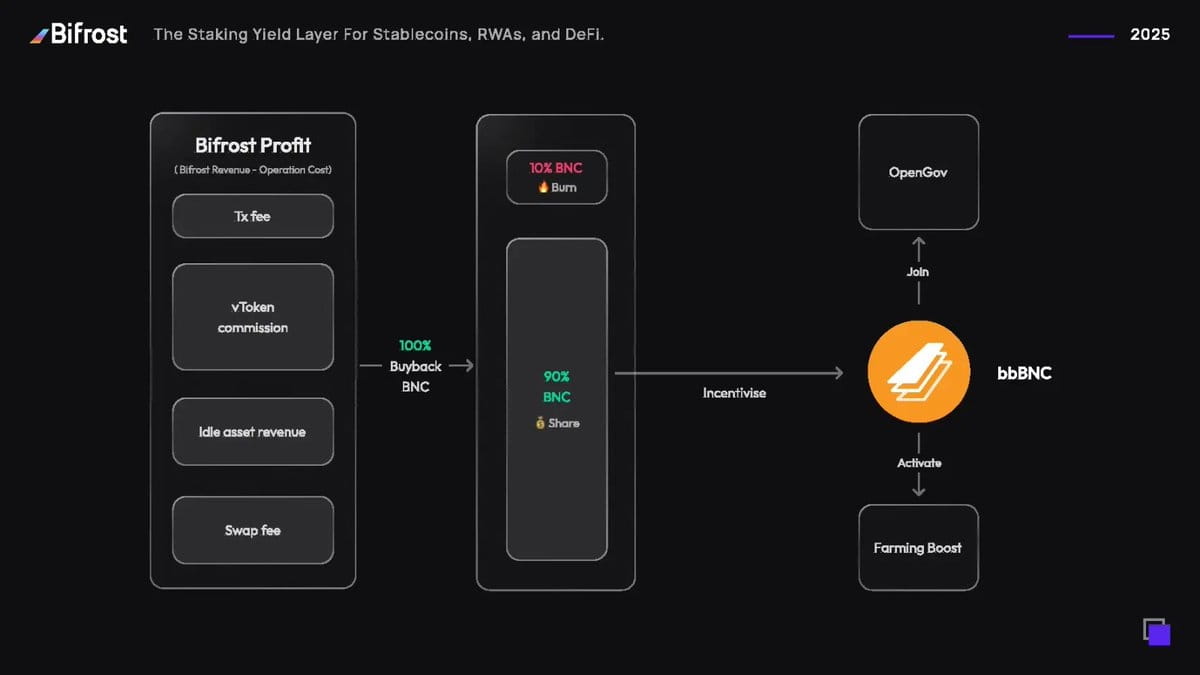
This leads to the second innovation: bbBNC.
bbBNC: redefining staking
bbBNC is not a tradable token, but a locking certificate. You obtain it by locking BNC or vBNC.
The design here is clever. The amount of bbBNC you receive depends on two factors:
How much have you locked— the more you lock, the more bbBNC you receive
How long have you locked— the longer you lock, the more bbBNC you receive
The maximum lock-up period is 4 years. But there’s a mechanism: over time, your bbBNC will automatically decay. If you want to maintain maximum returns, you need to renew regularly.
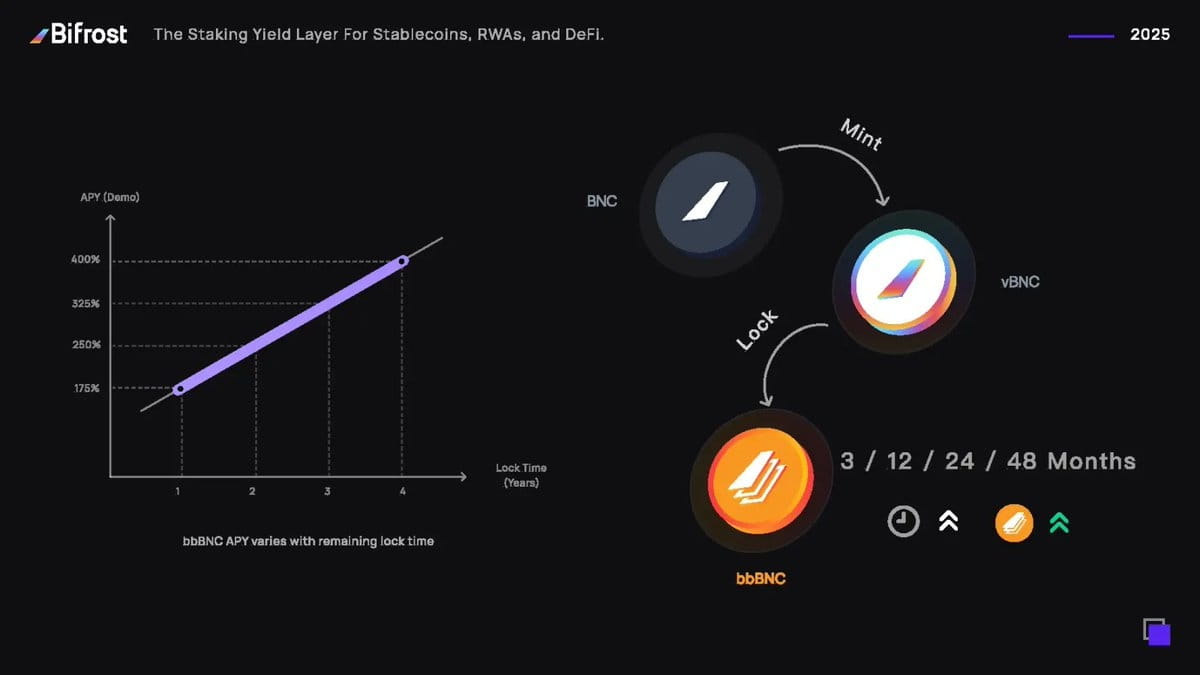
The brilliance of this design lies in that it filters out true believers.
Those willing to lock for 4 years are clearly not short-term speculators. They believe in the future of Bifrost. And the buyback income from Bifrost will be prioritized for these people. This is not only fair but also attracts those who genuinely want to contribute to ecological construction.
This model has no precedent in traditional finance, but in the crypto world, it represents a whole new possibility.
From commitment to action
On November 1, 2025, Bifrost launched this mechanism.
So far, they have completed the buyback of 955,108 BNC, forming an equivalent amount of distributable income. This number accounts for 1.25% of the total BNC supply.
All buyback records can be viewed in the Bifrost Dapp. Each buyback is associated with the corresponding governance proposal. This is 'code is trust'—no need to trust anyone, just trust the code.
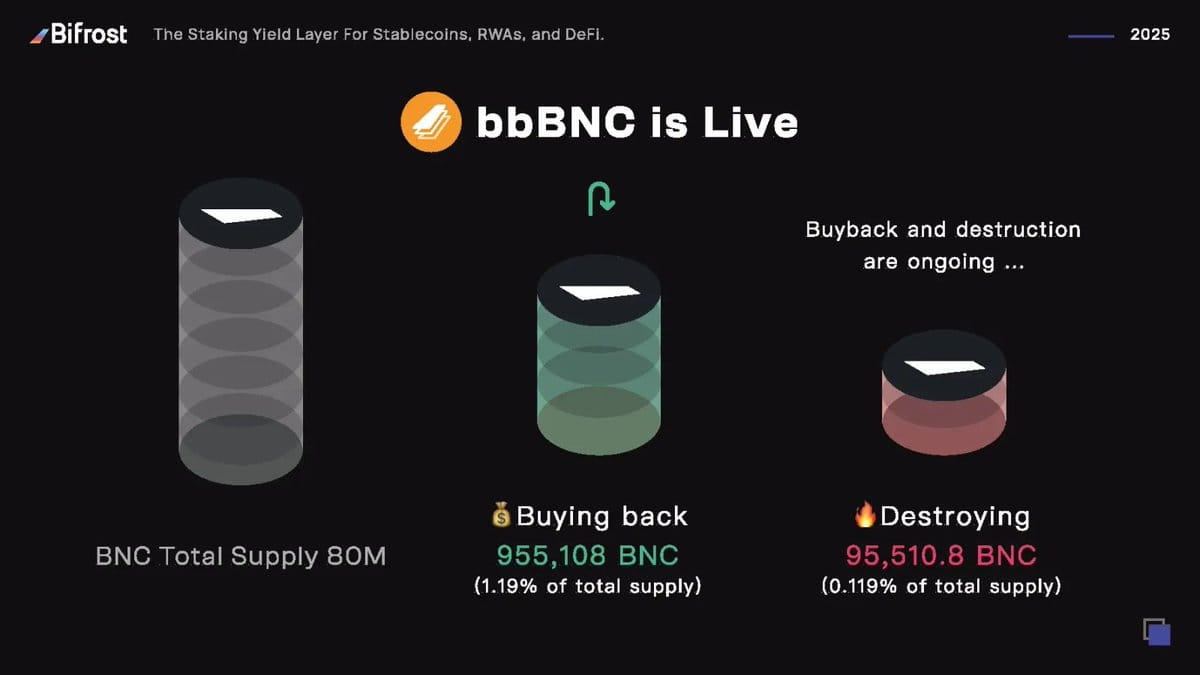
At the same time, the minting of bbBNC has also been launched. Users holding bbBNC can claim their earnings at any time. If you minted bbBNC at the first opportunity, you can immediately claim a portion of the already accumulated distributable income.
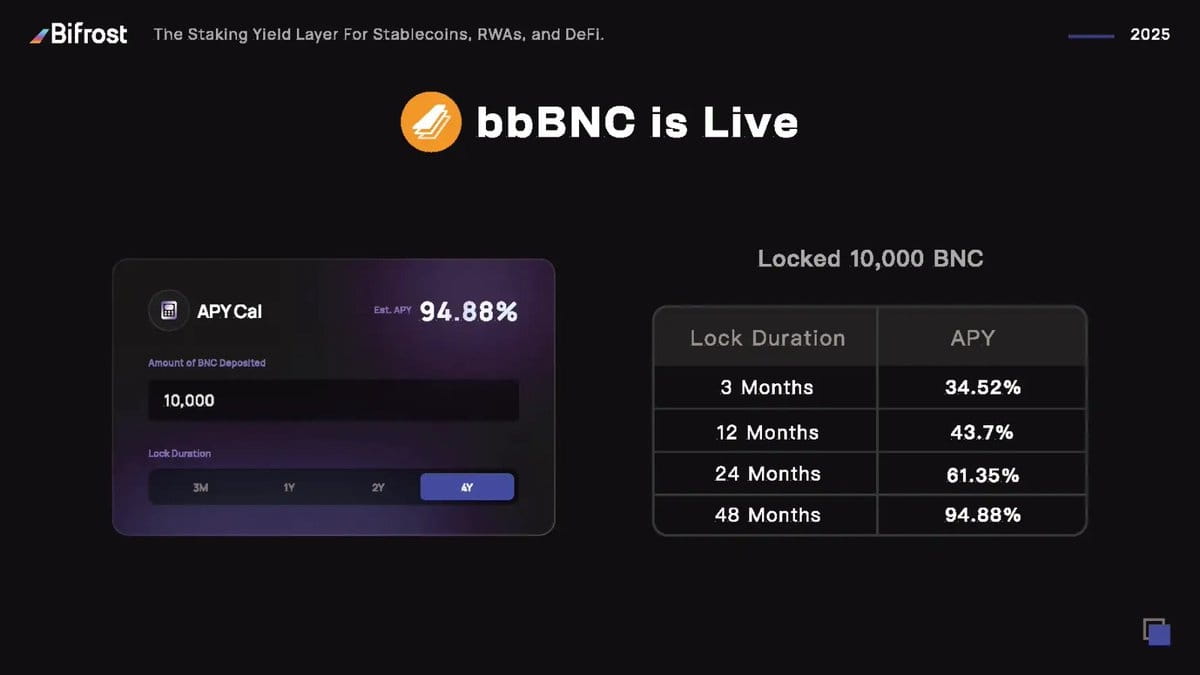
This is not a promise. This is reality.
Numbers speak
Now let’s look at the value of BNC in numbers.
In the crypto industry, the standard method for evaluating token valuation is MarketCap/Revenue—the ratio of market value to annual income. The lower this ratio, the cheaper the token.
Bifrost's situation is as follows:
Total supply of BNC: 80 million tokens
Unlocked quantity: 77.36 million tokens (unlock rate 96.72%)
Current price: $0.1
Unlocked market value: approximately $7 million
Revenue for the past 12 months: $1.37 million
Valuation multiple: approximately 5.6 times
What does this number mean?
Look at other DeFi projects. LIDO's valuation multiple is 9.8 times. Most mainstream DeFi projects are above 8 times.
And Bifrost only has 5.6 times.
In other words, BNC is severely undervalued.
Flywheel effect
But why will this undervaluation be corrected? Because Bifrost has initiated a self-reinforcing growth flywheel:
As long as PoS mining continues to generate staking income, Bifrost will have stable cash inflow. This cash flow guarantees the rigid buyback every month. Buybacks mean dividends. Dividends reinforce community loyalty. A more loyal community will participate more actively in ecological construction. Ecological expansion drives business growth. Business growth enhances protocol income. Higher income supports larger-scale buybacks.
This is a positive cycle.
Moreover, this cycle has a key feature: it is automatic and does not rely on anyone's decision.
Why institutional investors are paying attention
This is significant for traditional investors.
Bifrost's clear profit model and continuous dividend mechanism allow traditional investors to evaluate this project using their familiar analytical framework. It is no longer about 'how cool this narrative is', but 'how much can this project earn'.
This lowers the threshold for institutional capital entry. The influx of institutional capital usually means an increase in valuation.
The story of growth continues
Bifrost's TVL is currently stable at around $100 million. But the signs of growth are evident:
The minting volume of vDOT increased by 242% in 2025
Number of vDOT holdersIncreased by 82.2%
And this is just the beginning. Bifrost plans to launch more products: vETH 3.0 for EVM users, a stablecoin Vault, and a brand new vToken.
Every new product means more cash flow, more buybacks, more dividends. The flywheel is accelerating.
The beginning of an era
If the first half of the crypto industry is 'narratives and speculation', then the second half is 'cash flow and landing'.
Bifrost is reshaping the rules of the game in this industry in three ways:
Break the governance black box with rigid profit-sharing
Rebuild community trust with transparent buybacks
Anchor profit to lower the investment threshold
What is the result? The BNC token has both the value certainty of traditional assets and retains the ecological growth potential of crypto assets.
Final words
As more and more projects fall into 'narrative internal competition', Bifrost has already proven a simple truth with cash flow:
True crypto innovation is not about drawing a bigger pie but about earning real money.
The true growth flywheel is not accelerated by speculation but driven by value.
For investors, choosing Bifrost is not just choosing an undervalued token, but a direction—an era rooted in profit and value.
This era is slowly unfolding from the cash flow of Bifrost.
