
In the cryptocurrency space, 3000 yuan is about 440 USD. Let me provide an actionable plan. If you can execute it, turning 3000 yuan into 1 million is achievable.
To give some practical and useful advice to those just entering the cryptocurrency world! My trading method is very simple and practical; I made it to an 8-digit number in just a few years, relying solely on 11 types of chart patterns for trading. I only enter the market when I see a clear pattern, and I don't trade without a pattern. I've maintained a win rate of over 90% for five years!
I spent 5 years checking 400 charts every night, turning 11,000 into 18 million, relying solely on 11 types of chart patterns for trading, achieving a win rate of 100%. Through my own practice, I also remarkably achieved a win rate of 100%. These days, I have organized my findings, and I’m now sharing them with those who are destined to learn and master them; it’s worth keeping!
1. Cup and handle pattern:
The cup and handle pattern is a corrective formation that occurs after a strong rise in a coin. Generally, a coin will experience about 2 to 4 months of intense volatility, followed by market adjustments. During the pullback, the coin will encounter sell-offs and drop about 20% to 35% from the previous high, with the adjustment period generally lasting between 8 to 12 weeks, depending on the overall market conditions. When the coin price rises and attempts to challenge the previous high, it will face selling pressure from those who bought at or near the previous high. This selling pressure will cause the coin price to drop and consolidate horizontally, typically lasting from 4 days to 3 weeks. The handle's position is usually 5% lower than the previous high. If the handle is lower, it often indicates a defective coin, meaning a higher risk of failure.
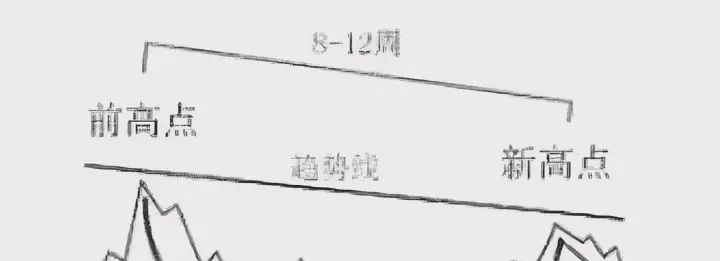
The best time to buy this coin is when it rises to a new high at the top of the handle, rather than when it touches the previous high point from 8 to 12 weeks ago. This is one of the best and most reliable formations. It is important to note that the best stocks with this formation usually appear at the beginning of a market trend after a significant market adjustment, rather than during or at the end of a major market rise.
2. Rounded bottom:
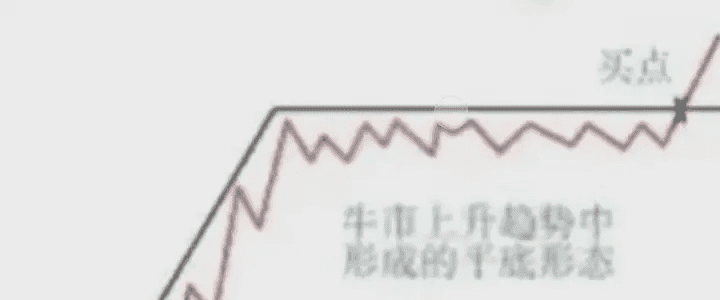
A rounded bottom is a chart pattern that moves horizontally over any time frame. This pattern can generate very strong upward movements. What we are looking for is when the coin price maintains a level or roughly the same level, and trading volume is exhausted. Draw a trend line at the top of this rounded bottom, and buy when the price breaks through the trend line and the volume increases.
3. Ascending triangle:
The ascending triangle is a variant of the symmetrical triangle and is generally considered the most reliable bullish pattern in an uptrend. The top of the triangle is flat, while the bottom of the triangle is sloping upwards.
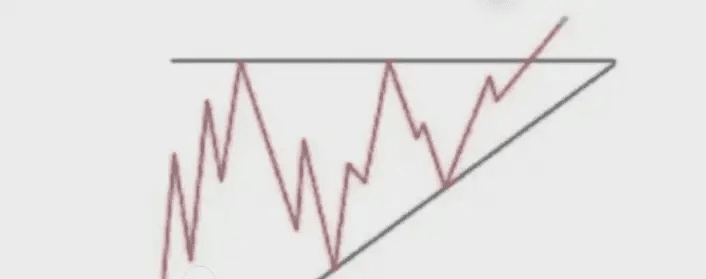
In an ascending triangle, the stock is overbought, and the price reverses and falls back. Subsequently, buying pressure re-enters the market, and the price quickly reaches a historical high, then falls back again after hitting the peak. Buying pressure will appear again, although the price will be higher than before. The price ultimately breaks through the previous point, and with the arrival of new buying pressure, the price will be pushed higher. In the case of a symmetrical triangle, the breakout is usually accompanied by a significant increase in trading volume.
4. Parabolic:
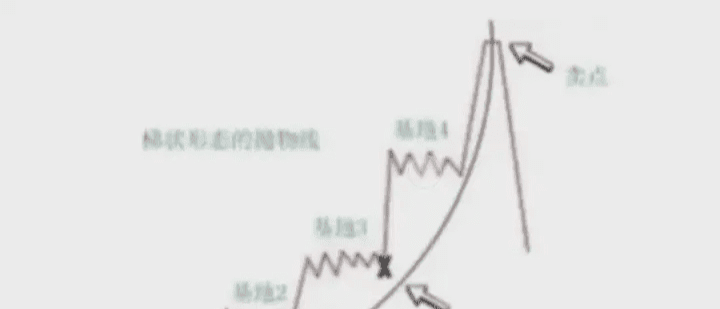
The parabolic pattern may be one of the most revered and highly regarded models. This pattern can provide you with the maximum and fastest returns in the shortest time. Generally, you will find such patterns at the end of a major market rise or close to its end; this model is the final result of a breakout formed after multiple bases.
5. Wedge:
The formation of a wedge also resembles a symmetrical triangle in appearance because the trend lines intersect at their apex. However, the distinction of the wedge lies in its obvious tilt, with both sides sloping. Like triangles, volume should decrease during the formation of the wedge and increase during its breakout. Below is a typical wedge trend pattern:
Descending wedges are generally considered bullish and typically appear in an uptrend. However, they can also occur in a downtrend; however, this means that overall it remains bullish. This chart pattern consists of a series of lower highs and lower lows.
The ascending wedge is generally considered bearish and usually appears in a downtrend. They can also be found in an uptrend but are still mostly regarded as bearish. The ascending wedge consists of a series of higher highs and higher lows.
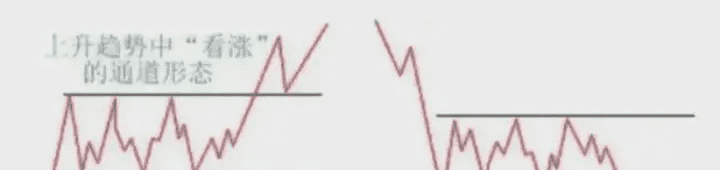
Channel:
The channel pattern is generally considered a continuation pattern. They are areas of indecision and usually move in the direction of the trend. Of course, the trend lines within the rectangular zone move parallel, representing a balance of supply and demand, with buyers and sellers appearing to be evenly matched. The same "high points" will continuously be challenged, and the same "low points" will also be constantly challenged, causing the currency to fluctuate between two clearly defined parameters. Although trading volume does not seem to be as affected as it is in other patterns, trading volume typically decreases during the pattern, but like other currencies, volume should significantly increase during breakouts.
7. Symmetrical triangle:
The symmetrical triangle can be described as an area of indecision, where the market stagnates and the future direction is questioned. Generally, at that time, the forces of supply and demand are considered almost equal.
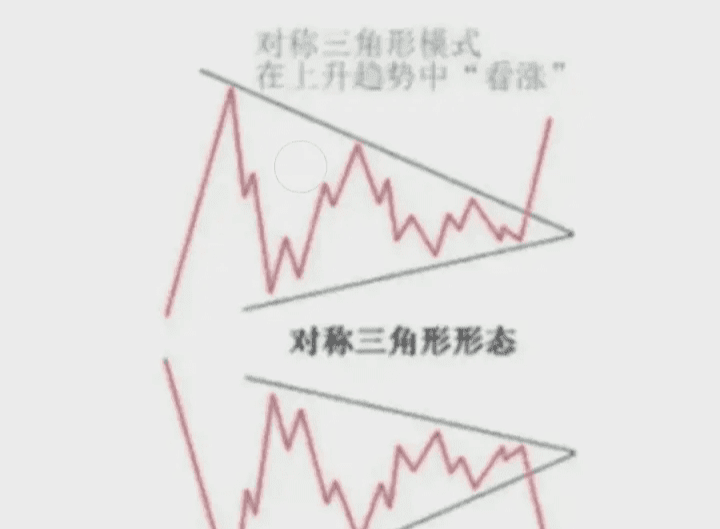
Buying pressure that pushes the coin price up quickly encounters selling pressure, while a drop in coin price is seen as a buying opportunity. Each new lower high and higher low becomes narrower than the previous ones, forming the shape of a sideways triangle. (During this period, trading volume tends to decrease.) (Usually under significant trading volume conditions). Eventually, this indecisiveness ends, often leading to an explosion from this shape. Studies show that symmetrical triangles overwhelmingly reverse in the direction of the trend. In my opinion, symmetrical triangles are very useful chart patterns that should be traded as continuation patterns.
8. Descending triangle:
The descending triangle is also a variant of the symmetrical triangle, generally considered bearish, and usually appears in a downtrend.
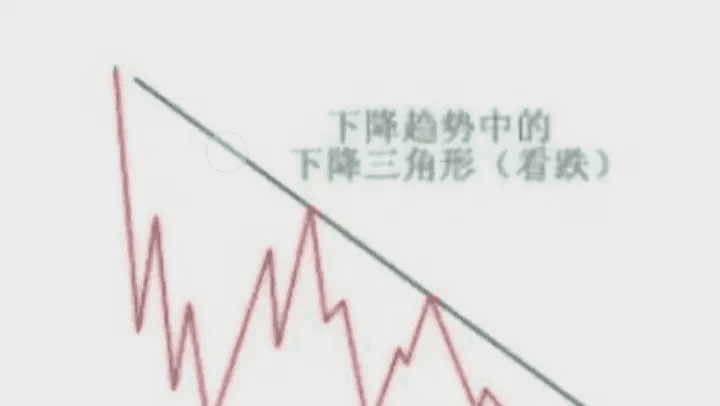
Unlike the ascending triangle, the bottom of this triangle appears to be flat. One side of the top of the triangle slopes downwards. The price will drop to an oversold level, and then tentative buying pressure appears at the low, causing the price to rebound.
However, higher prices attracted more sellers, and prices constantly challenged previous lows. Next, buyers tentatively re-entered the market, but the rising prices attracted more sellers once again. Ultimately, sellers took control of the situation, breaking through the previous low of this pattern, while earlier buyers were eager to sell their positions. Like symmetrical triangles and ascending triangles, trading volume tends to decrease during the formation of the pattern until it expands at the time of the breakout.
9. Flags and pennant patterns:
Flags and pennant patterns can be classified as continuation patterns; they typically only represent a brief pause in dynamic cryptocurrencies, usually appearing after a rapid and significant rise, where the currency will often rise again in the same direction. Studies show that these patterns are relatively reliable continuation patterns.
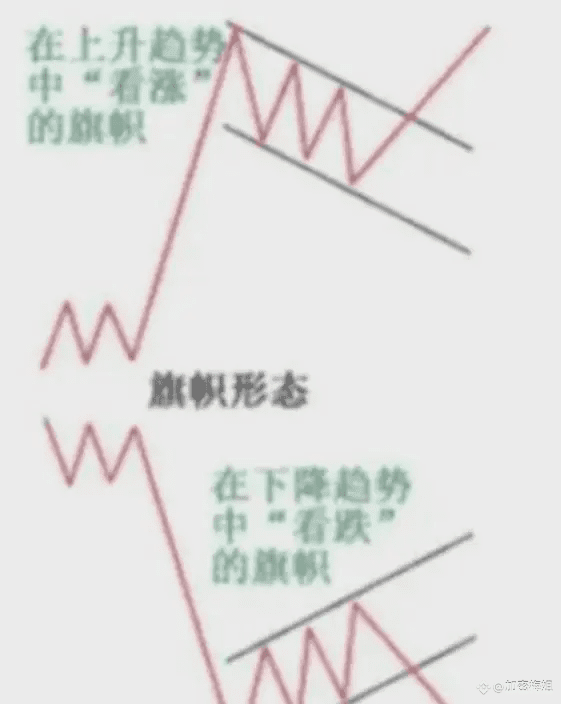

1. The characteristics of a bull market flag are lower highs and lower lows, with the slope direction opposite to the trend. However, unlike wedge lines, their trend lines are parallel.
2. Bearish signals consist of higher highs and higher lows. The "bear market" flag also has a reverse trend slope. Their trend lines are also parallel. Triangle flags look very similar to symmetrical triangles, but the triangle flag patterns generally have smaller magnitude fluctuations and durations, with trading volume typically contracting during stagnation and expanding during breakouts.
10. Head and shoulders:
Head and shoulders are generally considered reversal patterns, appearing in an uptrend as the most reliable. Eventually, the market begins to slow down, and the forces of supply and demand are generally considered balanced.
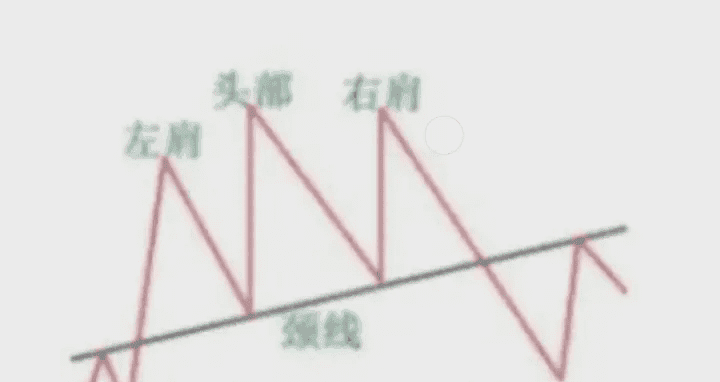
Sellers offload at the high point (left shoulder) and begin a tentative decline. Buyers quickly return to the market and eventually push the price to a new high. However, the new high quickly falls back and will again undergo a test of the neckline. Tentative buying pressure appears again, and the market rebounds, but fails to break the previous high. The last peak is considered the right shoulder.
Volume is very important in the head and shoulders pattern. Volume typically follows the price increase of the left shoulder. However, the head forms under decreasing volume, indicating that buyers are no longer as aggressive as before. The volume of the right shoulder is even smaller than that of the head, suggesting that buyers may be exhausted. New sellers enter, while previous buyers exit. When the market breaks through the neckline, the chart is completed, and volume expands during the breakout.
11. Inverted head and shoulders:
The head and shoulders pattern can sometimes be inverted, and the inverted head and shoulders pattern typically appears in a downtrend. The inverted head and shoulders pattern is noteworthy for its volume characteristics.
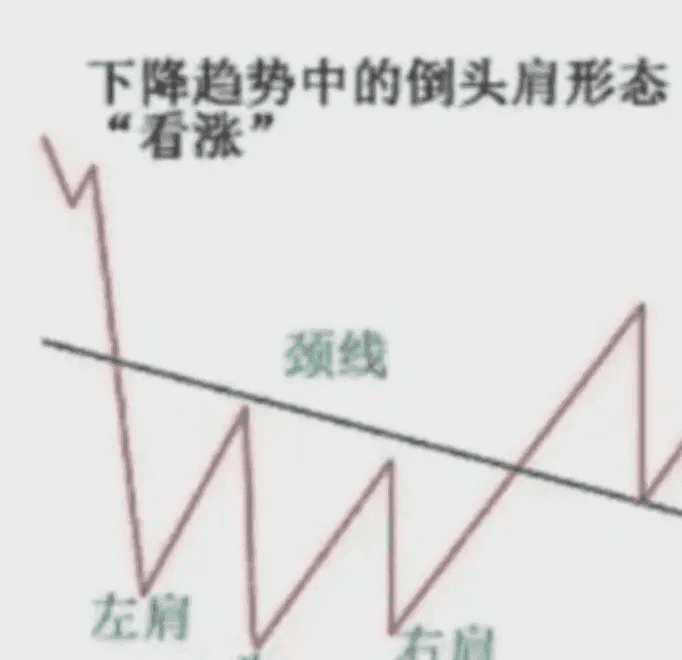
1. The inverted left shoulder should be accompanied by increased volume.
2. The inverted head should form under smaller volume.
3. However, rebounds from the head should show greater trading volume than rebounds from the left shoulder.
4. The volume of the inverted right shoulder should be the smallest.
5. When the coin price rebounds to the neckline, the trading volume should increase significantly. New buyers enter, while previous sellers exit. When the market breaks through the neckline, the chart is complete. Volume will increase during the breakout.
In the early years of trading, like many others, I stayed up late every day watching the market, chasing highs and selling lows, losing sleep over my losses. Later, I gritted my teeth and stuck to a simple method, and surprisingly survived, slowly starting to make steady profits.
Looking back now, this method, while simple, is effective: "If I don't see a familiar signal, I absolutely won't act! I'd rather miss the market than place random orders. Relying on this iron rule, I can stabilize my annual return rate at over 50% and finally don't have to rely on luck to survive.
Here are some safety recommendations for beginners, all based on the experiences I gained from real trading losses:
1. Trade after 9 PM. The information during the day is too chaotic, with various false positives and negatives flying around, causing the market to jump around erratically, making it easy to be fooled into the market. I usually wait until after 9 PM to operate; by then, the information is generally stable, and the candlestick charts are cleaner and clearer in direction.
2. Immediately secure profits after making money. Don't always think about doubling! For example, if you made 1000 USD today, I suggest you immediately withdraw 300 USD to your bank card and continue playing with the rest. I've seen too many people who made three times their investment and then aimed for five times, only to lose everything back on one pullback.
3. Look at the indicators, not your feelings. Don't trade based on feelings; that's blind.
On your phone, install TradingView and check these indicators before trading:
MACD: Is there a golden cross or death cross?
RSI: Is there overbought or oversold?
Bollinger Bands: Is there a squeeze or breakout?
At least two of the three indicators must give consistent signals before considering entering the market.
4. Stop-loss orders must be flexible. If you can monitor the market, when you make a profit, manually adjust your stop-loss price upwards. For example, if your purchase price is 1000 and it rises to 1100, move your stop-loss to 1050 to secure your profits. But if you are going out and cannot monitor the market, definitely set a hard stop-loss of 3% to prevent sudden crashes.
5. Withdraw weekly. Non-withdrawn profits are just a numbers game! I consistently transfer 30% of my profits to my bank card every Friday, and continue to roll over the rest. Over time, this will lead to a thicker account.
6. There are tips for reading candlestick charts.
For short-term trading, look at the 1-hour chart: If the price has two consecutive bullish candles, consider going long. If the market remains stagnant, switch to the 4-hour chart to look for support lines: Consider entering when it drops near the support level.
7. Be careful not to fall into these pits! · Leverage should not exceed 10 times; beginners are best kept within 5 times. Avoid coins like Dogecoin and shitcoins, as they are easy to be harvested.
A maximum of 3 trades per day; too many can easily lead to a loss of control. Absolutely do not borrow money to trade cryptocurrencies!! The last piece of advice I give you: trading cryptocurrencies is not gambling; treat it like a job, clock in and out every day, shut down when it's time, eat when it's time, sleep when it's time, and you will find that making money is actually more stable.
Lastly, let me say something heart-wrenching.
In the market, there are no guaranteed profits, only probability games. The essence of the pullback confirmation rule is to use rules against human nature—be calm when others panic, and be restrained when others are euphoric.
Playing around in the cryptocurrency market is essentially a contest between retail investors and institutional traders. If you lack cutting-edge information and firsthand data, you can only be at the mercy of others! Still, the same advice: If you don't know what to do in a bull market, follow Mei Jie for spot planning, contract passwords, and free sharing.
I am Dong Ge, nice to meet everyone. Dong Ge focuses on Ethereum contract spot strategies. The team still has positions available; get on board quickly to become a major player and a winner.