The bull and bear are indistinguishable; no one dares to speculate on coins anymore. Putting money into DeFi wealth management, unexpectedly DeFi also experienced a crisis.
So this time we won't talk about those yields that often reach dozens or hundreds of percent, nor encourage doing any fancy strategies. Rhythm BlockBeats has selected a few relatively stable options in the current market, with APYs around 10%, and pools that have been validated over time in both on-chain and off-chain trading platforms. These are all one of the selectable directions in the current market.
Overall, Binance's BFUSD currently has relatively outstanding comprehensive advantages, being more stable than similar products in terms of yield, mechanism design, usage expansion, and risk structure.
Binance: BFUSD (11%)
The annualized yield of BFUSD will dynamically fluctuate with changes in funding rates and hedging strategies, recently averaging around 4% to 7%, and the current actual annualized rate is about 6.34%. Earnings are distributed daily without the need for additional purchases; simply holding will automatically allow for collection.
Perhaps to commemorate the one-year anniversary of BFUSD's launch, Binance has recently introduced an additional earnings activity, during which an extra 5% reward can be stacked on top of the basic annualized rate.
That is to say, eligible users can enjoy a comprehensive annualized yield of around 11% within the limited quota.
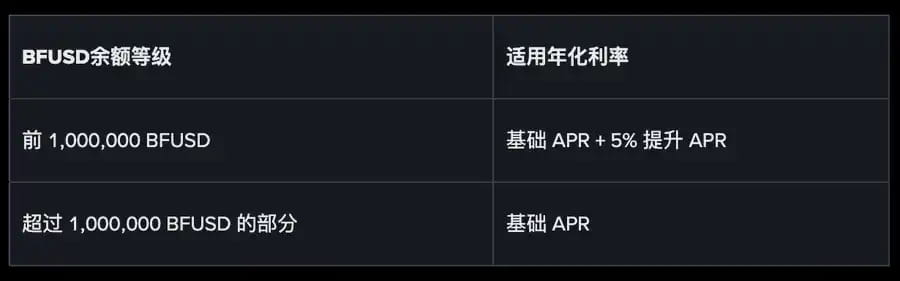
There are two conditions for participation: holding BFUSD in a contract account or unified account; maintaining a minimum open contract volume of 1,000 USD in U-based or coin-based contract accounts. Binance will take multiple random snapshots of users' open contract volumes within each trading day and determine eligibility based on the lowest snapshot value. The event has now been extended to December 2.
In addition, a very attractive point is that under the 'joint margin' model, BFUSD can also be directly used as contract margin, further improving capital efficiency while earning returns.
The maximum limit for additional earnings per account is 1 million BFUSD. However, the limits for sub-accounts are calculated independently, so users with larger capital can maximize activity earnings through multiple accounts and sub-accounts.
After all, this is Binance, with a relatively high safety factor, and it is also a stablecoin investment, while the yield is currently the highest among these four, worth paying attention to.
Sky: sUSDS (9.4%)
Sky Protocol (formerly MakerDAO)'s sUSDS savings pool currently offers an APY of 4.50%, with earnings coming from its core Sky Savings Rate (SSR) mechanism. In the entire product matrix, including sUSDS savings (4.50%), SparkLend lending (3.55%), and traditional DAI DSR (1.25%), the three together form Sky's stable income system.
Currently, the total locked value (TVL) of the protocol is 5.93 billion USD, and it has achieved multi-chain deployment.
Among these options, the risk-return ratio is still optimal with the Sky Savings Rate (sUSDS). The current APY is 4.50%, and DeFiLlama's predictive model shows that it is highly likely to maintain above 3.60% in the next four weeks; the TVL of this pool is 3.737 billion USD, with a stable scale. Users need to hold USDS first to deposit and obtain sUSDS.
The specific operations to obtain USDS include: upgrading DAI to USDS at a 1:1 ratio (no fees); redeeming through the PSM mechanism with USDC or USDT; or directly exchanging ETH for USDS on the CoW Protocol. After authorization, depositing USDS into the savings pool will automatically mint sUSDS and start accruing interest.
In addition to the basic earnings, the protocol also provides SKY token rewards (STR) as an additional source of income. Currently, this part's extra APY is 4.91%, also calculated based on sUSDS amounts. If combined, the theoretical total earnings can reach about 9.41% (4.50% basic earnings + 4.91% SKY rewards).
The participation method is to deposit sUSDS into the designated farm to start earning SKY rewards. However, it should be noted that SKY rewards need to be claimed manually, and the token price is subject to volatility, so the actual yield will be affected by market prices.
Lista: slisBNB (10.8%)
The core position of Lista DAO in the BNB Chain goes without saying. Lista DAO has now built a relatively complete DeFi ecosystem, with the most core product being the slisBNB staking pool. Currently, the APY of this pool is about 10.8%, and the total locked value of the overall protocol reaches 1.83 billion USD.
In addition, Lista also provides lending vaults, stablecoin CDP minting, and various liquidity mining pools, with yield ranges from 2% to 15%, covering a variety of strategy needs from conservative to aggressive.
The core slisBNB currently has a TVL of approximately 1.2 billion USD. It maintains a 1:1 redemption relationship with BNB, and its price continues to appreciate with the accumulation of staking rewards. All slisBNB is fully backed by real BNB staked on validation nodes, belonging to a non-custodial mechanism, with relatively high security and transparency. The protocol will extract 5% from staking rewards as treasury income, but the overall annualized impact on users is not significant.
The basic BNB validator staking rewards are approximately between 7% and 8%; after the protocol extracts fees, Lista incentivizes further enhancement of overall yields through LISTA tokens, stabilizing the final APY at around 10.8%; and all earnings will automatically compound in slisBNB's price, requiring no manual operations from users, nor additional staking or reward claiming, the holding will automatically grow.
The operation process is also quite simple. Users just need to connect their wallets, deposit BNB, and the system will automatically mint slisBNB and start generating returns. After that, no additional operations are needed, and the earnings will continue to accumulate and be reflected in the token price.
Jupiter: JupSOL (6.58%)
As the largest DEX aggregator in the Solana ecosystem, Jupiter has already become one of the most core staking pools on-chain. Currently, the annualized yield of JupSOL is approximately 6.58%, and the total locked value of the entire Jupiter-related ecosystem is about 2.91 billion USD.
In addition to JupSOL staking, Jupiter also has lending markets, perpetual contract liquidity pools (JLP), aggregation trading routes, and other products, and supports direct entry into the ecosystem through jup.ag, while stacking the reward mechanism of JUP governance tokens, creating a complete financial network on Solana.
Among all products, JupSOL is the most core and stable. Its yield primarily comes from SOL validator staking rewards, averaging in the range of 5% to 7%, supported by Sanctum infrastructure, and there is no lock-in period, allowing free use in DeFi at any time. The yield from JupSOL will continuously roll over automatically, re-staking every hour, allowing holders to continuously earn incremental returns. Additionally, some deposits from Jupiter Perps will be automatically staked, enhancing the yield structure of the entire pool. Users only need to connect their Solana wallet and exchange SOL for JupSOL to begin accumulating rewards immediately. Of course, the premise is that you can withstand a drop in SOL.
Additionally, Jupiter's lending market offers another more strategic yield direction. Assets like USDC, USDT, USDG/USDS, SOL, JUP, and mainstream assets ETH, WBTC can participate in deposits or lending, with deposit annualized rates ranging from 4% to 7%, while lending rates will dynamically adjust with utilization. The platform allows for high loan-to-value ratios, such as up to 95% LTV between stablecoins, suitable for leverage cycles: users can deposit USDC, borrow SOL, and then continuously exchange SOL back to USDC to amplify yield space, but risks will also correspondingly increase. If stability is preferred, JupSOL staking with the current 6.58% APY is a better choice.#加密市场回调