OpenGradient (OPG): The on-chain verifiable AI infrastructure layer - A deep dive into the tokenomics
When AI meets blockchain, trust no longer needs to be blind.
On April 21, 2026, OpenGradient officially launched its mainnet and kicked off the TGE, co-led by a16z crypto and Coinbase Ventures. This isn't just another token drop for an AI project; it's a watershed moment for 'verifiable AI computation' transitioning from concept to sovereignty.
1. Why do we need 'verifiable AI'?
Today's AI is a black box:
When you call GPT-4o/Claude, you can't verify if the model has been tampered with.
You pay reasoning fees but can't prove if the computations were executed correctly.
You rely on AI for financial decisions but can't audit the inference process.
OpenGradient addresses this fundamental issue: making AI inference mathematically provable, verifiable on-chain, and publicly auditable.
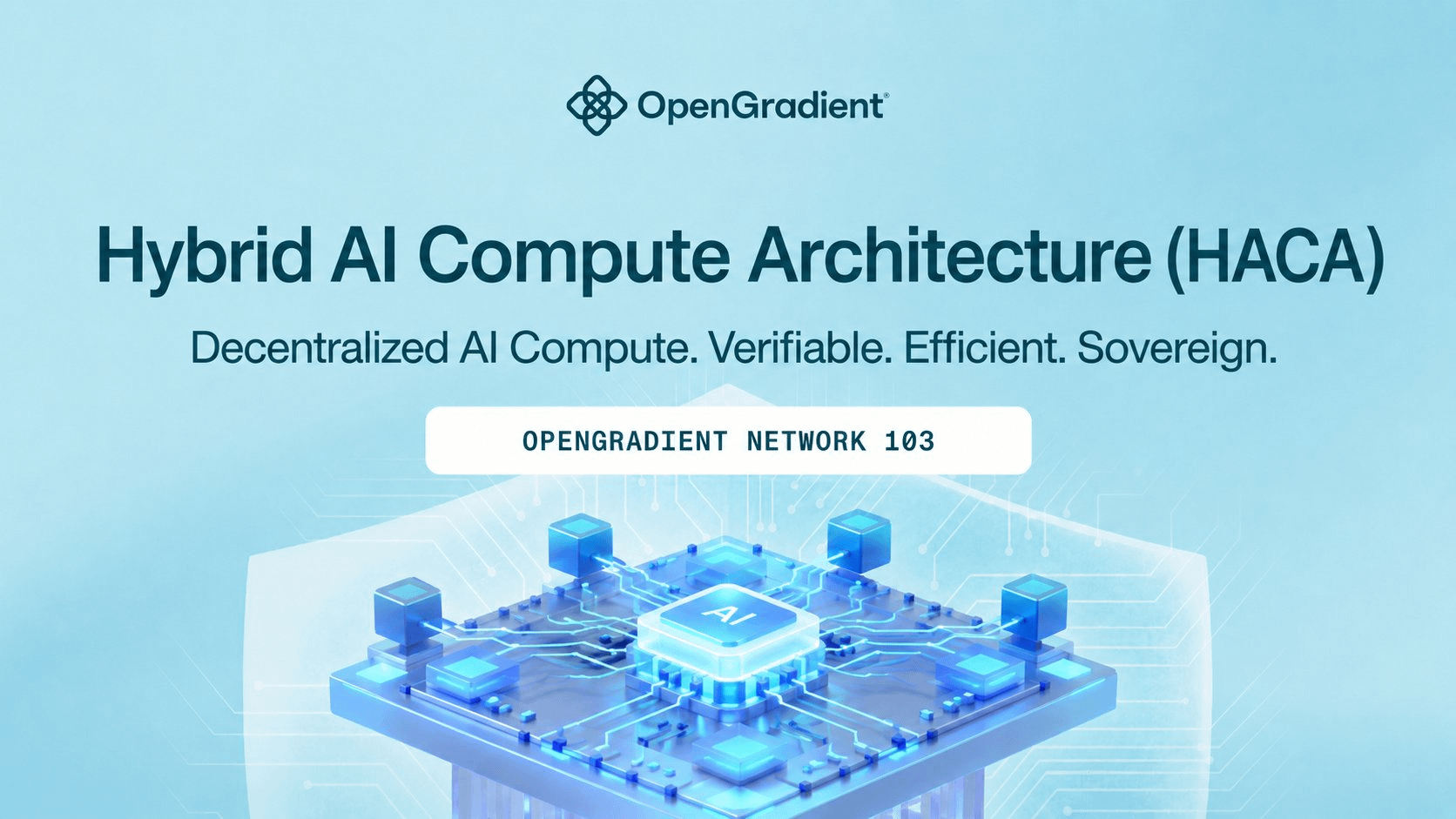
Its core infrastructure—Hybrid AI Computing Architecture (HACA)—separates the execution of AI inference from verification:
Components Roles Inference Nodes GPU/TEE nodes, near centralized latency execution of inference Full Nodes CometBFT consensus validation layer, validating crypto proofs Data Nodes TEE protected secure data retrieval layer Storage Layer Decentralized storage (Walrus), only blob ID remains on-chain
The verification methods cover a full spectrum from TEE (hardware-level trusted execution, default LLM solution) to ZKML (zero-knowledge proof, maximum security) down to Vanilla (signature verification, rapid prototyping).
Pre-launch data: 2 million+ verifiable AI inferences, 500,000+ crypto proofs, 2000+ models, 100+ developers on board. These aren't just numbers from a whitepaper; this is the actual workload done on the mainnet.
Two, $OPG Token Model — Flywheel-driven Tokenomics
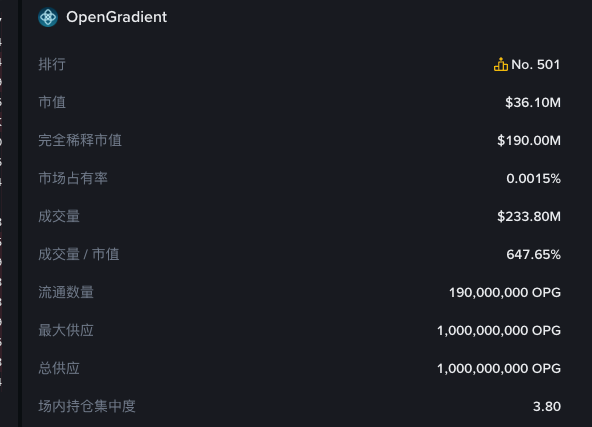
Total Supply: 1 billion OPG (fixed supply, never to be inflated)
OPG is a Utility Token deeply coupled with AI computing demand, its value is based not on narrative but on actual computational consumption.
📊 Allocation Structure
Allocation Category Percentage Quantity TGE Unlock Release Period Ecosystem 40% 400 million 10% 60 months linear release Foundation 15% 150 million 33.33% 48 months linear Core Contributors 15% ~155 million 0% 12 months cliff → 36 months linear Investors + Advisors 10% ~96 million 0% 12 months cliff → 36 months linear Staking Rewards 10% 100 million 0% 96 months linear (8 years) Liquidity & Listing 6% 60 million 100% TGE fully unlocked Airdrop Season 1 4% 40 million 100% TGE fully unlocked
🔒 Locking Structure Analysis — This is the healthiest part
Initial circulating supply at TGE: approximately 19% (~190 million OPG)
Constituents:
✅ 4% Airdrop + 6% Liquidity = Fully Unlocked
✅ Ecosystem 10% (4%) + Foundation 33% (5%) Initial Unlock
Key Locking Design:
Investors & Core Team 12 months fully locked
Institutional investors like a16z and Coinbase Ventures cannot sell any tokens before April 2027
After that, a linear unlock over 36 months — preventing concentrated sell pressure.
Ecosystem has a 5-year long-term release
40% of the maximum share is allocated for ecosystem development
Monthly gradual release to incentivize long-term builders
Staking rewards are released over 8 years
Only ~1.25% of total supply is released per year for node incentives
Extremely low inflation pressure
🪙 6 Core Uses of the Token
OPG isn't just another 'governance token'; it has 6 layers of genuine demand driving its value:
1️⃣ Inference Payments — Every AI model call must pay OPG (maximum demand engine) 2️⃣ Model Rewards — Developers earn OPG for their models being called 3️⃣ Node Incentives — GPU/TEE nodes earn OPG by providing computing power to the network 4️⃣ Staking Security — Stake OPG to participate in consensus, earn rewards, violations will be penalized 5️⃣ Premium Features — Premium permissions for ecosystem applications require holding OPG 6️⃣ On-chain Governance — Voting to determine fees, upgrades, hardware support, etc.
Flywheel Logic:
More AI calls → More OPG consumption → Less circulating supply ↓ ↑ Model developers earn OPG ← Nodes provide computing power ↓ ↑ Attract more quality models → Attract more user calls
Three, Team and Funding — A top-tier 'AI × Crypto' combination
🧠 Core Team
Name Position Background Matthew Wang CEO & Co-founder Two Sigma (quant), Google, Facebook, NASA Adam Balogh CTO & Co-founder Palantir AI Platform Tech Lead, Google, Amazon
The team is based in New York, composed of members from top tech companies like Google, Meta, Palantir.
💰 Top-tier funding endorsement
Funding Amount: $9.5 million
Lead Investors: a16z crypto, Coinbase Ventures
Follow-on Investors: SV Angel, Foresight Ventures
Angel Investors:
Balaji Srinivasan (former Coinbase CTO)
Sandeep Nailwal (Polygon co-founder)
Illia Polosukhin (NEAR co-founder)
💡 Interpretation: a16z is simultaneously investing in both AI and Crypto sectors, with OpenGradient being one of the critical intersections. The involvement of Coinbase Ventures also paves the way for future Coinbase spot listings.
Four, Market Performance and Roadmap
📈 Price Range (May 2026)
Time Price Notes ATH (April 22) ~$0.478 Day one high after TGE Mid-May $0.24 – $0.26 Correction May 22 $0.29 (+23%) Binance listing drive
🏦 Listing Exchanges
Binance (Spot & Futures)
Coinbase (Spot OPG/USD)
Bybit, HTX, BitMart, Bitrue, SuperEx
PancakeSwap (Tier 1 DEX)
🗓️ Recent Important Events
April 21 — TGE + Season 1 Airdrop
May 7 — Virtuals Protocol 'Titan Airdrop' distributes 500,000 OPG
May 22 — Binance officially lists OPG
May 27 — SuperEx lists and supports OPG as margin for all contracts
May 21 — First ecosystem unlock (~9.13 million OPG, approx. $2.4 million)
📌 About the unlock: The initial ecosystem unlock only accounts for ~4.8% of the circulating supply, and the release schedule is controlled by the foundation, minimizing market impact. The real test will come in April 2027 (investor cliff expiration).
Five, Why is it worthwhile to pay attention to OpenGradient now?
🆚 Competitive Advantages
Dimension OpenGradient Other AI Tokens Technical Validation 2M+ Inferences + 500K Proofs (before mainnet launch) Most only have whitepapers Token Lockup Investor 12 months cliff often only 3-6 months VC Quality a16z + Coinbase + SV Angel varies Real Revenue 6 layers of paid scenarios Most only have governance Team Background Two Sigma + Palantir + Google varies
⚠️ Risk Warning
Highly Competitive: The AI × Crypto space is crowded (Bittensor, Render, Akash, etc.), long-term success depends on execution
Unlock pressure in 2027: Investors like a16z may exert selling pressure after their cliffs expire
Price Discovery Phase: The token has only been live for 1 month, and the price is still finding its balance
Developer Adoption: The ultimate value depends on whether developers continue to build on the platform
Six, One More Thing: Why 'Verifiable'
AI is entering every aspect related to money—trading strategies, risk control models, DeFi liquidation, lending scores. When AI decides the direction of your assets, 'verifiable' is no longer optional; it's critical.
Would you trust an un-auditable AI model to determine your position?
Are you willing to pay reasoning fees to a node that can't prove its computations are accurate?
Would you let a black-box model manage your DeFi treasury?
OpenGradient's answer: Use cryptographic proof to replace trust.
📌 Official Links
Resources Links Official Website opengradient.ai Base Explorer basescan.org X/Twitter @opengradient
Disclaimer: This article is for informational purposes only and does not constitute any investment advice. The cryptocurrency market is highly volatile, please make decisions after thoroughly understanding the project and assessing your own risk tolerance. DYOR.
You can use referral code BITDEER when registering on Binance.
(Permanent 20% fee discount)
Follow me for periodic updates on various project information!
https://www.binance.com/en/join?ref=BITDEER