
Strong Voice: Security responsibility transitions from institutionalization to personal endorsement by leaders
On November 28, 2025, Sun Yuchen made a shocking statement on the X platform: “I will capture every criminal involved in this matter, and I will not let go of anyone who has committed crimes against customers!” In the cryptocurrency industry, such expressions are extremely rare, not only because of their strong attitude but also because they come directly from the founder of TRON, clearly stating the platform's highest commitment to the security of user assets.
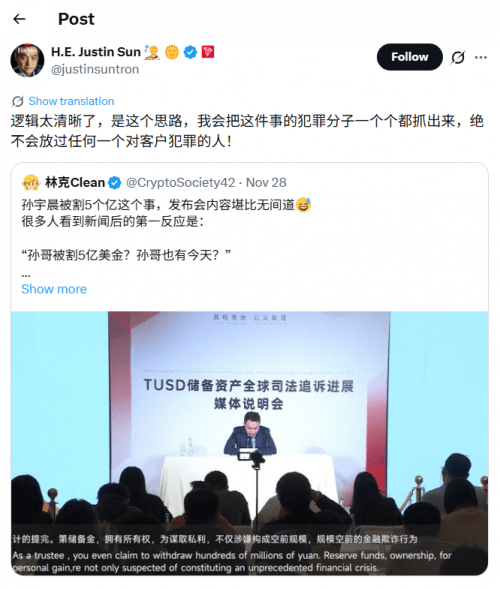
For the cryptocurrency world, which has always emphasized that 'code is law', the willingness of leaders to personally assume responsibility is a significant turning point. It means that TRON is no longer solely reliant on technical risk control, but has elevated the protection of users to the first priority at the governance level, allowing the outside world to see that its responsibility extends to actual actions across jurisdictions and teams.
User trust dividend: Security narrative becomes part of ecological value.
In the field of decentralized finance, security incidents often become key points for market confidence collapse. But this time, Sun Yuchen's strong statement has become a counterforce to market sentiment. After the declaration was released, community discussions quickly focused on the core issue of 'whether the platform really puts user interests first,' and TRON, benefiting from its global layout and long-term stable operations, has made this statement not just a public relations response, but seen as a further strengthening of its value system.
The user base of the TRON ecosystem is large, with high circulation of on-chain stablecoins. When security commitments are combined with ecological scale, it conveys a new narrative to the global market: In TRON, security is not an additional feature, but the core product itself. This brand effect is expected to drive more institutional users, payment projects, and stablecoin issuers into the ecosystem, making 'reliability' a new source of competitive advantage for the network.
Industry shock: The statements of leading projects are changing the culture of security.
More significantly, this public, direct, and firm expression of responsibility will have a spillover effect on the entire blockchain industry. For a long time, most projects have adopted a 'vague, technical' statement method after security incidents, emphasizing vulnerabilities and third-party security audits, but rarely expressing accountability itself. Sun Yuchen's public commitment has set a new execution standard for the industry—platforms have the obligation to continue to bear responsibility after security incidents, rather than just providing technical protection before the event.
It is foreseeable that, under the influence of this paradigm, other public chains and CeFi platforms may reassess their security systems, including strengthening custody mechanisms, increasing the frequency of third-party audits, and upgrading cross-border compliance collaboration. More critically, the culture of 'user supremacy' will no longer remain at the level of slogans, but may truly become a part of the industry rules.
Future outlook: Security governance moves from verbal declaration to substantial framework.
This incident has made the market aware of another thing: In the current global digital asset environment, security and regulation, accountability often span multiple legal jurisdictions. If TRON wants to truly achieve 'pursuit one by one,' it means it will deeply engage in cross-border judicial collaboration, which provides a highly representative sample for future industry governance.
If TRON can form a systematic experience from this incident, including evidence chain handling, law enforcement collaboration models, asset freezing processes, and cross-border legal connections, its case may become a reference paradigm for other projects, even prompting international regulatory agencies to study new digital asset governance frameworks.
