Local time on Monday, Kevin Hassett, director of the National Economic Council at the White House, stated that it would be "irresponsible" for the Federal Reserve to announce the specific path of interest rate policy for the next six months in advance, emphasizing that decisions must be based on economic data.
Hassett stated in a media interview: "The responsibility of the Federal Reserve Chair is to observe the data, make adjustments, and explain why they do so. So if I say I'm planning to do that in the next six months, that would really be irresponsible."
Hassett is one of the popular candidates to succeed Powell as the chair of the Federal Reserve, whose term will end in May next year. When asked how many rate cuts are needed by 2026, Hassett said: "I'm not really willing to answer in terms of 'number of rate cuts,' but I can say that what you need to do is keep an eye on the data."
Earlier this year, U.S. President Trump repeatedly called for the Federal Reserve to lower the benchmark interest rate to below 2%, while the current target range is 3.75% to 4%. The market widely expects Powell and his colleagues to lower the benchmark interest rate by 25 basis points at Wednesday's meeting.
Hassett stated that he believes Powell "has done a great job coordinating opinions within the committee," successfully promoting the consensus for a rate cut this week. "I believe Chairman Powell agrees with me on this point, that we should continue to moderately lower rates while acting cautiously and closely monitoring the data."
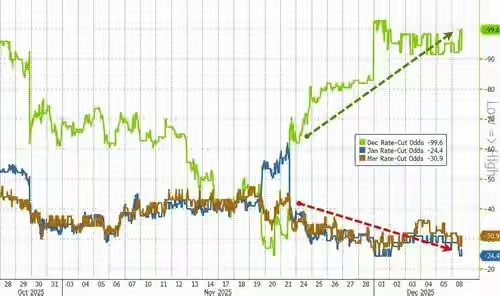
He also pointed out that, although the members of the Federal Open Market Committee (FOMC) who set interest rates "did not seem to have completely consistent opinions" before this decision, Powell has successfully gotten policymakers to "reach consensus around the expectations reflected in the futures market." As of Monday, the futures market showed that the probability of a 25 basis point rate cut on Wednesday was close to 100%.
Hassett reiterated his view: investments in artificial intelligence are expected to bring about a "positive supply shock" similar to that brought by the computer technology boom of the 1990s, which was this supply improvement that allowed the Federal Reserve to "let the economy run a little hotter." He said:
"If we achieve a decrease in inflation and maintain positive economic growth driven by a positive supply shock like in the 1990s, then there is significant room for a decline in the 10-year Treasury yield."
Hassett also stated that the bond market has "significantly improved" compared to the beginning of this year, referring to the decline in yields since 2025. "However, there is still some volatility at the moment—I believe this is partly related to the uncertainty in the market regarding how the Federal Reserve will act in this meeting and what signals it will release."
Regarding the position of Federal Reserve Chairman, Hassett stated, "Trump has many good options. If I had to be that choice, I would be happy to help him."
Financial blog Zerohedge commented that Hassett's latest speech did not signal expectations of a dovish stance, and the market's expectations for the Federal Reserve's easing actions next year have declined, with the latest forecast showing two rate cuts in 2026, a decrease from three rate cuts more than a month ago. Hassett's more hawkish remarks than expected did not boost U.S. stocks on Monday, and the three major indexes ultimately closed lower.