
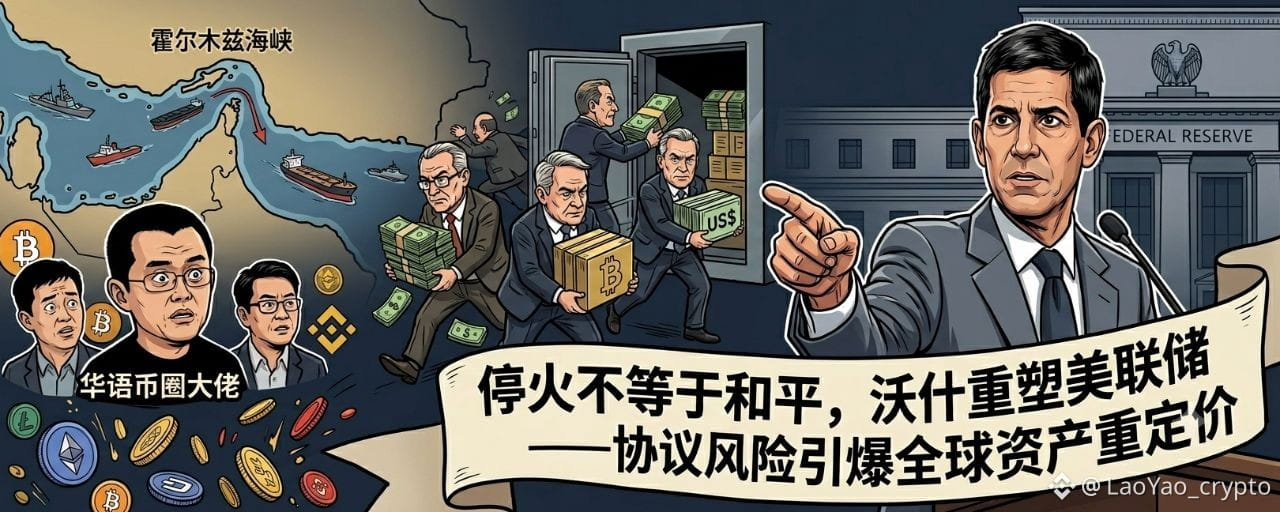
From the Persian Gulf to Wall Street, from tanker routes to on-chain capital, a new power shift is underway.
In the past 24 hours, the market has finally realized:
What truly terrifies capital isn't necessarily war itself, but the execution risks that come after the war ends.
As details of the US-Iran ceasefire agreement gradually emerge, debates over sanction exemptions, the timeline for opening the Strait of Hormuz, and post-war reconstruction arrangements are rapidly escalating. Meanwhile, new Fed Chair Kevin Walsh is holding his first policy meeting, using a highly restrained communication style to signal fresh policy directions to the market.
On one side, the Middle East shifts from military conflict to agreement games;
On one side, the Fed shifts from forward guidance to institutional restructuring.
When two main lines change simultaneously, global capital starts to reprice risk.
The dollar strengthens, US Treasury yields climb, gold retreats, and risk assets come under pressure; as the crypto market, one of the most liquidity-sensitive asset classes, stands once again at the eye of the storm.
\u003ct-59/\u003e \u003ct-61/\u003e
🧱 Geopolitical chessboard: The 'execution risk' behind fragile peace.
① Details of the US-Iran ceasefire agreement have sparked significant controversy.
At a critical juncture where conflict leads to rising global inflation expectations, details of the US-Iran 14-point peace memorandum (MOU) leaked just before negotiations in Switzerland, triggering a sharp reorganization of market bullish and bearish sentiment:
Core sanctions exemption: The US will implement 'exemptions, not cancellations' of broad sanctions against Iran after signing, allowing Iran to immediately resume free oil sales.
Trump's legal justification and statements in Paris.
After the G7 summit, Trump told reporters at the Orly Airport in France that if countries like Saudi Arabia and Qatar have ballistic missiles, it's 'a bit unfair' for Iran not to have them, advocating for 'relative parity.' He emphasized that even after an agreement is reached, US troops will 'stay for a while' in the Persian Gulf. Facing domestic conservatives' anger at his 'surrender' to Tehran, Trump strongly defended that this move was to avoid a 'global economic disaster' and publicly warned: 'If Iran doesn't comply with the agreement, bombing will resume at any time.'
② Fed's Kevin Warsh's debut promises a new vision.
Fed Chair Kevin Warsh's debut, with the federal rate held steady;
There should have been 19 decision-makers' dot plots, but ultimately only 18 were received. Warsh refused to submit his personal interest rate path forecast;
A minimalist statement returns to the 'Greenspan era', with the policy statement significantly shortened, completely removing all suggestive and guiding vocabulary regarding future interest rate directions.
🧘 Mindset Notes:
The most dangerous moment of war is not necessarily when the guns are firing the loudest.
The real big risks often emerge when the market thinks the danger has passed.
As the conflict enters the agreement phase, the game shifts from military power to credit, and the market begins to trade not based on who is stronger, but who is more trustworthy.
💹 Capital Mapping: Oil price shocks and asset repricing.
The Fed's press conference sent out extreme hawkish signals, and the details of the US-Iran ceasefire agreement sparked huge controversy. Global risk assets took a hit, while the dollar and US Treasury yields strengthened, and precious metals plummeted.
📈 US Stocks: All three major indices closed down. The Nasdaq dropped 1.34%, the S&P fell by 1.21%, and the Dow decreased by 0.98%.
🛢️ Crude Oil: Severe V-shaped fluctuations. While expectations for long-term supply increases are clear, due to ongoing execution risks of agreements, WTI ultimately closed at $78, and Brent at $86.
🥇 Precious Metals: Hit by a double whammy of reduced geopolitical risk aversion and Fed rate hike expectations, spot gold bulls hit the brakes, falling below key support levels.
💵 Forex: The dollar is extremely strong. The yen struggles to hold its ground despite the Bank of Japan raising rates to 1.0%, still feeling the pressure as most non-USD currencies weaken.
🧘 Mindset Notes:
Every severe fluctuation in the capital market is a systemic clearing of human obsessions.
💸 Web3 Overview:
Under the shadow of a broad decline in mainstream coins, the underlying power structures in the on-chain world are undergoing profound changes.
BTC: Lost the 65K level, fluctuating widely between 63K-65K.
ETH: Underperforms BTC, with considerable macro pressure.
① Aster announces a 'buyback + burn' violent plan, with noticeable price movements.
Decentralized exchange Aster DEX dropped a bomb last night: announcing that 99% of daily platform fees will be directly used for automatic buyback \u003cc-98/\u003e and matched with burns, aiming to forcibly reduce the total supply from 8 billion to 3 billion.
Reorganization of interests: Buyback profits flow directly to veASTER stakers, and the additional $50,000 fee collected from newly launched spot trading pairs will also be integrated into this system.
Market feedback: On-chain data shows that its 24-hour trading volume has surged rapidly past $100 million to $200 million, with tokens showing significant volume anomalies, reflecting the community's direct funding vote in favor of this hardcore violent scheme that 'directly ties platform revenue to token deflation.'
② CZ on Hyperliquid: 'Innovation is very impressive, but Binance finds it hard to compete in its niche market.'
Binance founder CZ rarely praises competitors on the (Galaxy Brains) podcast. CZ stated: 'I think Hyperliquid's innovation is really impressive (actually awesome).'
He pointed out that Hyperliquid, with no KYC and purely decentralized attributes, firmly occupies a niche market that centralized giants (like Binance) find 'hard to compete in' due to compliance costs.
However, he simultaneously issued a subtle warning based on his own regulatory experiences: 'I won't adopt their current operational methods; I guess they have a good legal team.'
③ The Monetary Authority of Singapore (MAS) has added Bybit to its investor warning list.
The compliance iron curtain continues to tighten. The Monetary Authority of Singapore (MAS) has officially added Bybit to its 'Investor Alert List', clearly warning the public that this entity has not received official permission and regulation from MAS. This action follows Bybit's regulatory easing in other regions and highlights the increasingly torn compliance gap between different global crypto jurisdictions.
Recommended reading:
· Ultimate simulation of the global DEX track: The Chinese sector may not even get a drop of soup.
· Chinese crypto space vs. Wall Street institutions: A brutal battleground in the global crypto market.
🧘 Mindset Notes:
As the crypto market gets woven into mainstream financial narratives, players need to align their thinking with traditional finance rules.
The current global crypto market is in the midst of a brutal showdown between the Chinese crypto space and Wall Street institutions.
What Wall Street values is 'reality'—achieving 24/7 on-chain migration of substantial quality assets from the NYSE and Nasdaq (RWA), reshaping the underlying settlement rules of global finance, with its imaginative scope and financial backing being structural.
Yet most Chinese DEXs and exchanges remain obsessed with 'fame'—playing games of stock competition and concepts in the shrinking 'Binance backyard'.
The rise of Hyperliquid is essentially not the victory of a product but a direct charge of crypto-native finance against traditional exchange models.
The biggest challenge facing Chinese exchanges is no longer competition among themselves, but the global capital pricing power is increasingly concentrating on Wall Street and compliant financial systems.
🧘 Conclusion:
In the past few years, the market has become accustomed to attributing everything to liquidity.
Rate hikes and drops, wars causing swings, ETF fluctuations.
But today, a deeper variable of the era is emerging.
Geopolitical issues are reshaping energy and trade orders;
Artificial intelligence is reshaping productivity and inflation logic;
Meanwhile, blockchain attempts to reshape the rules of circulation and settlement for global assets.
On the surface, this looks like a migration of funds;
Essentially, this is a migration of rules.
Most people see price fluctuations, while a few see the transfer of power.
The biggest opportunities in the future may not come from a skyrocketing coin, but from understanding the formation of a new order.
Everything is changing, and so are the rules.
Only by constantly updating our understanding can we find our anchor in the torrent of this era's reconstruction.
Only when the mind is not trapped by price fluctuations can one see the trend.
📌 LaoYao (\u003cm-88/\u003e)
Using mindset as a blade, cut through the deeper truths of power within the crypto space.