Cryptocurrency projects love talking about token burns. It's become almost a cliché—projects announce a burn, the community cheers, and within weeks the hype dissipates because the burn wasn't actually economically meaningful.
Injective's burn mechanism is different, but not for the reasons usually cited.
The standard narrative around INJ goes like this: "60% of protocol fees are burned weekly, creating deflationary supply, making the token scarce, driving price up." This is technically accurate but economically misleading. It makes the burn sound like a price-pumping gimmick.
The actual significance is far deeper: Injective's burn mechanism fundamentally aligns the economic incentives of validators, builders, and token holders.
Let me unpack this.
On most blockchain networks, the fee structure creates a misalignment: users pay fees to use the network, validators earn those fees, and token holders benefit... occasionally. It's ambiguous. On Injective, the alignment is direct and permanent.
Here's how it works mechanically:
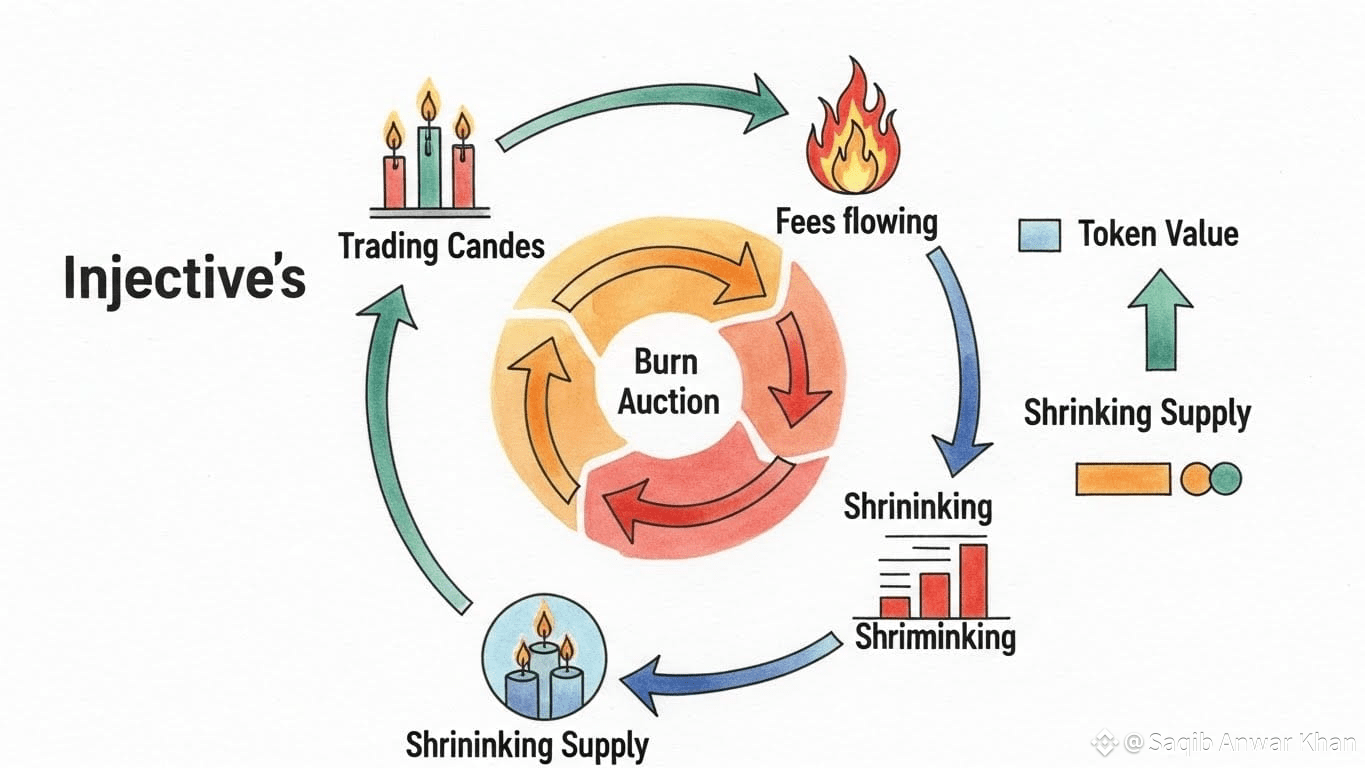
Every transaction on Injective—whether spot trades on Helix, perpetual futures, lending transactions on Neptune, or governance operations—generates fees. In the traditional model, validators pocket these fees. Injective does something different: 60% of fees flow into a weekly auction where INJ tokens are repurchased from the open market and then permanently burned.
What does this mean economically?
First, it creates automatic buy-pressure on INJ. As the Injective ecosystem grows and transaction volume increases, fee generation increases, burn auction size increases, and market buy-pressure increases. This is passive mechanical buy-pressure, not reliant on external narratives or sentiment. More transactions = more burns = more buy-pressure.
Second, it creates an economic moat. Any builder or developer recognizing this incentive structure understands: if I increase transactions on Injective, I'm participating in something that directly reduces INJ supply. This makes building on Injective more economically rational than building on chains without similar tokenomics.
Third—and this is crucial—it inverts the usual value-capture problem. On most blockchains, the relationship between network growth and token value is indirect and fragile. More activity doesn't guarantee token appreciation because the economic connection is unclear.
On Injective, network growth creates immediate, direct value capture for token holders: more activity → more fees → more burns → less circulating supply → increased token scarcity. The mechanism is transparent and irrefutable.
But there's a subtlety that separates sophisticated observers from casual commentators: the burn works specifically because Injective generates genuine transaction revenue.
This matters because many projects with small transaction volumes use burns as cosmetic value-capture mechanisms. Burning 1% of a tiny token supply that experiences minimal transaction volume accomplishes almost nothing economically. Injective's burn is meaningful because the protocol actually hosts significant activity. Helix alone processes substantial daily volume, as do Neptune Finance, Silo, and the emerging ecosystem of 200+ dApps.
The mathematics becomes compelling when you look at actual numbers: Injective processed 1.5+ billion transactions in 2025 alone. With even a fractional percentage of transactions generating fees, weekly burn auctions represent substantial INJ repurchases. The 60% burn rate combined with the INJ 3.0 upgrade actually increased the burn rate by 400%, meaning recent weekly auctions likely involved burns far more significant than retail observers realize.
Here's the longer-term implication: as the RWA ecosystem on Injective expands and institutional trading increases, fee generation will accelerate. Tokenized Treasury trading, corporate debt markets, and private credit products all generate transaction fees. If institutional RWA activity reaches even a fraction of centralized financial volumes, the burn mechanism's economic importance becomes substantial.
The common misunderstanding: people think burns matter because of scarcity narratives (fewer coins = higher prices). This is backwards. Scarcity narratives exist because the burns are economically meaningful. The causality runs from transaction-generated fee revenue to meaningful supply reduction to scarcity, not from hype to burn to value.
One final perspective: the burn mechanism also aligns INJ holder interests with regulatory compliance. Because INJ holders directly benefit from increased transaction volume, there's a structural incentive to ensure the ecosystem operates ethically and sustainably. Malicious activity, scams, or regulatory problems that reduce ecosystem usage directly harm INJ value. This creates alignment between token holders and ecosystem health—something that's actually quite rare in crypto.