
The rebound of assets like Ethereum gives us hope for an overall market correction, which could make everything better.

The market may not be fully ready for a comprehensive recovery, but despite the overall bleak outlook, certain specific assets still show strong momentum: Ethereum has begun testing mid-term resistance levels, while Ripple (XRP) has ample liquidity and is poised for action. However, smaller assets like SHIB are struggling.
Ethereum has shown who is the king
Since the comprehensive adjustment phase began in mid-October, Ethereum has shown the strongest recovery momentum. The market has stopped declining and is rebounding, rebuilding its structure, and beginning to pressure its first significant technical resistance level—the 50-day moving average—which is currently hovering above $3350. For the past two months, this price level has posed dynamic resistance, hindering all upward attempts, but the current strategy is entirely different.
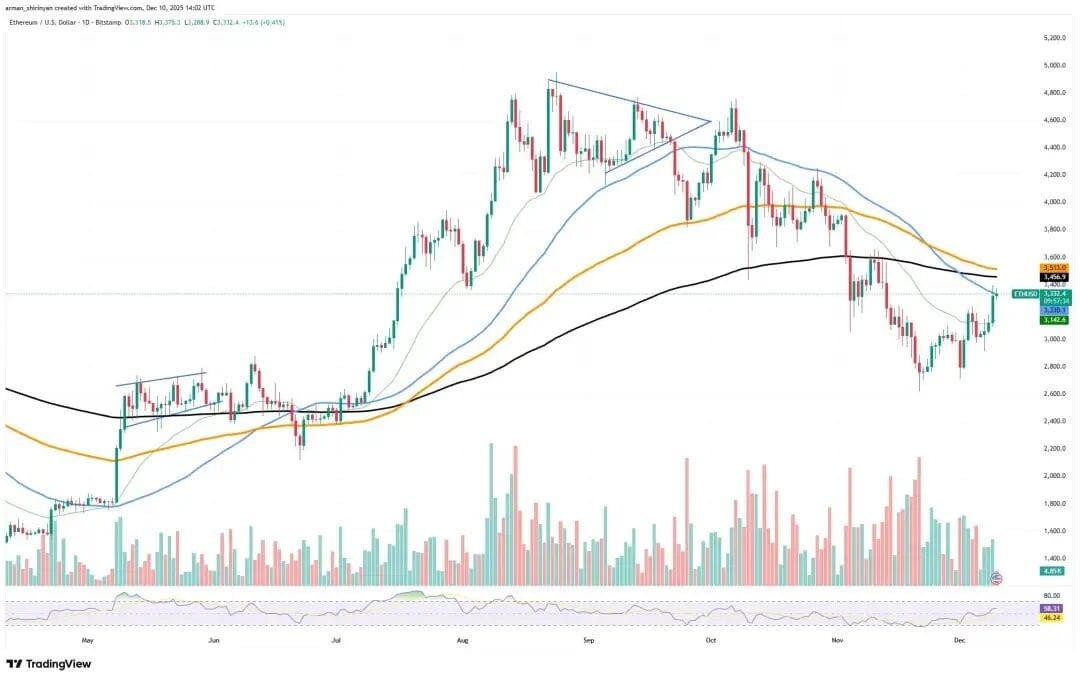
The rise in Ethereum (ETH) price is due to increased volume, higher lows, and a significant shift in sentiment across the entire altcoin market. The candlestick structure is significant, as Ethereum has seen multiple strong green candlesticks continuously since early November, without being immediately sold off. Just based on this, sellers are gradually losing control.
If volume remains stable, a bullish breakout is most likely. Ethereum (ETH) breaks strongly above the 50-day moving average, rising to $3500 and re-entering a larger rebound structure. This allows Ethereum to potentially test the $3700 to $3800 range again, from which the previous large drop began. In this case, the key is whether Ethereum can once again challenge $4000 after the bulls regain control of the market.
Ethereum formed a new higher low in the range of $3200-$3250 after being blocked near the 50-day moving average. This move will maintain upward momentum and delay a breakout. If overall market liquidity improves, the second strategy may work.
Failure scenario (probability reduced): After ETH price makes a strong rebound and falls below the $3100 support level, it retreats to around $2950. This indicates that market demand is still too low, and the previous rebound was too hasty.
XRP's current structure
For the past two months, the asset has been slowly fluctuating within a clearly defined downward channel, continuously creating lower highs and lower lows, and losing momentum after each rebound.
The flattening of the lower boundary is the first signal to pay attention to. The strong force that pushed XRP to lower lows at the beginning of November is no longer present. Instead, the last retest of the downward trendline brought a relatively strong rebound and held steady. This single change indicates that bearish strength has been exhausted.
Secondly, the mid-channel downward trendline, 20-day moving average, and 50-day moving average have converged near the $2.15 to $2.25 region, indicating that XRP is gradually starting to test upper resistance levels. If a breakout occurs, when multiple technical resistance levels overlap in this way, the breakout is usually decisive. If the daily closing price is above $2.28, the short-term trend will reverse, which may attract buyers who have been waiting for confirmation signals to enter the market.
The biggest weakness in the chart remains the volume. The lack of determination from the bulls indicates that XRP lacks the momentum needed to break through the existing structure. Unless there is an increase in capital inflow, the asset may continue to consolidate within the channel, delaying any significant upward potential.
If XRP's volume breaks above the resistance level of $2.25 to $2.30, the next target will be at the upper boundary of the channel between $2.40 and $2.50. If XRP breaks through the entire channel, it is expected to rise further to above $2.70, where the 200-day moving average is located.
If XRP fails to continue rising, it will fall back to the lower trendline and around $2. As long as this level remains unchanged, its overall structure is still intact, but upward momentum will weaken.
Shiba Inu lying on the ground
The resistance level near the short-term moving averages (20 EMA and 50 EMA) confirms what the chart has shown for weeks: buyers still lack the strength to reverse momentum, and SHIB continues to trade in an established downtrend.
The asset's price briefly entered the range of $0.0000089 to $0.0000091 but failed to close above this range, triggering selling pressure and causing the price to drop again. This is significant because this resistance level has played a key role for nearly a month. If this resistance level is broken, short-term market sentiment will shift from a dead cat bounce to an early reversal.
On the contrary, SHIB's inability to maintain above the moving average reinforces the bearish structure: lower highs, lower lows, and weakening volume. The simple conclusion is a lack of demand; when an asset tests resistance with reduced volume and faces rejection, the downtrend will continue.
If SHIB cannot quickly regain upward momentum, the current price range may further deteriorate. Weak breakout attempts are usually punished by the market, so the price is likely to drop back to the range of $0.0000082 to $0.0000080. If the price breaks below the support level near $0.0000075 (where buyers previously had confidence to intervene), that support level will face downside risks.
SHIB's initial resistance test failed, and the short-term outlook is bleak. However, its structure has not suffered irreparable damage. There is still hope for a market rebound; the key is whether buyers can truly enter in large numbers rather than just a brief rebound.


