
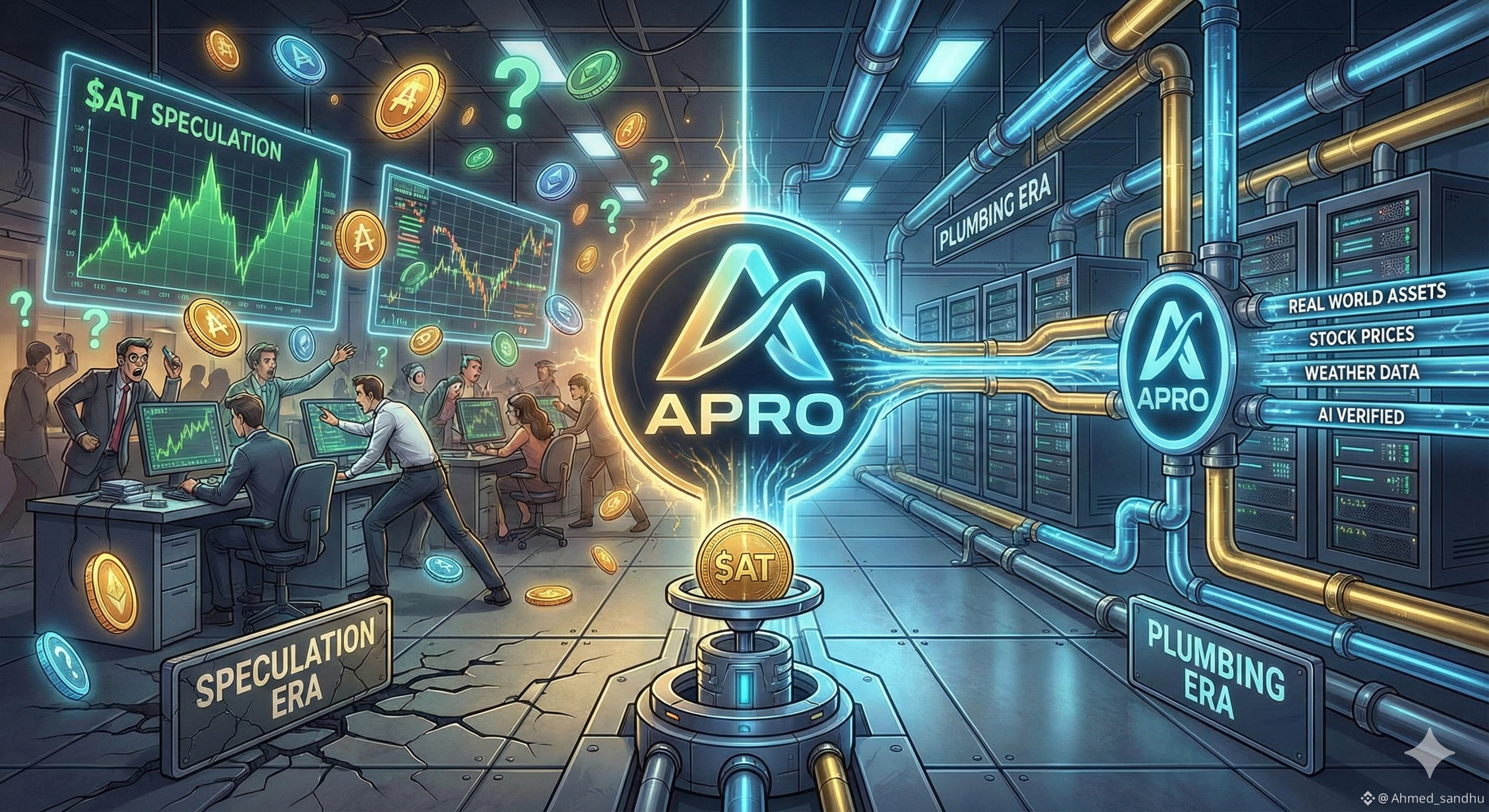
In the early days of Web3, "infrastructure" was a buzzword often used to justify billion-dollar valuations for empty networks. Investors speculated on potential utility rather than actual usage. But as the industry pivots toward Real World Assets (RWAs), institutional DeFi, and AI-driven automation, the narrative is shifting.
APRO ($AT) has emerged as a central player in this shift. It represents the moment when "Oracle Infrastructure"—the middleware connecting blockchains to the outside world—stops being a casino chip and starts being the digital plumbing required to run the global economy.
1. The "Oracle" Problem: Why We Need Plumbing
To understand the value proposition of APRO ($AT), one must first understand the fundamental limitation of blockchains: They are blind.
A smart contract on Ethereum or Solana can mathematically verify a transaction, but it has no idea what the price of gold is, who won the Super Bowl, or if a shipping container has arrived in Rotterdam.
Without Oracles: Blockchains are isolated calculators.
With Oracles: Blockchains become programmable economies capable of reacting to real-world events.
For years, the "Oracle" sector was dominated by a single narrative: feeds for crypto prices. APRO argues that this is merely the "dial-up internet" phase. The "broadband" phase involves complex, high-frequency, and AI-verified data.
The APRO Solution
APRO distinguishes itself by moving beyond simple price feeds. It positions itself as a proactive intelligence layer:
AI-Driven Verification: Unlike traditional oracles that simply pass data from Point A to Point B, APRO uses AI to verify data integrity before it hits the chain, filtering out anomalies and manipulation.
Dual-Layer Architecture: It separates data sourcing (off-chain) from validation (on-chain), ensuring that the "pipes" don't burst under high congestion.
2. The Shift: Speculation vs. Utility
The "Speculation Phase" of crypto infrastructure is characterized by tokens that people buy hoping someone else will buy them later. The "Plumbing Phase" is characterized by tokens that are bought because they are required to make the system work.
Here is how APRO ($AT) aims to cross that chasm:
Key Insight: When an asset becomes "plumbing," it becomes boring to speculators but essential to institutions. You don't speculate on the existence of water pipes in your house; you just pay the water bill because you need the water. APRO aims to be that utility bill for Web3.
3. The Killer App: Real World Assets (RWAs)
The strongest tailwind for APRO is the tokenization of real-world assets.
If BlackRock or a major bank wants to tokenize a treasury bond or a real estate deed, they cannot rely on a decentralized anonymous node simply "reporting" the price. They need:
Guaranteed Accuracy: Insurance against bad data.
Verifiable Randomness: For fair distribution (e.g., lottery or gaming).
Cross-Chain Capability: The ability to move that asset data between blockchains.
APRO’s architecture is specifically designed for these high-stakes environments where a 0.01% error in data reporting could result in millions of dollars in losses. The $AT token functions as the economic security layer—node operators stake $AT to guarantee their honesty. If they lie, their "plumbing" license is revoked (their stake is slashed).
4. Conclusion: The Infrastructure Play
The thesis for APRO and $AT is not about "going to the moon" on hype; it is about becoming the boring, invisible layer that powers the next generation of the internet.
As the crypto market matures, capital will likely rotate out of "governance tokens" that do nothing and into "infrastructure tokens" that generate revenue from actual usage. By integrating AI verification and focusing on the RWA sector, APRO is positioning itself to be the copper wire of the decentralized age.
The Bottom Line: When the hype fades, only the plumbing remains. APRO is betting that the world will always need reliable pipes.
Next Step
Would you like me to generate a comparative table analyzing APRO against other major Oracle networks (like Chainlink or Pyth) to see how their technical "plumbing" differs?

