
Entering is a technique, while exiting is an art. Why do I say this? Because entering is assessed from a technical perspective, while exiting is more about managing oneself, managing one's attention during long waiting times, and adjusting one's expectations.
Perhaps some friends do not quite understand my meaning. It's like trend trading; in the end, it's just a symmetrical thing, with symmetrical technical conditions for entry and exit, and symmetrical principles for buying and selling.
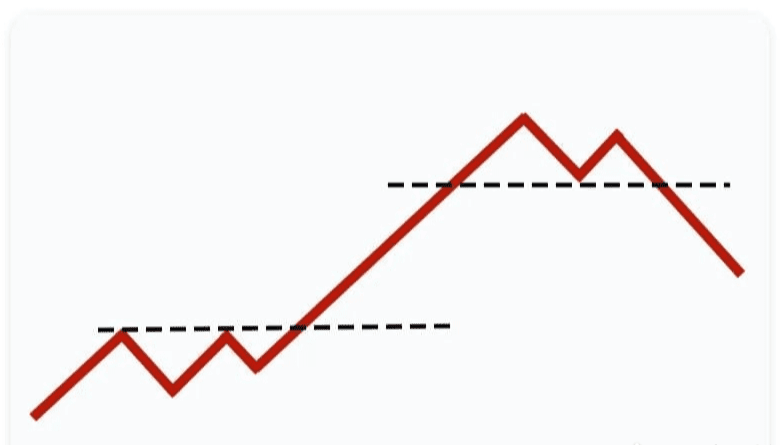 Under the main logic, why do we enter positions?
Because it determines that one-sided fluctuations break the oscillation boundaries, transforming the oscillation pattern into a bullish pattern, prompting trend followers to enter and pushing prices to strengthen continuously.
The pattern of fluctuations returning back and forth is influenced by the 'breakout consensus,' transforming into the operational rules of a unilateral trend. Therefore, is the base order a pursuit of breakouts or some short-term technical concepts like golden crosses and dead crosses? No!
Essentially, opening a position is betting on the change of trend operation rules; as long as it transforms into the operating rules of a trend, then trend-following strategies will inevitably profit under such market conditions.
Always remember this: what we do is not an abstract technical concept, but the advantage of volatility expansion increasing the win rate of trend-following strategies!
Therefore, exiting is not for anything else; do not care about what small levels show 'golden needle probing the top, divergence, dead cross', the performance of short-term trends cannot predict the emergence of tops and bottoms; just flip through historical trends to know.
Which round of strong unidirectional trends does not walk against divergence?
Which round of strong trends is not replaced by consolidation instead of a pullback?
Therefore, there is only one principle for exiting: that is to maintain a symmetrical entry and exit mode; one enters because of the formation of a bullish pattern and exits when that bullish pattern is broken.
But to be fair, what tests a person is not the confidence to enter the market with the trend, nor the melancholy after clearing positions when the pattern collapses, but the trials from the market that lie between two dashed lines.
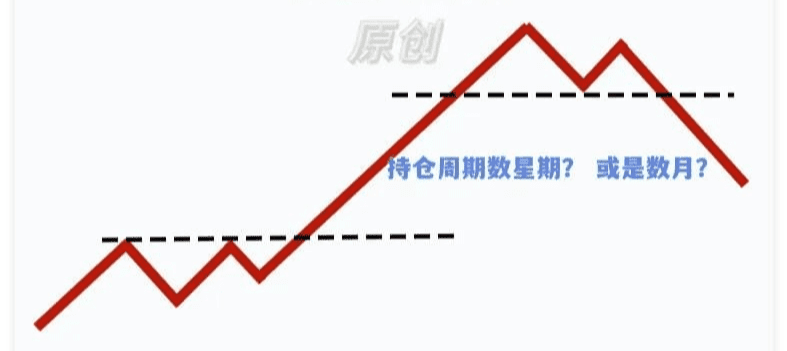 Real positions are different from simulations; there is no time to enter or exit even for a moment, the fluctuations of gains and losses constantly affect your emotions, for example:
(1) In the case of small level rapid pullbacks, the agony of shrinking floating profits
(2) Understand the amplitude of the trend with recent experience, harboring doubts about the trend.
(3) In extreme trends, oversold and overbought create psychological fear of prices.
(4) Past psychological shadows, the blow to confidence when the trend halts midway.
(5) Overly focusing on small level trends, interpreting guesses of tops and bottoms produced by single K-lines.
So, in a round of trends, we do not rely on technical judgments but constantly ask ourselves whether we have faith under multiple tests!
Those without faith may give up their positions because of a phrase like 'it has risen too much, I feel a pullback is coming'; those with faith can firmly execute the symmetrical principle even if one-third of profits are given back.
Naturally, technology can make some money, but only faith can transcend classes.
Moreover, to trade well, one must learn dual thinking; the mid-term and short-term goals are contradictory, but they can coexist and integrate at different time levels.
A person can have unlimited confidence in the trend's development, but that does not prevent them from paying attention to short-term pullback risks. The two may seem contradictory, but upon careful thought, their timing can be separated for response.
Just like, the secondary logic under the main logic, short-term positions within the overall holdings.
 How to balance one's mindset? I believe the best method is to follow the essence of the trend.
The essence of the trend is that the mainstream expectations that have not yet been realized are gradually fulfilled through unilateral fluctuations.
The principle of holding positions should also align with this essence—maintain the base orders while actively reducing positions at optimal prices to realize profits.
Simply put, always close positions at high points in the stage, but never close them all!
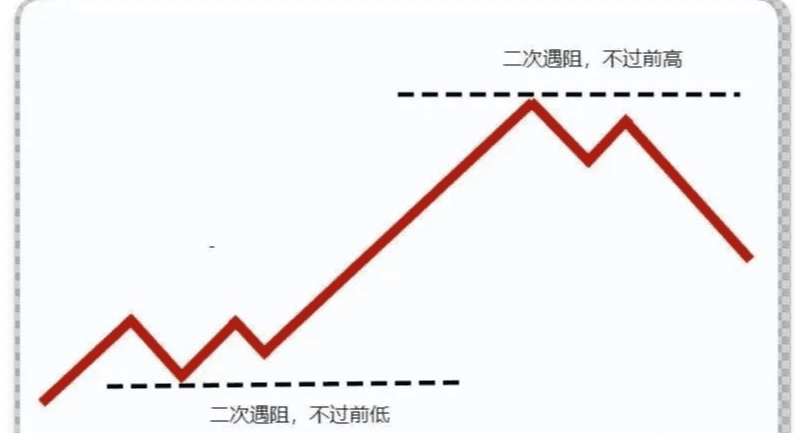
For judging high points, the main observation is whether there is a formation of 'secondary peaks' in the bullish trend, meaning that after a second high push, it does not surpass the previous high, and there is a clear buying pressure reaction, such as high volatility K-lines directly engulfing with a long upper shadow.
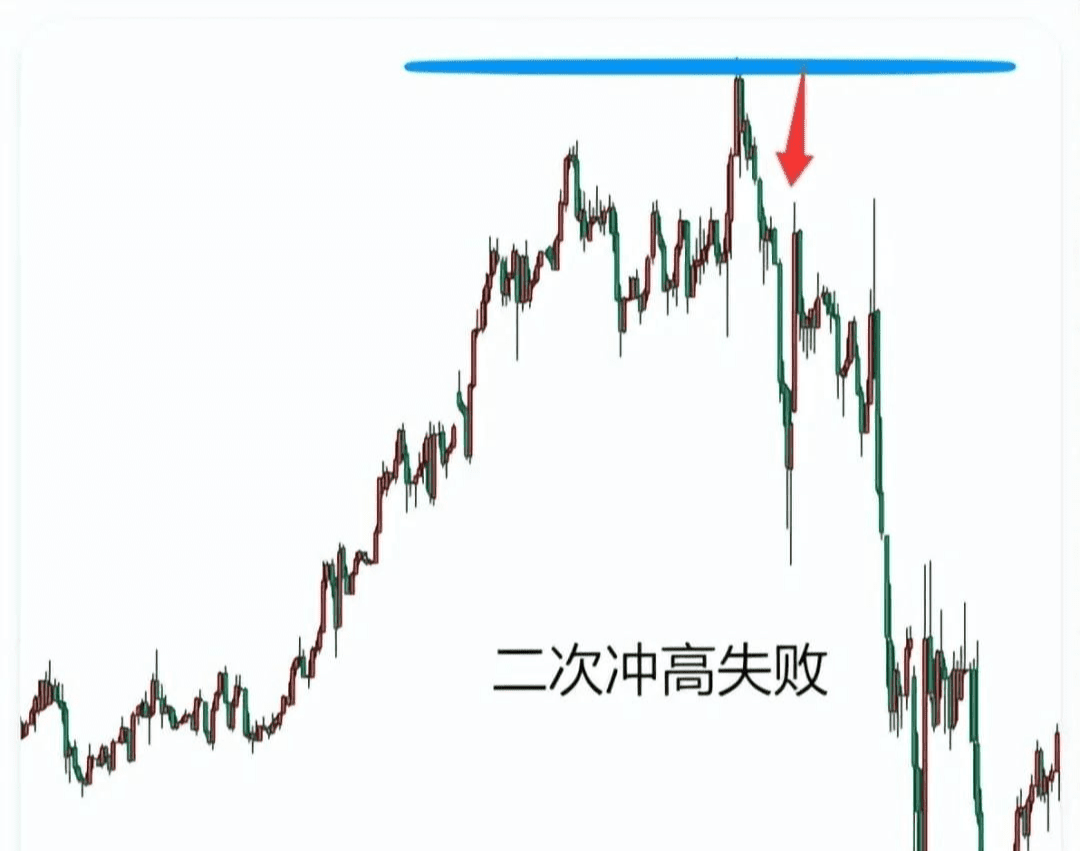 Actively reducing positions is not merely to avoid pullback risks because no one can predict the endpoint of a trend; it may pull back and then move in a low-level consolidation for several days before breaking through again, or it may directly rise after a pullback. Therefore, do not harbor thoughts like 'what if I reduce too early.'
Its only function is to balance expectations; actively reducing part of the position is like an emotional 'vent', preventing us from being so extreme in pursuing the trend. Once the trend pattern collapses completely later, you will find it easier to accept the pullback of the base order because 'you reduced a part at the high point' and won't be obsessed with blindly holding shorts or longs, allowing you to decisively clear your positions and exit.
Otherwise, there are too many extreme examples in the market, such as dead long and dead short. They hold their entire position without decreasing; when the reversal occurs and profits are given back, they cannot accept it psychologically and continue to hold, resulting in a margin call from flipping positions.
After trading for over a decade, I cannot count such examples on both hands...
The amplitude of the trend will always exceed human imagination, but at the same time, it accumulates a large number of speculative positions, and the panic selling triggered during reversals can also be fierce.
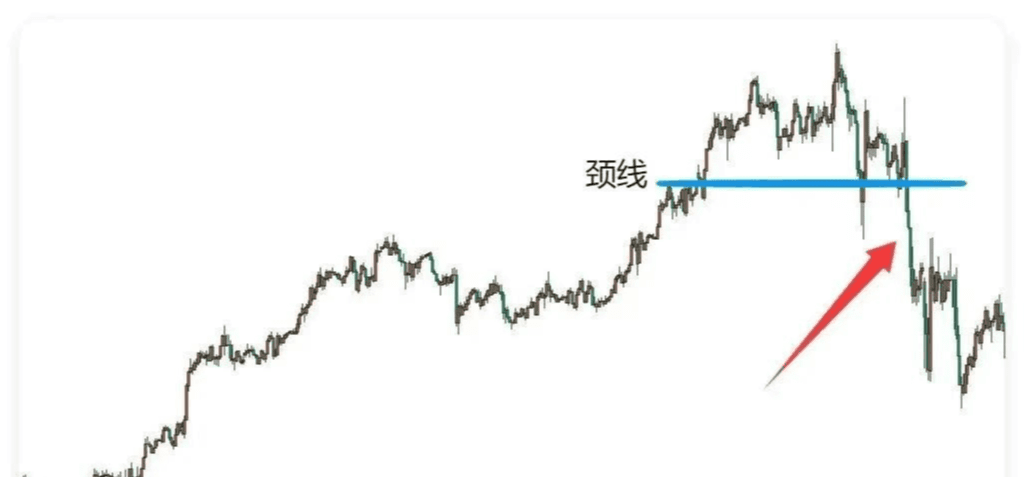 For example, in the figure above, after a few hours, profits were almost completely given back, and after a delay of one or two days, it turned into a loss.
In summary:
When the trend first sees a pullback, it is easy to be slow and hard to be urgent; wait for the next peak and bottom to appear, then observe the price reaction to make an effective judgment.
After the second block, accompanied by the destruction of the trend pattern, it is easy to be urgent but hard to be slow, as a panic change may attack one's hesitation and luck.
Therefore, trend trading is about not having a second block; all doubts about the trend may be 'anti-logic' because there is no proof of the trend's exhaustion in graphical representation, but merely psychological fears of heights and lows, thinking that after a rise, it should fall.
But in reality, just because it has risen a lot does not mean it will fall; it may consolidate at high levels for a long time before continuing to rise, or it may quickly pull back before reaching new highs. Such fantasies are akin to expecting a speeding car to reverse in place the next second.
Ask yourself, will the shift in direction directly reverse? Will the shift in the bullish and bearish trends occur without a time process? The answer is self-evident!
After the second block appears, we need to adjust our expectations and prepare to start the process of clearing positions. We can reduce positions gradually at high points when encountering resistance until the pattern collapses and we exit, or we can reduce by half and wait for a reversal to close half.
Position management does not have a rigid plan; it needs to be planned in conjunction with trends. The focus is not on finding a perfect plan but whether we have thought through the process of exiting!
Wenjing focuses on Ether contract spot ambush, and the team still has spots available to get on the bus #加密ETF十月决战 $BTC
