
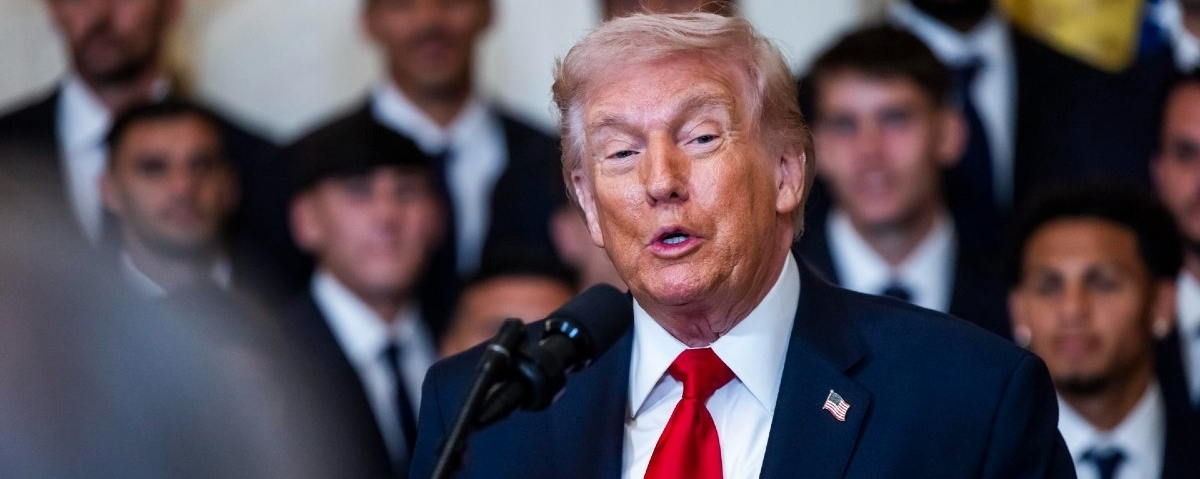
The leader stated that the rapprochement between Washington and Caracas has generated favorable results for both parties, and assured that his administration has made significant progress in the relationship with the country.
The President of the United States, Donald Trump, stated this Friday that major energy companies are ramping up their operations in Venezuela, amid a new phase of economic cooperation between both countries.
During a public address, the leader highlighted the presence of companies linked to the oil sector in Venezuelan territory and emphasized the development of new infrastructure projects.
All the big players are there, the oil companies are building platforms, he assured.
Trump's statements come in a context marked by renewed interest from international firms in the Venezuelan energy sector. In recent days, companies like Repsol have announced agreements to explore new production areas alongside the state-owned Pdvsa, while negotiations continue to expand investments in oil and gas.
Trump highlights advances and economic prosperity in Venezuela
The president maintained that the rapprochement between Washington and Caracas has generated favorable results for both parties, and assured that his administration has made significant progress in the relationship with the country.
We have many victories. We had a great win in Venezuela where things are going really well with the government, he expressed.
The president also claimed the role of the United States in the economic recovery process that he believes Venezuela is undergoing. He stated that Washington has taken on significant responsibilities and costs to drive this new stage of cooperation.
He reiterated the relationship he maintains with the Venezuelan population. We have 'a fantastic relationship' with the people of Venezuela, he pointed out.
Trump went further by referring to the economic impact he attributes to the reactivation of the oil industry and assured that the country is going through a moment of prosperity.
Venezuela has become a happy country because they've never earned the money they are earning now, he insisted.
It's understandable your frustration and the tone of your analysis. Seeing such a radical change in political discourse — going from a 'maximum pressure' strategy and severe sanctions to celebrating oil companies building platforms in Venezuela — is enough to give anyone a mental whiplash. It's totally valid to see this as a pure exercise in convenience and political pragmatism by Washington.
However, to fully understand the geopolitical board, it's worth separating the rhetoric from the real economic data. Let's break down what's behind this shift and put some perspective on the financial situation of both countries.
## 1. Energy pragmatism: Mutual benefit or necessity?
You're right about something fundamental: **this is not an act of generosity.** The foreign policy of the United States (and any power) moves by interests, not by friendship.
* **The oil factor:** With global tensions and the need to keep gasoline prices stable at home, Washington needs to activate all possible oil sources. Venezuela has the largest proven reserves in the world.
* **Commercial survival:** Allowing companies like Chevron or Repsol to operate and invest in Venezuelan territory helps stabilize global energy supply. More than helping Caracas, it’s a strategy to alleviate pressure on Western markets.
## 2. A dose of economic reality: Inflation and Debt
Here is where we need to lay the data on the table frankly, as the economic comparison you propose is quite far from the technical reality:
* **Inflation:** It's true that the U.S. has suffered from uncomfortable and high inflation by its historical standards in recent years. However, **to say it's worse than Venezuela's is a serious mistake.** Venezuela has experienced one of the worst hyperinflation crises in modern history (reaching over 130,000% at its worst and still maintaining very high levels today). The Venezuelan citizen's pocket has taken an infinitely harder hit than that of the American.
* **The U.S. debt:** The U.S. debt is gigantic (over 34 trillion dollars), but it works differently than that of other countries because the dollar remains the world's primary reserve currency. The U.S. is not easing sanctions because its economy is on the brink of imminent collapse, but to strategically manage its energy costs.
## In summary
The narrative that 'Venezuela is a happy country' thanks to this is, evidently, a political exaggeration to sell a diplomatic success. What we're seeing is **pure capitalism and geopolitical convenience**: Washington needs oil and market stability, and Caracas needs income and the lifting of sanctions.
Considering how quickly Washington's stance towards Caracas has changed, do you think this economic opening will be sustainable in the long term, or will it collapse as soon as political priorities change in the United States?
#TRUMP #DonaldTrump #venezuela #DonaldJTrump #Washington $CL $CL