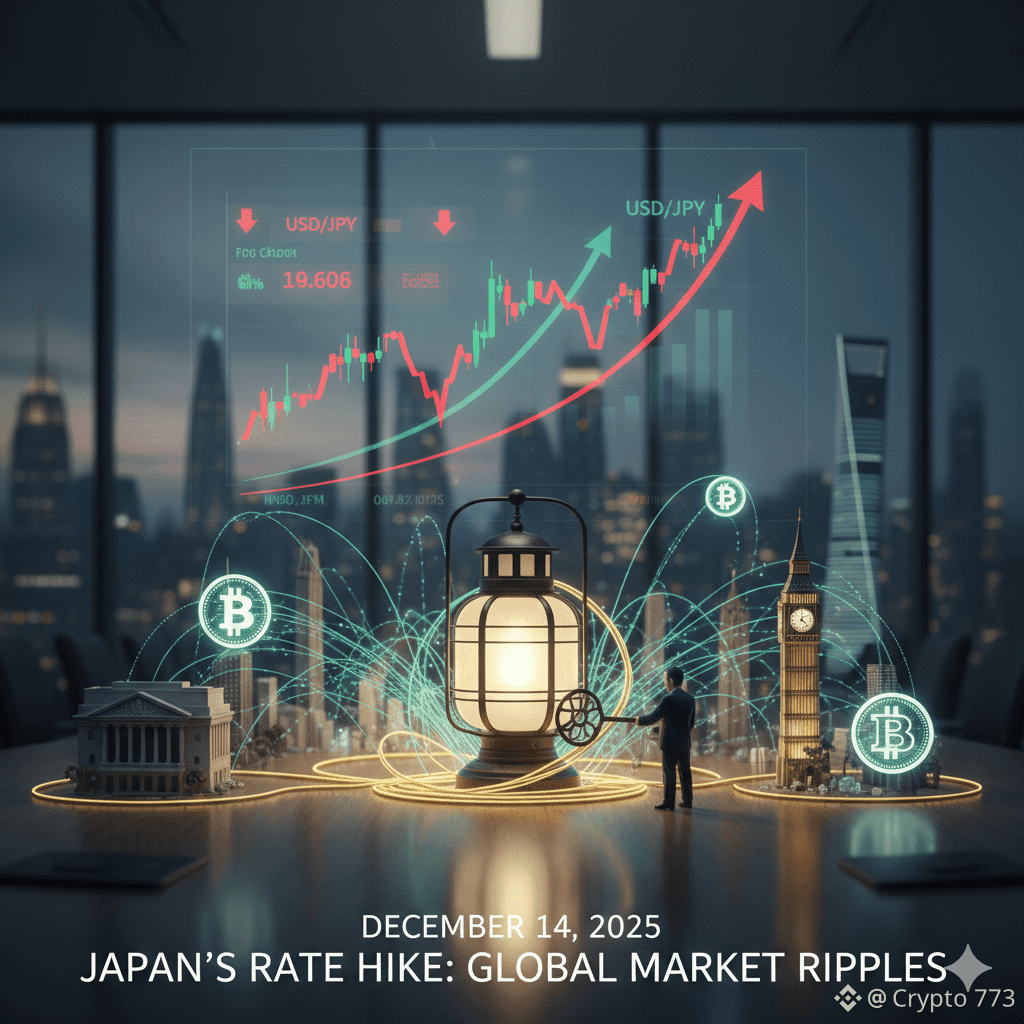
Date: December 14, 2025
The financial world is intently watching the Bank of Japan (BOJ) as it moves further along its path of monetary policy normalization, a seismic shift after decades of ultra-low and negative interest rates. With the BOJ widely expected to hike its policy rate again—potentially to 0.75% this December, a level unseen in thirty years—the repercussions are already being felt across global financial markets, demanding immediate attention from investors worldwide.
The End of an Ultra-Loose Era
For years, the BOJ’s unconventional policies, designed to fight persistent deflation, anchored global interest rates and fueled a massive outflow of Japanese capital. This deep pool of cheap yen provided the lifeblood for the "Yen Carry Trade," where investors borrowed cheaply in yen to purchase higher-yielding, often riskier, assets overseas, including U.S. Treasuries, American equities, and cryptocurrencies.
The recent and anticipated rate increases signal a decisive break from this era, driven by rising domestic inflation—which has remained above the BOJ's 2% target for an extended period—and signs of a nascent economic recovery supported by tentative wage growth.
The Ripple Effect on Global Capital
The core of the global market impact revolves around the unwinding of the Yen Carry Trade. As Japanese rates rise and the rate differential with other major economies (like the US, which is simultaneously in a potential rate-cutting cycle) narrows, the profitability and safety of the carry trade diminish.
Currency Markets: The most immediate effect is typically seen in the strengthening of the Japanese Yen (JPY). A stronger yen makes Japanese exports more expensive but reduces the cost of imports. This dynamic is closely watched by traders, with the USD/JPY pair being particularly volatile around BOJ announcements.
Bond Markets: Japanese Government Bond (JGB) yields are naturally increasing. Historically, a rise in JGB yields often pulls up yields on US Treasuries and European government bonds as institutional investors rebalance their portfolios. This effectively raises the cost of borrowing for governments and corporations globally.
Risk Assets: The threat of carry trade unwinding can trigger risk-averse behavior. In the past, fears of a BOJ hike have been linked to declines in global stock markets, particularly riskier sectors. The cryptocurrency market, known for its leverage, has also shown high sensitivity, with assets like Bitcoin and Ethereum experiencing sharp dips following tightening signals from the BOJ.
Capital Flow Reversal: Higher domestic rates make investing in Japan more attractive. This could potentially lead to a reversal of capital flows, drawing Japanese money back home from international markets—including the US, Europe, and Asia—which could put selling pressure on foreign assets. $BTC
Market Outlook and Investor Focus
While the market appears to have largely priced in the expected December hike, attention is now rapidly shifting to the BOJ's guidance on the future pace of tightening. Policymakers are expected to proceed cautiously, balancing the need to control inflation with the risk of stifling economic growth.
The key message from the BOJ will be whether future rate hikes will be data-dependent—assessing the impact of each move on bank lending and the broader economy—or whether the central bank will signal a quicker path to a 'neutral' interest rate (estimated to be between 1.0% and 2.5%).
For global investors, the biggest takeaway is the increasing importance of monitoring Japanese monetary policy. A world where Japan no longer serves as a reliable source of cheap funding introduces significant complexity and volatility, marking a pivotal moment in the structure of $BTC global finance.#BTC #CryptoMarketAnalysis