
Preface
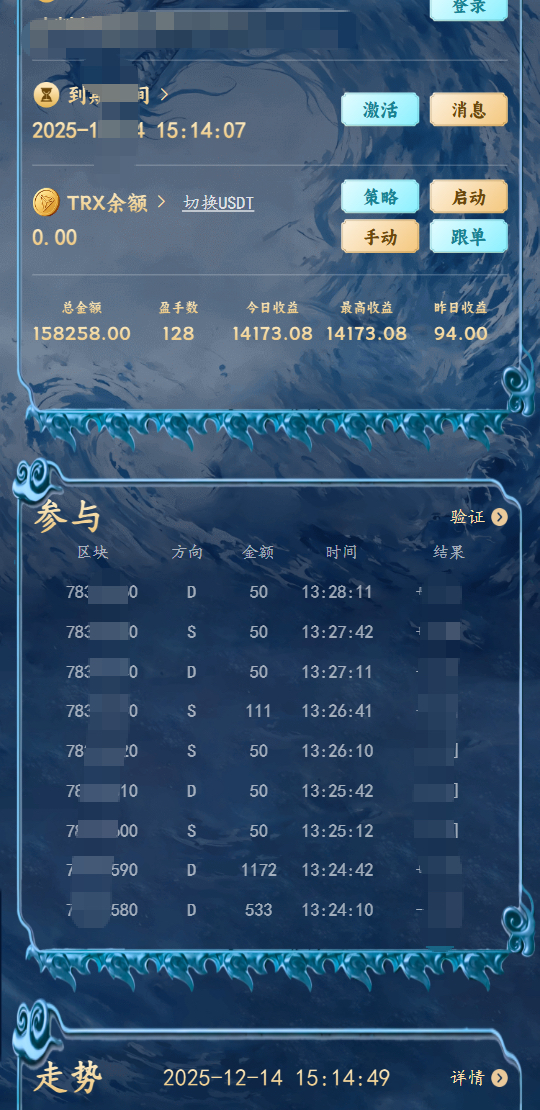
"Controlling your hands" may be harder than "seizing opportunities." Today, we observe a systematic plan centered around "controlling hands" through real operational data from November 27 to December 14, examining how it can continue to operate within the framework of rules and discipline. All content is merely a personal record of operations and thought organization, and does not involve any form of advice.
______
1. Plan Design: Establishing "operational red-green lights" with rules
This plan, called "11-5-2.1," is essentially a set of "operational red-green lights":
Red light (no operation): No intervention for 11 consecutive below
Yellow light (preparation): Reach 11 consecutive to activate preparation
Green light (execution): Execute in 5 batches, each at 2.1 times the coefficient
Emergency red light (mandatory stop): Stop immediately upon encountering 16 consecutive
Such design transforms decisions that originally required real-time judgment into clear conditional rules.
______
II. Data Observation: Specific Presentation of Rule Execution
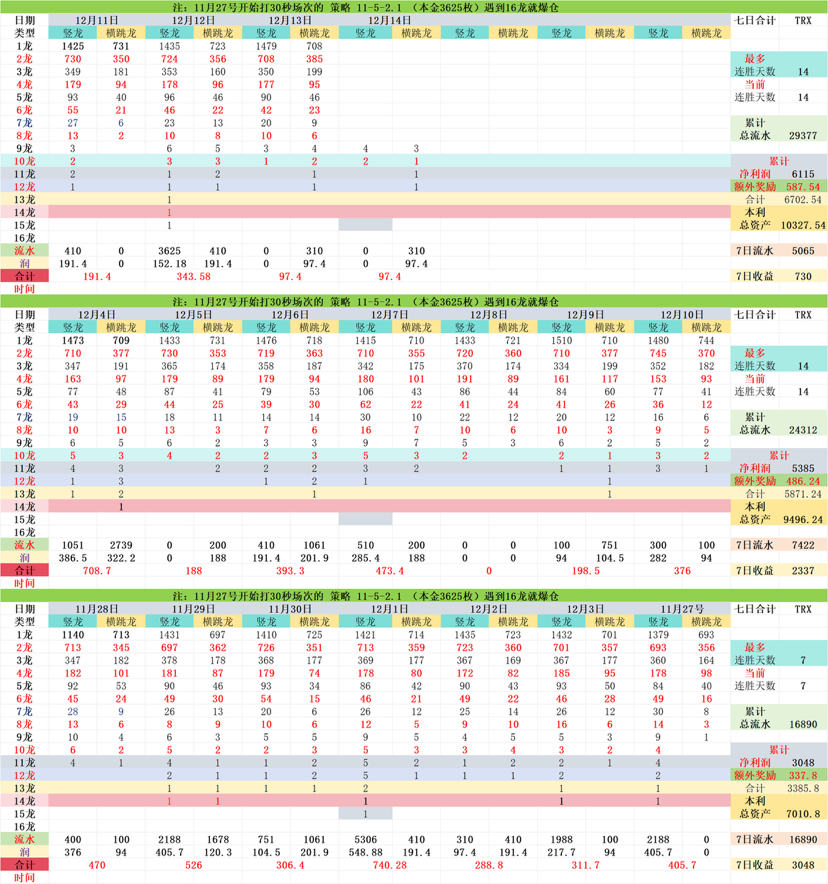
Operation period: November 27 - December 14
Starting capital: 3625
Total assets at the end of the term: 10327.5
Cumulative net change: +6702
Key execution characteristics:
Discipline of waiting
Data shows that most of the time is in the '1-5 consecutive' range
This is precisely the 'red light waiting period' in the program design
The system strictly implements rules without intervention to avoid ineffective operations
Restraint after triggering
Even in the '11-15 consecutive' range, the frequency of operations shows a decreasing trend
Reflect the risk dispersion effect of batch mechanisms
Never once touched the '16 consecutive' emergency red line
The wisdom of being in cash
Multiple time periods with 'horizontal jump dragon' data at zero
Reflect the execution principle of 'silence in the absence of clear signals'
Avoid common misconceptions of operating just for the sake of operating
______
III. Core Value: How Rules Help Us 'Control Our Hands'
Clarify boundaries to reduce entanglement
No longer need to judge 'whether to enter' for every signal
Clear rules lead to natural execution
Avoid self-compromise of 'this time is an exception'
Batch mechanism to smooth mindset
5 batches to avoid the pressure of 'one bet decides all'
Even if a single instance is unfavorable, there is room for adjustment
In line with the operation philosophy of 'taking small, steady steps'
Mandatory stop-loss to protect the bottom line
'The emergency red line of 16 consecutive is the final discipline guarantee'
Prevent the complacency of 'let's wait and see'
Maintain the last line of defense for principal safety
______
IV. Observations and Thoughts During Execution
Adaptability of rules
Current parameters show stable performance during the observation period
But continuous attention to adaptability at different stages is necessary
Rules can be solidified but must maintain observational flexibility
Sustainability of discipline
Short-term discipline is easy; long-term persistence is more difficult
Need to establish a regular review mechanism
Maintain self-supervision through recording
Management of mindset
In the early stages of rule execution, one may feel 'itchy hands'
Need to convince oneself with data rather than feelings
The longer the time, the more rules become a natural habit
______
V. A Few Reminders About 'Controlling Hands'
The value of rules lies not in complexity, but in executability
Any rule needs validation over time
It is recommended to start with simulated execution to establish rule habits
Recording is the best way to verify execution
Accept that there may be periods of non-adaptation to rules
______
Conclusion
The essence of 'controlling hands' is not to suppress the impulse to operate, but to establish order in operation with clear rules. This operational record presents not only changes in data but also a complete practice of rules from design to execution. Perhaps what needs to be managed is not the 'hands', but our ability to establish and execute rules.
Thoughts on rules
How do you 'control your hands' in operation? Is it based on rules or self-discipline? Feel free to share your insights.
______
Compliance statement
All content in this article is a personal operation record and thought organization, and does not constitute any form of advice. The market always has uncertainties; please refer to it rationally, make independent judgments, and make cautious decisions.
#OperationRules #ExecutionDiscipline #SystematicManagement #DataRecording #RiskControl
