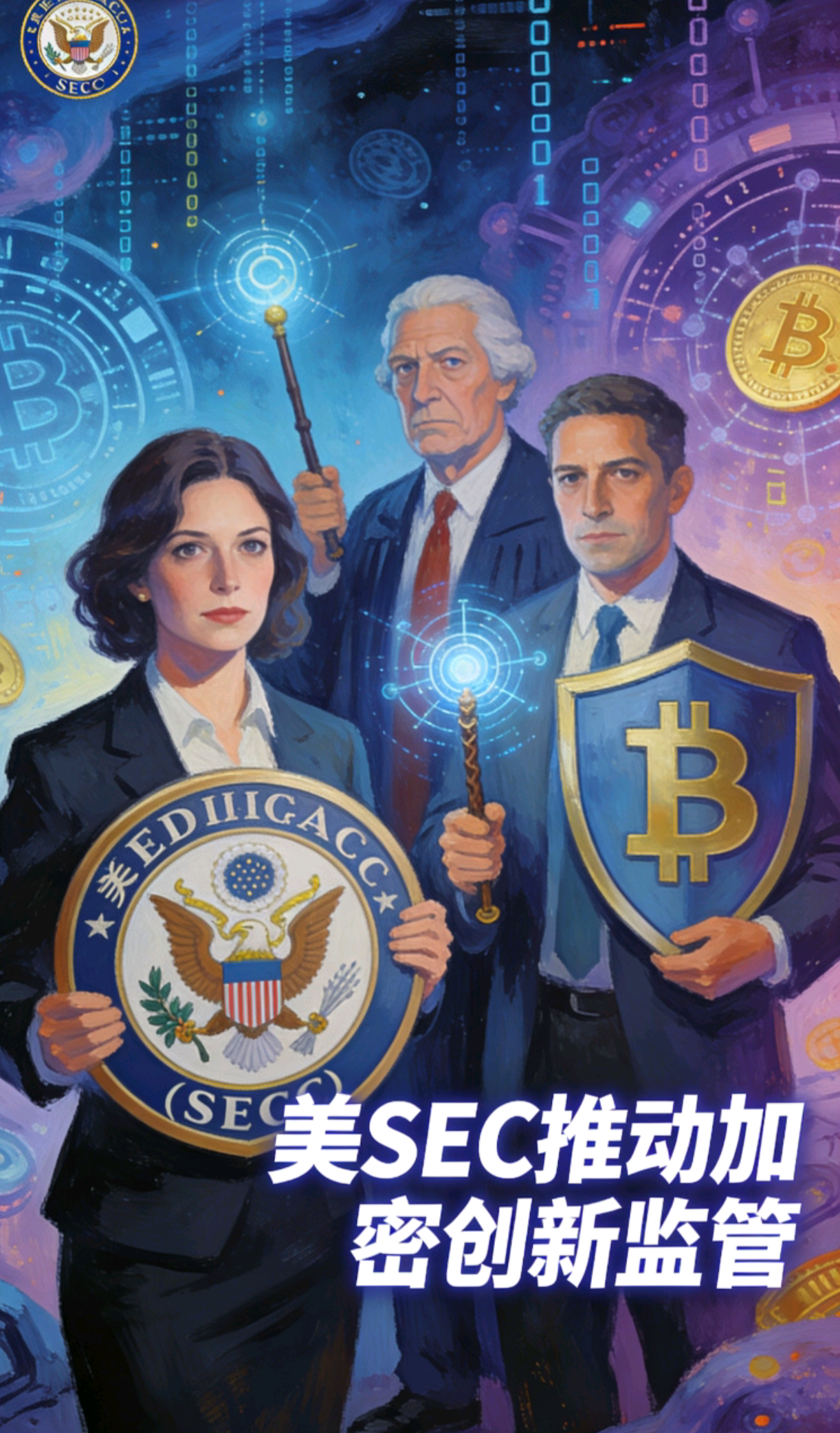
The U.S. SEC (Securities and Exchange Commission) is establishing new rules for the crypto industry: providing space for innovation while delineating clear boundaries for compliance, moving away from the past ambiguous state of 'either strictly regulated as securities or no rules and running wild.'
Core logic: first classify, then govern.
The SEC no longer treats all crypto assets as 'one type of thing', but instead divides them into four categories for differentiated treatment:
- Commodity types: For example, Bitcoin and Ethereum are considered 'digital commodities' and not classified as securities, leading to looser regulation.
- Collectible types: For example, NFT artworks and game collectibles are not considered securities and are managed as digital collectibles.
- Functional types: For example, on-chain membership certificates and game passes, like 'digital keys', are not considered securities.
- Tokenized securities: For example, tokenized stocks and bonds are still fundamentally securities and are strictly regulated according to securities rules.
The key change is: tokens will not always be 'securities'. For instance, a token from a project that initially started through financing might be considered a security;
Why make this change? To resolve the past difficulties on both ends.
- For the industry: Previously, due to ambiguous rules, domestic projects in the U.S. were either forced to register in Singapore or the Cayman Islands or operated in gray areas fearing investigation (e.g., Ripple relocating, Coinbase considering overseas listings). Now, with a clear framework, compliance costs can be significantly reduced—previously, it took millions of dollars and over a year to achieve compliance, but now it can be trialed and improved simultaneously.
- For users: Avoid falling into the traps of 'air coins' and 'scam projects', for example, retail investors will have limits on investment amounts, and platforms must disclose asset reserves, providing higher security.
- Regarding regulation: No longer relying on 'post-event enforcement' to replace 'pre-event rules', allowing for early risk monitoring and enabling the retention of true technological innovation.
The controversy remains: the contradiction between compliance and decentralization.
The new regulations have also sparked controversy, such as the requirement for DeFi projects to perform identity verification for users and to separate compliant and public liquidity pools, which conflicts with the original intention of the crypto industry of 'decentralization and anonymity'. Some are concerned about 'DeFi becoming traditional finance'. Additionally, there are no clear standards for 'complete decentralization', and project teams fear being retroactively punished once the exemption period ends.
Overall, innovation is encouraged, but it must occur within rules, allowing the crypto industry to transition from 'barbaric growth' to 'compliant development' #美SEC推动加密创新监管 #加密市场反弹.