
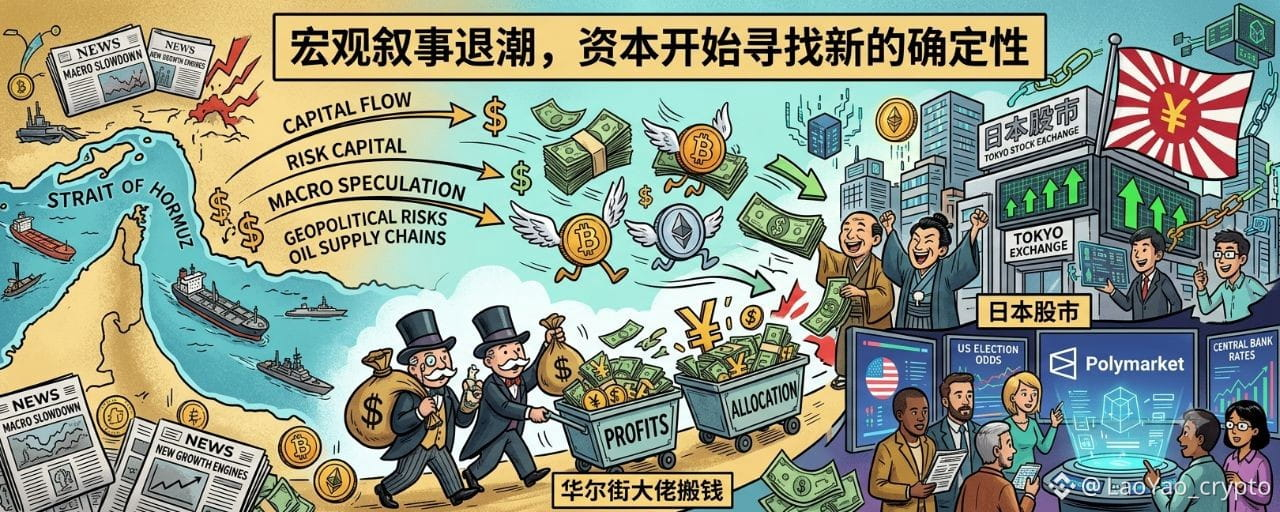
——From Hormuz to the Nikkei at 72,000 points, from GEODNET to Polymarket, the market is re-evaluating its 'realization capability'.
Over the past 24 hours, a subtle yet significant shift is unfolding in the global market.
US-Iran negotiations continue to advance, causing the Hormuz risk premium to drop rapidly; political turmoil erupts in the UK; the Japanese stock market hits historic highs, while the yen keeps weakening. The macro and geopolitical narratives that once dominated the market are gradually losing their marginal influence.
For capital, there's only one key change:
The market is beginning to transition from 'trading expectations' back to 'trading realizations'.
🧱 The geopolitical chessboard: peace is still on the way, but the market has priced it in early
① Progress made in the phase of US-Iran Switzerland talks
With mediation from Qatar and Pakistan, the US and Iran held a new round of high-level talks in Switzerland.
Both sides have reached initial consensus through negotiation led by Qatar and Pakistan to keep the Strait of Hormuz open and establish a crisis communication mechanism. The US simultaneously released partial signals to ease sanctions, including allowing some Iranian oil transactions and unfreezing overseas assets.
Although Iran subsequently tightened Hormuz commercial navigation again for a short period, the market’s reaction was clearly muted.
Capital is expressing its judgment in hard cash: war risk is declining.
② Turmoil returns to UK politics—Starmer resigns
If Andy Burnham ultimately takes over, the UK will have its seventh prime minister in seven years.
Behind the frequent comings and goings, the core issues are still UK economic growth stagnation, mounting fiscal pressure, and the continued tearing of social consensus.
For global capital, the importance of political changes in the UK is now far less than it was a decade ago.
What the market cares about more is growth, not political slogans.
🧘 Commentary on Mind Studies:
All geopolitical games are, at their core, the reallocation of interests.
When conflicts can’t create additional value, negotiations will become the optimal solution again.
Political sentiment can create volatility, but it can’t create wealth in the long run.
Ultimately, what determines the direction of capital flows is still real productivity and cash flow.
💹 Capital Mapping:
📈 US stocks: the three major indices diverge; technology and AI-related stocks face pressure. Nasdaq -1.32%, S&P -0.37%, Dow +0.29%.
🛢️ Crude oil: sharply falls back. WTI is at $74, and Brent closes at $77.
🥇 Precious metals: gold is consolidating at high levels; silver follows and performs slightly better than gold.
💵 FX: The US dollar is slightly stronger, the yen is weak, and it is approaching the 39-year historical low psychological level at 165. The euro, British pound, and others are under pressure.
① Nikkei 225 makes a historic breakthrough above 72,000—stocks and currency show opposite extremes
Nikkei 225 breaks through 72,000 points, and the Japanese stock market has become the most eye-catching presence in global capital markets.
Driven by the continued expansion of AI infrastructure, the robotics industry chain, and advanced manufacturing, Nikkei 225 has broken through the 72,000-point mark for the first time in history, rising for the eighth consecutive trading day.
What’s intriguing is that while the stock market hits new highs, the currency continues to depreciate.
This “stocks strong, currency weak” see-saw pattern essentially shows that global capital is chasing Japanese companies’ profitability—not the yen assets themselves.
The market isn’t buying Japan itself—it’s buying Japan’s future cash flows.
🧘 Commentary on Mind Studies:
The capital markets never reward effort. Capital markets only reward certainty.
When more and more capital pours in the same direction, there must be some validated logic behind it.
Price increases are just the result. The real reason is your ability to realize gains.
💸 Web3 Roundup:
Over the past 24 hours, the cryptocurrency market overall has shown high-level range trading with localized sector rotations. The main line in the market is shifting from “macroeconomic narratives” back to “industry fundamentals and the liquidity ecosystem.”
BTC: range-bound consolidation in the 63K–65K zone, unable to break the $65,000 resistance. Still in a pullback trend this year
ETH: tracking BTC. ETF outflows ease, but demand has not rebounded strongly.
① GEODNET lands on Coinbase—DePIN ushers in a moment of value validation
GEODNET’s native token GEOD is officially listed on Coinbase.
Compared with projects in the past that relied on story-driven narratives, the biggest difference of GEODNET is: it already has real revenue streams.
By globally deploying high-precision positioning hardware networks, provide centimeter-level positioning services for industries such as agriculture and autonomous driving.
Physical revenues are already able to continuously cover ecosystem operations.
The market has started to realize: what’s truly scarce in Web3 isn’t concepts—it’s cash flow.
② World Cup catalyzes the prediction market boom—Polymarket funds keep accumulating
As the World Cup enters its most intense stage, the heat of the prediction market track continues to rise.
An increasing number of traders are starting to view Polymarket as a global sentiment index, not just a gambling tool.
What the odds changes reflect is:
Cognitive distribution;
Change in expectations;
Where the money flows.
In a sense, prediction markets are becoming one of the world’s biggest emotion databases in the real world.
🧘 Commentary on Mind Studies:
The market is never short of stories; what it lacks are stories that can be cashed out.
In the past two years, the most successful assets have shared a common feature:
· Capable of continuously generating cash flow;
· Capable of continuously attracting users;
· Continuously able to prove its own value.
Whether it’s Japan’s stock market, AI infrastructure, or DePIN networks, they are essentially proving the same thing:
In the end, capital will only pay for real value.
🧘 Closing remarks:
As the war premium gradually dissipates and macro narratives start to cool off, the market will eventually return to the most basic question:
Who can make money?
Who can keep making money?
Who can prove that making money will remain possible in the future?
Wealth never rewards the best storytellers.
Wealth always rewards the person who tells the story that ultimately gets cashed out.
Recognize the situation and stay steady.
Perhaps a new round of capital migration has already quietly begun.
📌 LaoYao (@LaoYao_crypto )
Using Mind Studies as the blade, we slice into the truth at the deep core of power in the coin world.