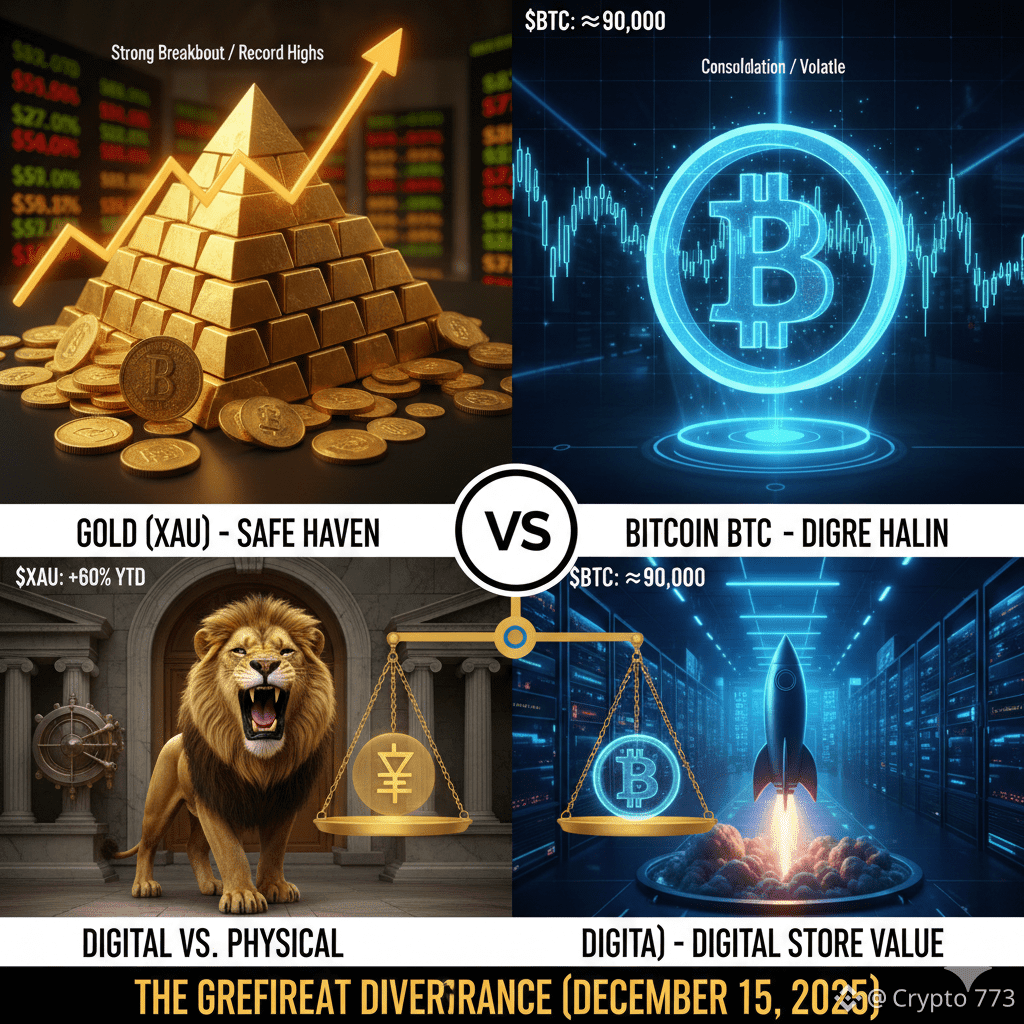
Date: December 15, 2025
As 2025 draws to a close, the long-standing debate over whether Bitcoin ($BTC) truly deserves the title of "Digital Gold" has intensified. While both assets are seen by investors as crucial hedges against inflation and government debt—with central banks' gold buying and institutional approval of spot Bitcoin ETFs providing massive tailwinds—their recent performance and market reactions tell a story of divergence.
Gold: The Unstoppable Hedge
Gold has had a phenomenal year, solidifying its traditional role as a crisis hedge. Driven by persistent global inflation fears, robust central bank accumulation, and a growing fear of unsustainable government debt burdens, Spot Gold prices are currently testing record highs, hovering around the $4,300 per ounce mark.
Year-to-Date Performance: Gold has seen a surge of over 60% in 2025, a performance on track to be its best annual gain in decades.
The Catalyst: The Federal Reserve's recent interest rate cuts have further weakened the US Dollar, typically acting as a strong bullish catalyst for the yellow metal. Analysts are increasingly optimistic, with some projecting a target of $5,000 per ounce in the medium term.
Market Position: Gold's stability and dual-nature—valued both as an investment and a consumer good (jewellery)—affirm its position as the preferred safe-haven asset in times of geopolitical and financial stress.
Bitcoin: Consolidation Amidst Macroeconomic Headwinds
Bitcoin's performance has been more muted in the last 12 months compared to Gold's explosive rally. After a historic year in 2024 that saw the approval of spot BTC ETFs, the cryptocurrency has been grappling with volatility and macroeconomic pressures.
Recent Price Action: Bitcoin is currently consolidating, battling to hold critical support levels around $90,000. Its price has been largely flat over the past year, failing to keep pace with the breakout seen in gold and silver following the recent FOMC meeting.
The Risk Factor: Market reports indicate that Bitcoin continues to correlate more closely with risk-on assets than its physical counterpart. In fact, a potential rate hike by the Bank of Japan, an event which has historically correlated with significant Bitcoin price corrections, is now seen as a major downside risk for the digital asset.
Institutional View: Despite the recent price consolidation, institutional appetite for Bitcoin remains strong. For instance, the Harvard Management Company (HMC) has significantly increased its exposure to Bitcoin ETFs, with its BTC holdings now doubling its gold ETF exposure, signalling a long-term belief in the asset's store-of-value potential.
In the short-term, Gold's stability and clear reaction to central bank policy have reaffirmed its role as the go-to crisis hedge. Bitcoin, with its greater volatility, is arguably still functioning as a high-growth, speculative asset that benefits from the same underlying macro concerns (global debt) but carries a much higher risk premium.
For investors, the present market landscape suggests that Gold provides the defensive stability needed to hedge against economic uncertainty, while Bitcoin offers the long-term, exponential growth potential of a revolutionary digital asset. A balanced portfolio, as suggested by the actions of major endowment funds like Harvard's, may require an allocation to both to capture stability and growth.#BTCVSGOLD #USJobsData #WriteToEarnUpgrade