
Positioning
When looking at the price fluctuations of an asset, many people only ask: is the price going up or down?
But for professional traders, the more important question is: who is participating in the market, which side are they on, and can they be forced to exit their positions?
This is the meaning of trader positioning. It is not about predicting prices, but rather understanding the positions of various groups of players existing in the market.
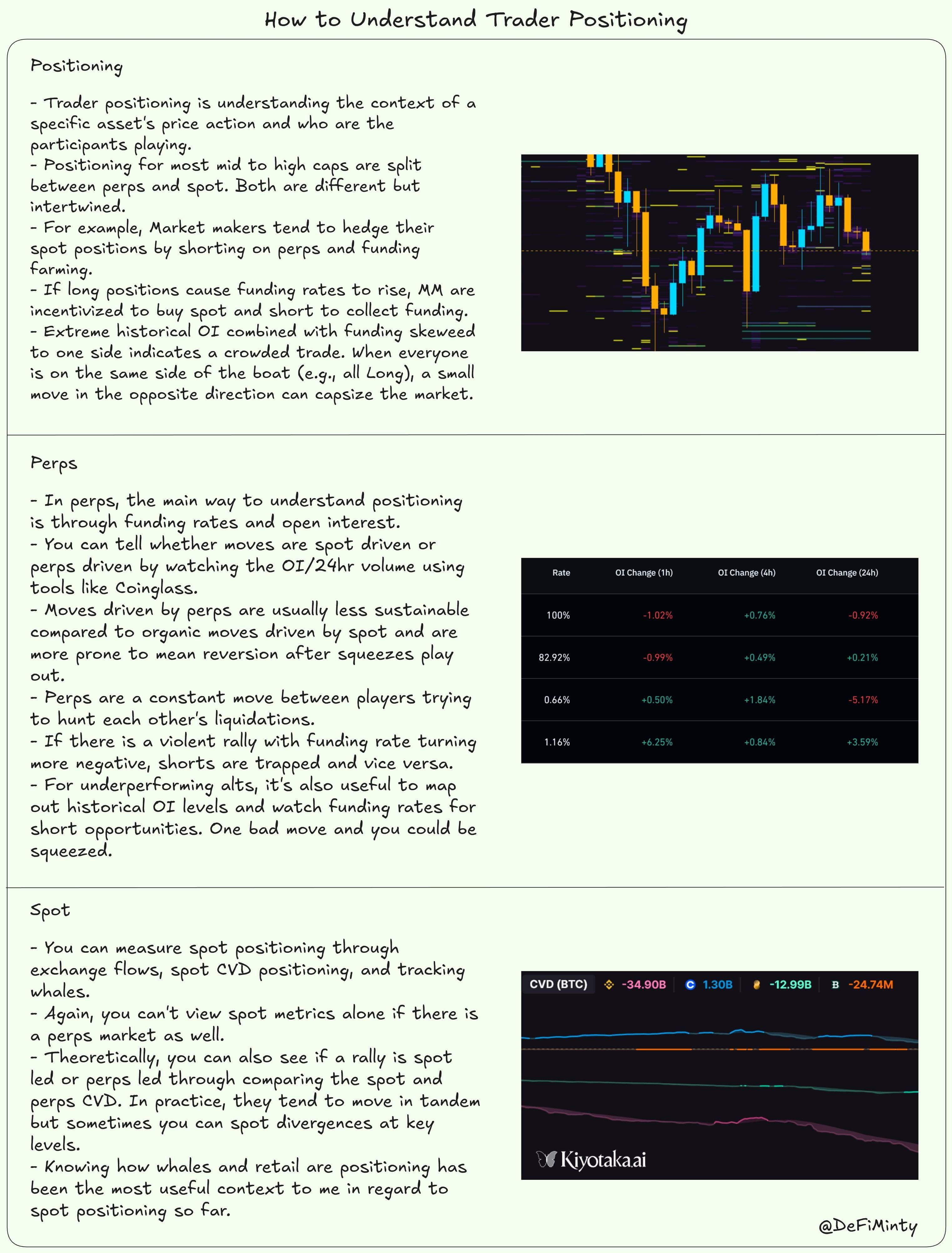
For most large and medium coins, positioning lies not only in the spot market (real buying and selling) but also in the derivatives market, especially perpetual futures (perps). These two markets operate differently but strongly influence each other.
For example, market makers often buy spot to provide liquidity to the market, but at the same time, they short on perps to reduce risk and earn extra funding. Therefore, the fact that many are short or long on perps does not necessarily reflect a belief that prices will go up or down, but sometimes it is just how large parties balance their positions.
When too many people are long, the funding rate will increase. At that point, market makers are incentivized to buy spot and short perps to capture funding. This causes the market to become skewed to one side. When open interest is unusually high and funding is heavily skewed, it is often a sign that the market is crowded with one side. In this state, even a slight drop can lead to a cascade of positions being liquidated.
Perps: Where Traders Hunt for Liquidation Against Each Other
In the perps market, the two most important indicators to read positioning are the funding rate and open interest (OI).
Funding indicates whether longs or shorts are paying fees to maintain their positions, while OI shows the total amount of leverage currently open in the market.
A practical way to know if the price is being pushed by spot or perps is to compare OI with the 24-hour trading volume. If the price rises sharply but OI also increases quickly, it is likely a leverage-driven spike. Such increases are often not sustainable because once the positions are squeezed, the price can easily revert to a balanced level.
The essence of perps is a game where traders continually seek to push prices to areas with many liquidation orders from their opponents. If the price rises sharply but funding is negative, it indicates that many people are short and stuck. Conversely, if funding is high while the price is sideways, the market may be overly long.
With weak altcoins, monitoring previous OI levels and funding is even more important. Just standing on the wrong side in a misaligned positioning market, a trader can be squeezed very quickly, even if the larger trend does not change.
Spot: Where is Real Money Going?
Unlike perps, the spot market reflects real money being put in or withdrawn. Spot positioning is often observed through the flow of money in/out of exchanges, spot CVD, and the behavior of whales.
However, you cannot only look at spot and ignore perps. In fact, prices are often influenced by both. Nevertheless, in important price areas, if spot and perps diverge, it is a very noteworthy signal. It indicates who is genuinely buying and who is just using leverage to bet.
Experience shows that understanding what whales and retail are doing on the spot provides traders with a much clearer picture. Spot is not always 'correct,' but it indicates who is willing to spend real money, while perps show who is borrowing the market's confidence to play with leverage.
Source: Defi Minty - Delphi Digital Researcher
Researcher: Jack Vỹ upside