As you all know, the little seal 🦭 is a fanatic of the Binance #ALPHA competition.
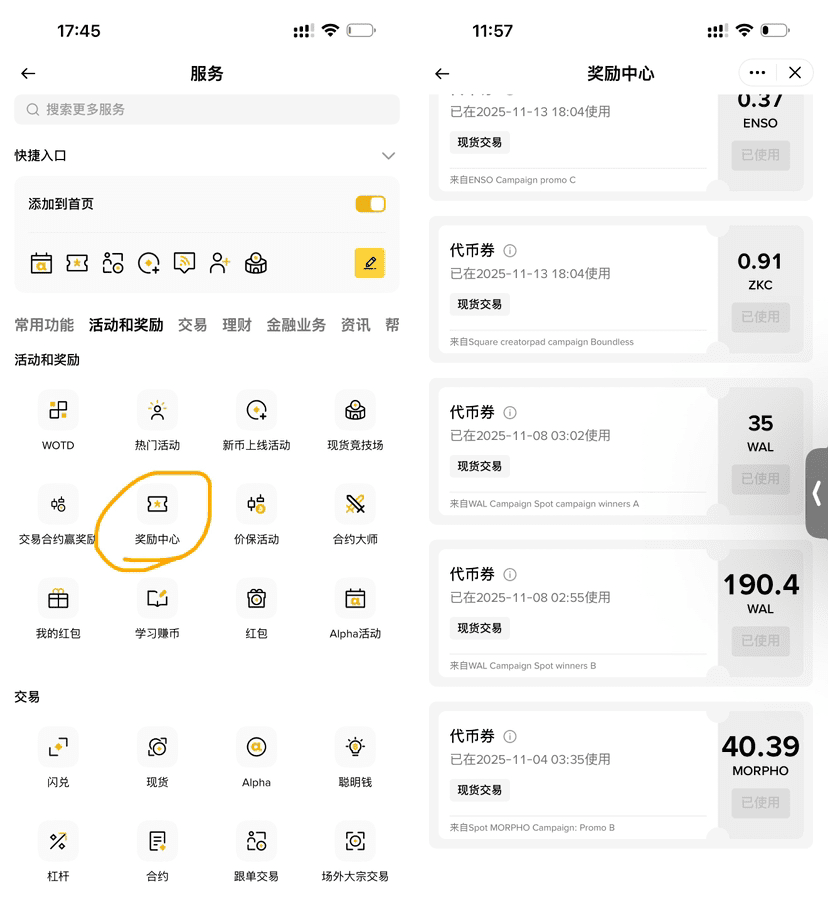
However, friends who often participate in Binance #ALPHA competitions can actually pay attention to Binance's spot trading competitions, which have completely different systems from alpha. The little seal has participated in several sessions, and aside from the recent livestock coin $AT having the risk of being counter-traded, it has been profitable at other times 🤩🤩:
Of course, there are also pitfalls. Let's break it down in detail today.
Competition system
Spot trading competitions also require trading volume to be brushed up, both buying and selling count.
However, unlike the Alpha competition's "equal share upon qualifying" format, the spot competition usually "shares the prize pool according to the proportion of your trading volume, more work more pays, less work less pays," so every 1u of trading volume you generate will not be wasted, making it very fair.
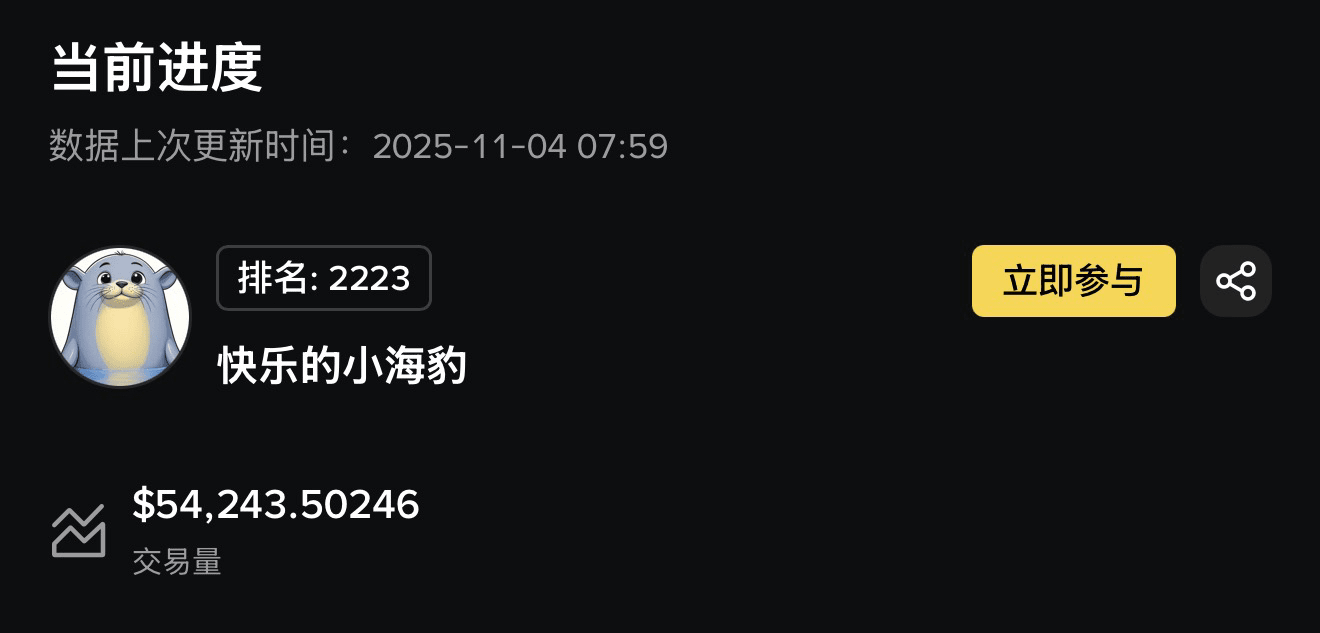
For example, in the ZBT spot trading competition (), the total prize pool was 7,720,000 tokens (
7,720,000 × 54,243.50246 / 19e8 = 220.4 pieces
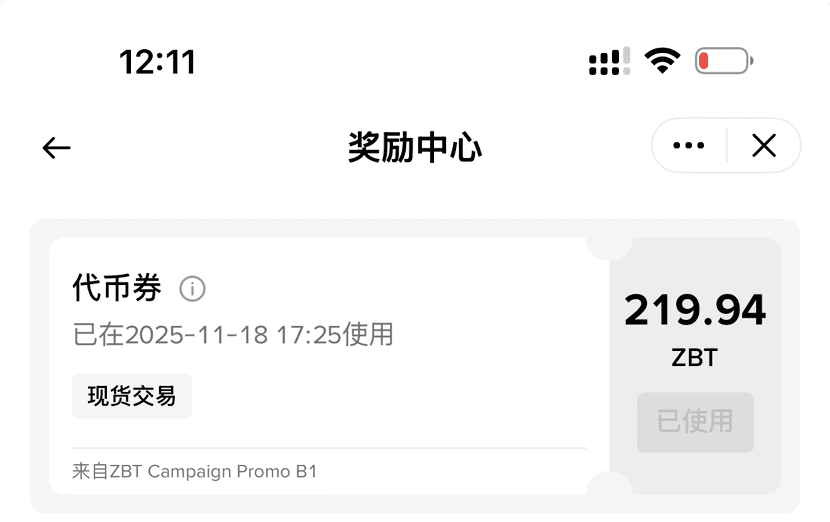
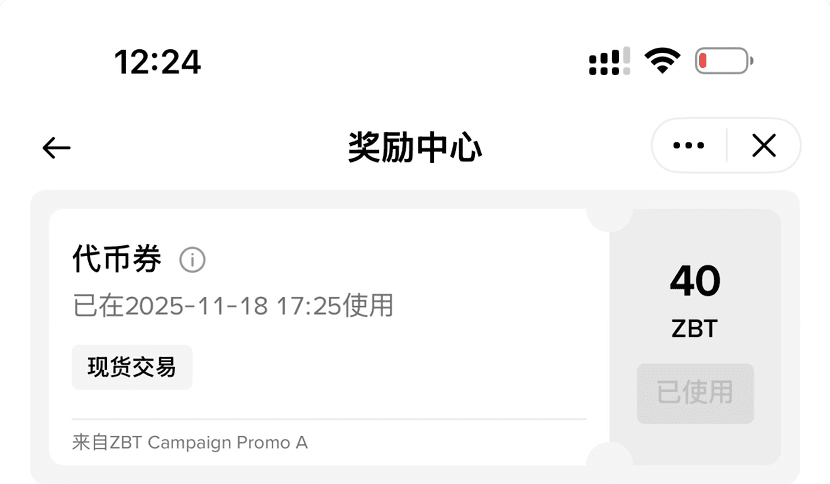
In addition, the spot trading competition also offers a certain amount of random guaranteed income. Usually, as long as you quickly accumulate 500u, you'll receive this guaranteed income. Simply buy 250u and sell immediately. For example, with ZBT, Little Seal randomly received 40 coins.
How to control commission depreciation
The spot trading competition, of course, has obvious drawbacks, the most troublesome being the fee attrition. Alpha tokens generally have fees of only 0.01%, but spot trading fees for ordinary users are 0.1%, which is 10 times more expensive than Alpha 🤨🤨.
Therefore, in the first few rounds of the Little Seals' participation in the spot trading competition, they were all carefully trying to make efforts to eliminate transaction fees.
Taking ZBT as an example, the transaction fee for spot trading is deducted as follows: 0.1% of the ZBT received when buying and 0.1% of the USDT received when selling. Under this model, any spot price only needs to increase by 1/0.999^2 times to exactly cover the transaction fee.
This can be rigorously proven mathematically, but I will not prove it here.
Previously, the little seal would always calculate the exact price at which he would break even using the calculator, then open a limit order in the spot market, and set a take-profit order in advance at the exact price at which he would break even. For example, if I bought at a price of 0.1870, the price I calculated in advance to be the exact price at which I would break even was: 0.1870/0.999^2 = 0.1874.
Note: The actual break-even price is 0.1873745617489, but the ZBT spot trading pair price can only have four decimal places, so only 0.1874 can be entered here.
Strangely, every time I place an order like this, Binance notifies me that my take-profit order has been "rejected," forcing me to sell manually 😡😡, as shown in the image below (note the red text):
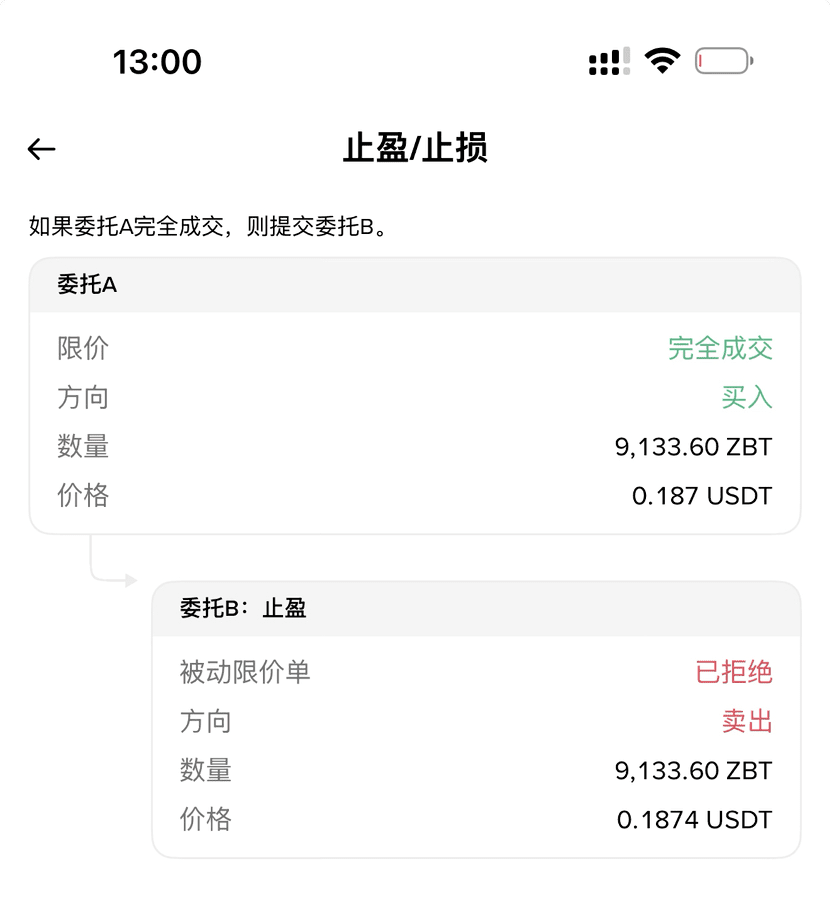
This initially confused and infuriated me 😡. After some investigation, I discovered the reason: after a limit order is placed, a 0.1% ZBT fee is deducted as a transaction fee, causing the take-profit order to "think that you haven't sold enough quantity" and reject it, preventing the automatic sale from proceeding.
Those familiar with Binance Alpha should know that Alpha's reverse orders don't have this problem. Binance Futures also don't have this problem.
Binance's spot trading design seems silly, but it's intentional because it forces you to use BNB to offset transaction fees. This leads to the next topic in this post: using $BNB as transaction fees to enjoy a 25% discount on spot transaction fees.
Enjoy a 25% discount on spot trading fees when using BNB as the commission rate.
Yes, it's exactly what the subheading means. Using BNB, you can actually enjoy a 10% fee discount on contracts, but we won't be discussing contracts in this post.
There are many devilish details here, and you'll suffer if you're not careful. Let me explain in detail.
Initially, I was very reluctant to use BNB because I felt its price was unstable, and when using it for transaction fees, it was settled at the market price. I also looked down on the 25% fee, thinking it wasn't worth much. However, after I tallied up my competition transaction fees, for example, for Morpho, I was shocked.
As you can clearly see from the image, I spent a total of 51.55 USDT + 26.73 Morpho fees to participate in this competition, which is worth a little over 100 USDT.
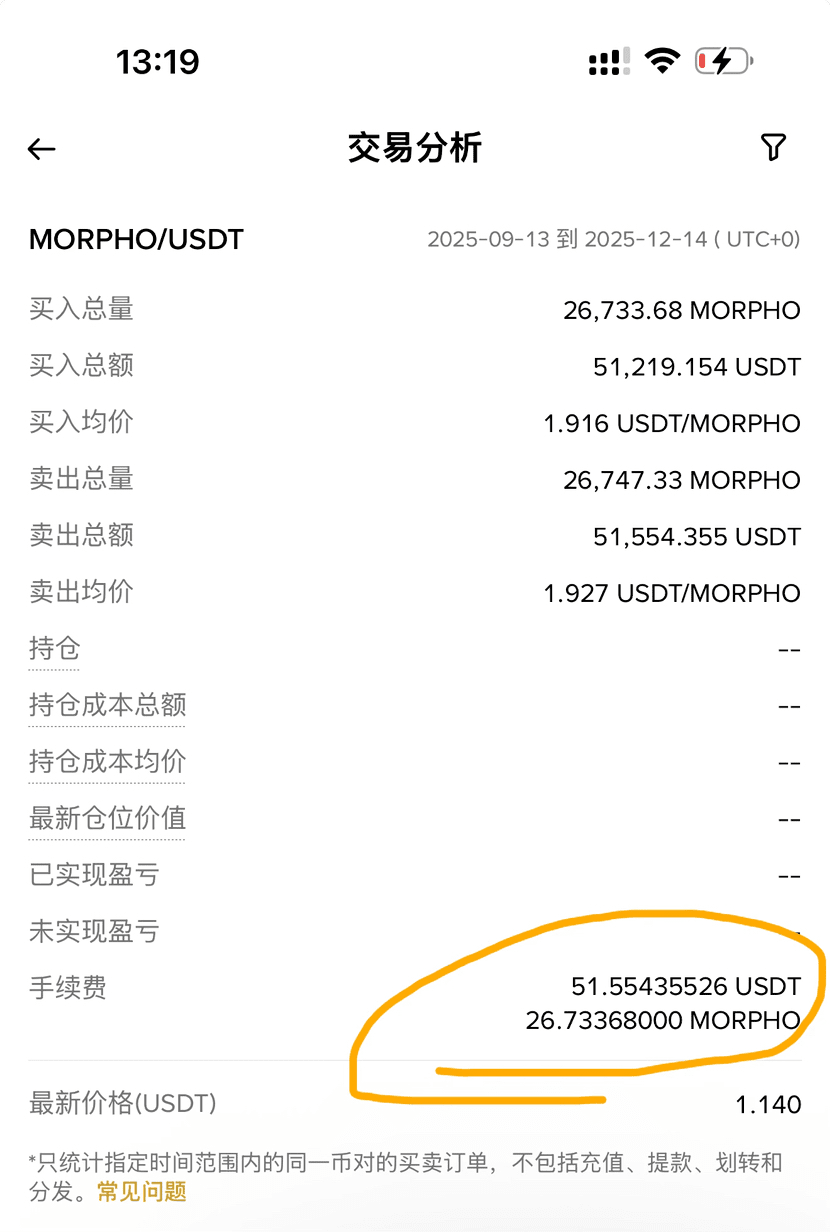
In fact, after deducting transaction fees, I made a total profit of 73 USDT from participating in Morpheo's spot trading competition. However, the transaction fees alone amounted to 100 USDT. If I had used the BNB discount, I could have saved up to 25 USDT, enough for several large meals.
I also realized that even though BNB fluctuates, using it to offset transaction fees is still very worthwhile. Moreover, I don't need to buy a large amount of BNB at once; I only need to buy a moderate amount when I'm boosting trading volume. No matter how volatile it is, it's impossible for it to drop by 25% all at once.
Another advantage of using BNB as a transaction is that stop-loss orders attached to limit orders can be executed automatically and will never be rejected again. This is very important because selling manually is really too difficult.
Important Reminder: To use BNB as a transaction fee payment, the BNB must be held in your spot trading account (or in your futures trading account if it's a futures contract). If you hold it in your wealth management account, you will not receive this benefit. Additionally, you must enable the BNB discount switch in the app settings.
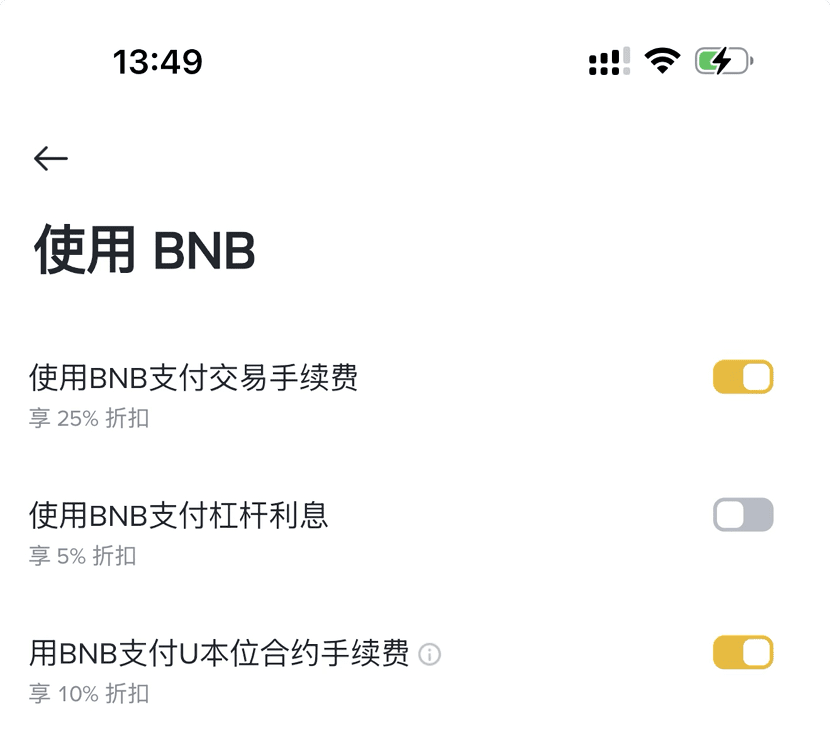
Furthermore, using BNB as the transaction fee brings the fee to 0.075%, but the model changes. The break-even price increase factor becomes 1.00075/0.99925 times, note that this is not the 1/0.99925^2 times mentioned earlier. In fact, the difference between these two values is very small, but they are fundamentally different. A rigorous mathematical proof can be provided here, but it is omitted.
Is there still no way to further reduce transaction fee losses? Of course there is, and that is rebates and transaction fee discount coupons.
Fee discount coupons are not a regular occurrence, but rather an occasional promotion, which will not be discussed in this post.
Rebate
Many people have likely used referral codes or registration links provided by KOLs when registering on Binance. KOLs will tell you that using their referral codes and links will earn you commissions.
However, as time goes by, most people have probably forgotten about it. There's nothing mysterious about it, but there are many details and shady dealings involved. I've already created a separate post specifically to explain it. Please be sure to click to read and bookmark this post; it can save you more transaction fees than you imagine 🤩🤩.
Currently, Binance's fee rebate system offers a maximum rebate of 20% to invitees for both spot and futures trading, and this is automatically settled by the system. Any rebate claiming to be higher than this is not necessarily a scam, but you should definitely be wary of it.
Assuming you received the 20% spot trading fee rebate and used the BNB discount, the current fee would be 0.1% × 75% × 80% = 0.06%, and the break-even price increase would be 1.0006/0.9994 times.
A new question arises: even if the transaction fee is as low as 0.06%, it is still not zero. Does this mean that participating in spot trading will not result in losses?
As a smart person, you may have already noticed something is wrong: the little seal used limit orders and take-profit orders, but in essence, it is still holding onto losing positions and betting that the increase will outweigh the transaction fees.
Gambling never ends well, whether it's alpha or spot trading competitions. Little Seal🦭 has always opposed holding onto losing positions. So, next we'll discuss strategies for inflating trading volume in competitions, which is the main focus of this article.
Understanding order book spread: The nemesis of your inflated trading volume.
What I'm about to discuss applies not only to spot trading but also to alpha and futures trading. So please make sure you understand it carefully.
Betting on price increases and holding onto losing positions is a losing proposition; a single bad bet can wipe out half a month's or even a month's worth of work. Therefore, consider a strategy like this: buy at market price and immediately sell at market price. Think about the ideal or average long-term losses for this strategy. Is it just a loss of 0.06% x 2 in transaction fees?
Of course not.
This introduces the concept of order book spread. In trading markets (including cryptocurrencies, stocks, futures, etc.), the order book spread refers to the difference between the best bid price and the best ask price. The formula is simple:
Spread = Ask price - Bid price
For example, the following chart shows the order book for the currency AT:
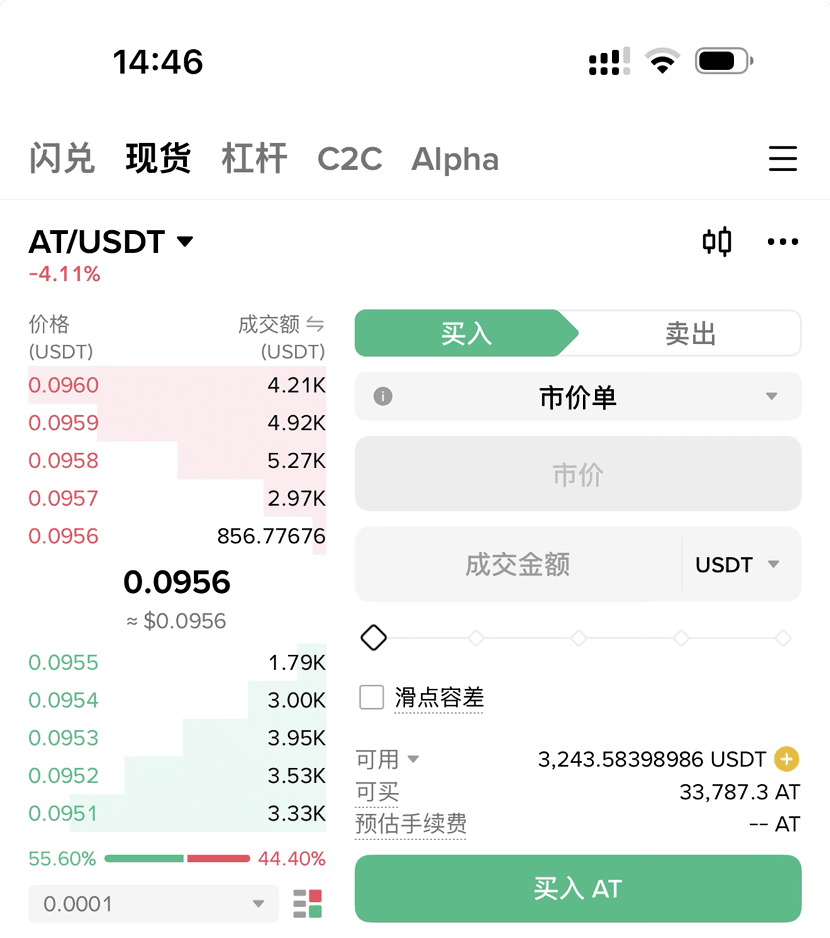
In the chart, the red ask price is 0.0956 with 856 USDT in order volume, while the green bid price is 0.0955 with 1.79k USDT in order volume.
At this point, if you execute the strategy mentioned earlier with 100 USDT, you will immediately buy at the best ask price, at a price of 0.0956, and then immediately sell at the best bid price, at a price of 0.0955.
In other words, besides the 0.06% x 2 transaction fee, this strategy will also cause you to immediately lose 100 * 0.0001 / 0.0956 due to the presence of spread, which is much greater than the transaction fee loss.
Since we don't speculate on price fluctuations, but simply "buy at market price and sell immediately at market price," and we make many transactions instead of just one, the wear and tear caused by spread exists systematically.
Furthermore, while cryptocurrency prices always fluctuate, the profits and losses resulting from these price fluctuations under this strategy are random in the long run and can offset each other. However, spread wear and tear does not occur because spread exists stably.
This might be a bit confusing, but that's mathematics, that's probability. You can stop and try to understand it carefully. Feel free to argue if you disagree; if you do, you're right.
As you may have noticed, for a coin with decent liquidity, spread is essentially equivalent to price precision. Therefore, the more digits in the price and the higher the price, the lower the spread wear. BNB at a price of 1030.58 has lower spread wear than BNB at a price of 850.21.
That's right, spread wear is roughly equal to price precision divided by the coin price.
Over a period of time, such as a week or half a month, the price of a coin always falls within a certain range, so the spread wear rate is easy to estimate.
Eliminating Spread: Further Discussion of This Seal's "Green Spread Technique"
Using the strategy mentioned earlier, spread wear cannot be eliminated. Fortunately, however, there is room for optimization. That is the "green-painting technique" that Little Seal mentioned many times when sharing his alpha scoring strategy:
Only trade when the 1-minute candlestick chart shows a green bar. Avoid any red bars or sharp drops in price action.
Only when the most recent few transaction records show a "consecutive green" trend should you quickly use alpha to buy or sell in the opposite direction (place a buy order at a higher price and a sell order at a lower price, and the transaction will be executed immediately).
Any alpha player who lacks the courage to "place buy orders at higher prices and sell orders at lower prices" has not understood the matching mechanism of the centralized exchange's order book. It is essential to understand this mechanism.
The principle is simple: placing a buy order at a higher price will immediately allow you to capture the best ask price on the order book. Don't worry about it being filled at your higher price, unless there are only 100 sell orders at the best ask price and you directly buy 10,000 shares. I don't think you'd be that stupid. The same principle applies to placing a sell order at a lower price.
Using this "greening technique" can greatly increase the probability of selling at par (selling price equals buying price), and can even sell at a price higher than the buying price.
In this way, thread wear will be eliminated to some extent. Complete elimination is impossible, and you shouldn't fantasize or struggle with it, because you are neither a prophet nor a god.
What you really need to do is to generate stable returns for yourself over the long term.
The principles of spot trading and alpha trading are exactly the same, except that the Binance app's spot trading interface doesn't have a reverse order function. However, you can use a market order instead. It only requires three quick clicks, which tests your hand speed, but mine is fast enough. In a trending or consolidating market, you can also use a limit order + take-profit order, but I don't recommend it because you can easily get caught off guard by sudden price drops.
In summary: the ideal maximum wear limit is the transaction fee of [0.06% x 2] plus the spread wear of [price accuracy divided by coin price]. This maximum can be reduced using the "green wave technique".
Please keep this conclusion in mind and strive towards it.
Those whose practical performance is worse than this are advised to review their performance more.
The little seal has already put this strategy into practice in AT's spot trading competition.
In the Binance app, you can track your spot trading volume and transaction fees.
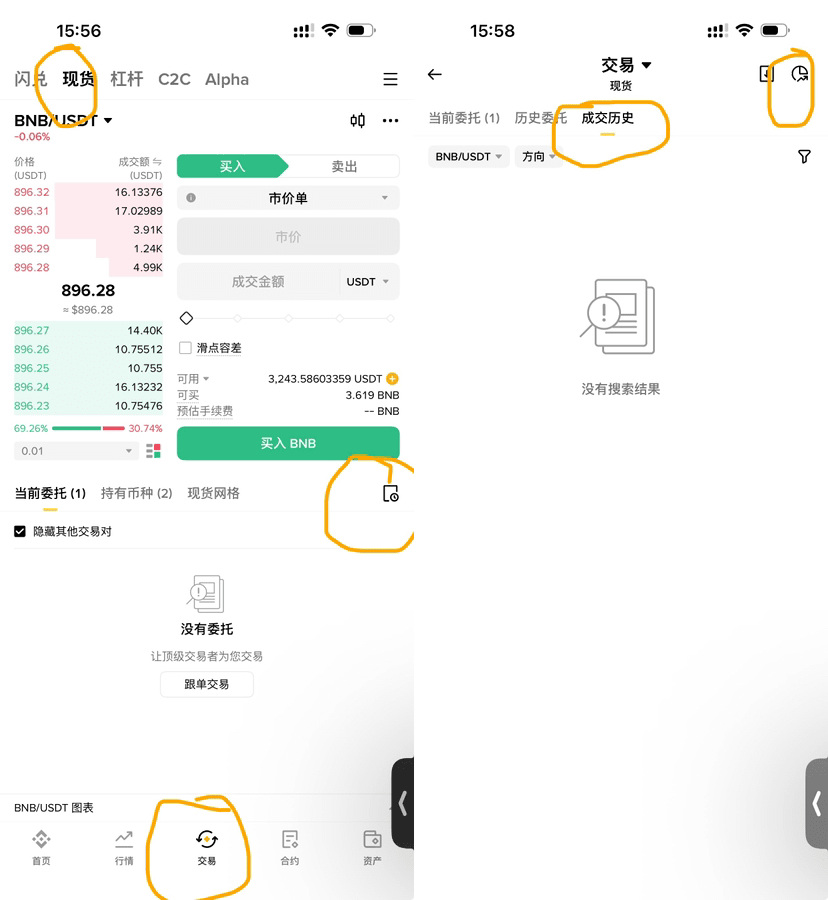
Binance app has a somewhat hidden feature that allows you to quickly track spot trading data for a specific token within a specific time period, which is very convenient. The entry point for this feature is shown in the image below:
The statistics interface is shown below, and it's quite clear at a glance:
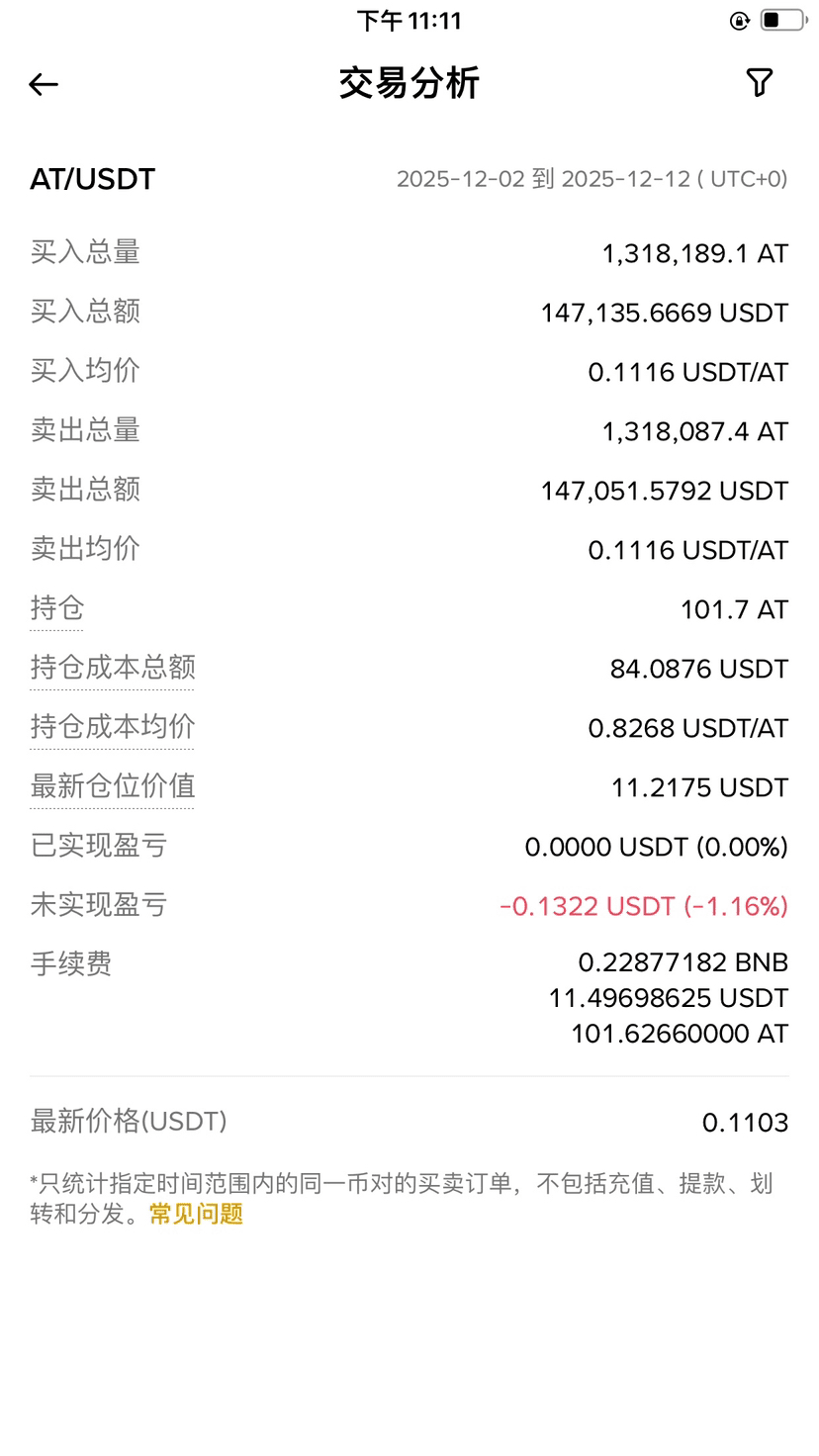
It should be noted that this feature has some known bugs and is quite idiotic:
I can't seem to select today as the start time for the statistics. If I do select today, it automatically sets it to the previous day. I suspect it's an app version issue, because some people don't have this problem.
When not using BNB as transaction fees, for example, if you buy 1000 MORPHO tokens, it will deduct 1 MORPHO as a fee. If you then sell the remaining 999 MORPHO, it will idiotically assume you still hold 1 MORPHO. 😅😅
Because of these bugs, it is recommended to only pay attention to the three data points: buy volume, sell volume, and transaction fees. Other data are inaccurate.
Another point to note is that if you do not use BNB as the transaction fee, the system will deduct the fees from the tokens you buy and the USDT you sell. These fees are included in the buy and sell amounts.
Other precautions
1️⃣ Statistics on competition transaction volume:
The rules state that transaction fees are not included in the trading volume. However, based on my observation, this is indeed the case when BNB has the highest transaction fees. But if you don't use BNB, the fees from buying tokens and selling USDT are still included in the trading volume.
2️⃣ Regarding the update time for total competition transaction volume:
The rules don't explicitly state this, but based on my observation, it used to update at 8 AM every day in the East 8 time zone, but recently it seems to be updating every hour.
3️⃣ Remember to click the "Enter" button:
If you don't click the "Enter" button, none of your trades will be counted. Remember this!
4️⃣ Regarding the event entry and reward distribution:
The most frustrating thing about spot trading competitions is the timing of reward distribution. The event rules page usually only gives a deadline, but doesn't specify what time it is, and rewards are often suddenly distributed earlier than expected.
The reward collection area is located in the "Rewards Center" within the function center. It is recommended to set it as a quick access function on the homepage and check it every day.
Events typically have two entry points: "New Coin Launch Events" and "Spot Trading Arena," but newly launched events won't appear in either of these entry points immediately.
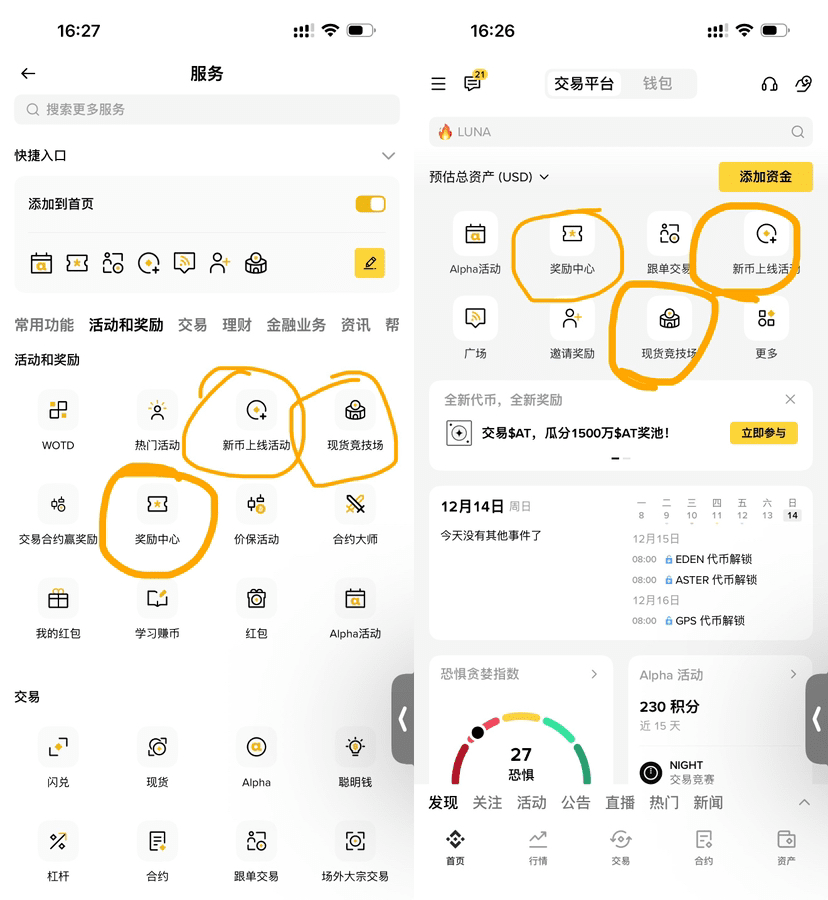
It is recommended to turn on all notifications in the Binance app and pay attention to the latest event announcements, as this is very important for grabbing the minimum guaranteed rewards.
5️⃣ About Hedging
Because the rewards for spot trading competitions are usually distributed more than ten days after the event ends, the price of the coin can plummet during this long period. For example, the recently depreciated coin AT.
Therefore, my advice is to use leverage if possible, but make sure you have enough margin (I recommend 10 times the margin) and keep an eye on funding rates.
In the latest AT index, I hesitated and didn't hedge in time, which put me on the verge of being liquidated. As I write this post today, this garbage stock continues to plummet.
Link to recent activities
The latest spot trading competition is this: Spot Trading Feast 4, click to go directly there.
This event is different from previous ones. Instead of distributing the prizes proportionally based on transaction volume, it's divided into tiers according to rankings, which is a bit disappointing.
Therefore, I do not recommend that you participate heavily in this activity; I only suggest that you receive the minimum living allowance reward.
However, the prize pool for this event is XPL, and the trading pairs in Hefei are all mainstream coins, not the garbage coins like AT from last time that only knew how to crash.
So the little seal will give this event a shot.
—————————————————
Writing this wasn't easy, so if you found it helpful, please leave a thumbs up before you go!