Three months ago, I interviewed Professor Han Feng, an independent researcher at Harvard University and a corresponding member of the National Academy of AI in the United States. The new book (Stablecoin) that I promised to send to me at that time has finally been read! 😜🌼. I am seriously studying it over the weekend and gaining a lot.
I haven't finished reading the whole book yet, but I can't help but share some of my interim thoughts with everyone. It’s not like an ordinary blockchain book, and it’s even less like an investment book; instead, it feels a bit like reading the first half of (The Three-Body Problem). The more I read, the more I realize that I’m standing at the starting point of a turning point in an era.
Many people only see the big players in the cryptocurrency world with their fortunes in the hundreds of billions or trillions, but they rarely realize that they did not smoothly arrive at today; rather, they are a group of OGs who continuously experimented and survived amidst chaos.
The book begins not with Bitcoin's price or technology, but with a real story:
The cloud boat school, founded by Professor Han with half his life's energy, eventually shut down.
It was also at this stage that Professor Han happened to hear a remark from the crypto circle's guide Dendi—a Tsinghua Chinese department alumnus: money is created by humans, but humans should not be its slaves.
This statement is not complicated, but at that time, it precisely hit the core of the problem.
In September 2013, a Bitcoin lecture in the Tsinghua alumni insight group became a key turning point.
This lecture brought not just an understanding of a concept but a change in cognitive level:
Currency, in essence, is a system constructed by humans, not something inherently unchangeable.
A system without a nation, army, or central bank, yet attempting to establish a global consensus.
From this moment on, Bitcoin is no longer an investment target in Professor Han's eyes, but a system that may reconstruct the underlying rules.
Professor Han himself is a PhD student in quantum physics at Tsinghua University, which also influences his understanding of the crypto world.
He did not apply traditional financial linear logic to Bitcoin but attempted to understand this emerging digital computing system from a more systemic and probabilistic perspective.
In December 2013, the 'Notice from Five Ministries' was issued, requiring all banks and formal financial institutions to cut off fiat recharge channels to Bitcoin trading platforms.
This means that the fiat entry point for the entire market has been directly closed.
Prices fell, liquidity dried up, and panic quickly spread.
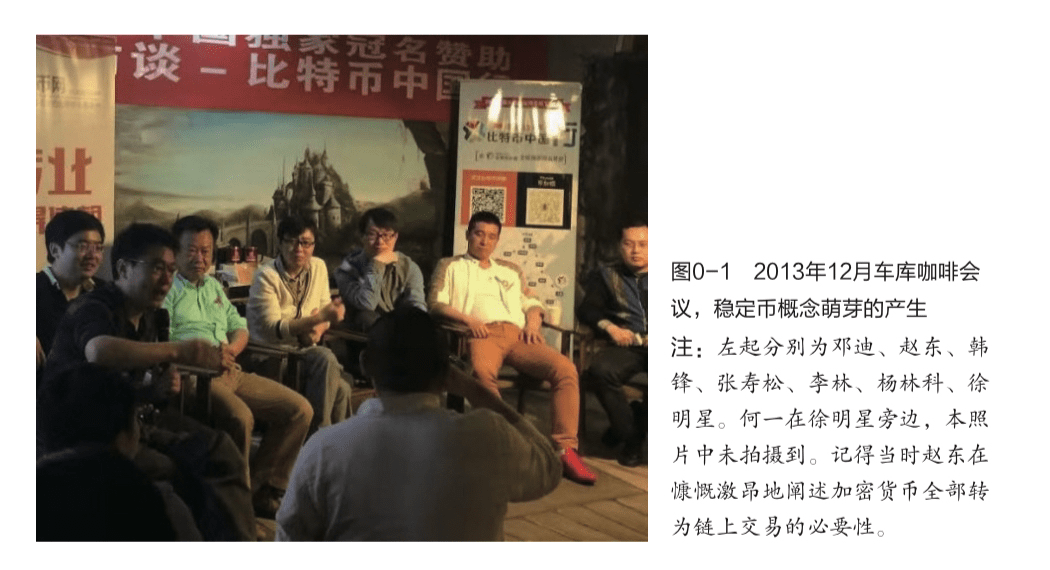
In such a context, a group of people sat together in a garage café in Beijing. Those present at the time later became almost all core figures in the industry: Xu Mingxing, Li Lin, Zhao Dong, Bao Er Ye, He Yi, Yang Linke, Zhang Shousong, Han Feng, etc.
They were not discussing opportunities, but a more fundamental question: can this system continue to exist if fiat channels are cut off?
It was precisely under such real pressure that the concept of 'stablecoin' first sprouted.
It can be seen that stablecoins are not a flash of inspiration, but a result gradually forced out by reality. Without a stable value scale and a stable trading medium, the entire system cannot operate in the long term.
Therefore, the logic in the book is very clear:
Stablecoins were not invented but are things that inevitably appear when the system operates to a certain stage.
It is not idealism, nor is it a business idea, but a survival demand.
The book regards USDT, MakerDAO, UST, and USDC as four different paths of survival.
Among them, USDT is not the most perfect solution, but it supported the market during critical times.
Against the backdrop of limited fiat channels, cross-border difficulties, and market fragmentation, USDT has become, in effect, a value intermediary, taking on the role of a 'blockchain central bank' in a certain sense.
The book also clearly points out: the stability of USDT is not a single company's action, but a structural result supported by traders, OTC, market-making forces, and real market demand.
The book also contains a very restrained yet impactful personal experience.
He Yi once offered Professor Han a 'golden finger account' with three times leverage, available for financing and currency exchange at any time.
At the stage where cognition has not yet matured, this is a highly risky tool.
In December 2013, at the peak, Professor Han shorted Bitcoin due to information advantages.
After the policy was implemented, prices halved, account profits rapidly expanded, and returns were substantial.
But closely following were misjudgments and losses, until ultimately, in a soft sleeper carriage from Beijing to Shanghai, it all collapsed to zero.
This includes funds borrowed by Professor Han, as well as his daughter's maintenance fees.
This section does not render emotions but repeatedly states a fact: the same tool can amplify both correctness and error.
Many people, after their first encounter with systemic failure, often have only two choices: either leave completely, declaring everything a scam; or stay, but only focus on the price, no longer thinking about the system itself.
Professor Han chose the third path—stop and re-understand the system.
Why is Bitcoin designed this way?
How does a decentralized system maintain order?
In a system without central authority, how to avoid collapse in extreme situations?
It is precisely for this reason that the book involves thinking methods from cryptographic papers, distributed systems, and even quantum physics.
This is to break out of the linear causal model of traditional finance and understand the underlying logic of the crypto world.
In the subsequent content, Professor Han began to truly dissect the stablecoin system. He clearly distinguished: USDT, MakerDAO, UST, and USDC have been on different paths since their inception. This is not a technical difference but a difference in survival strategy. USDT first solves 'whether there is or not';
MakerDAO represents a large-scale practical application of decentralized stablecoins. The book specifically presents the systemic challenges faced by MakerDAO through the 'Black Thursday' event.
Prices plummeted, networks congested, liquidation failed, oracles delayed, ultimately resulting in bad debts.
The significance of the event lies not in success or failure itself, but in clearly revealing that decentralized stablecoins are not only an economic model issue but also involve engineering issues such as network performance, participation thresholds, and governance reaction speed.
The final resolution of the system through the issuance of MKR itself indicates one point: even the most ideal design must face real-world constraints.
🌷Faye's impressions after watching, to be continued...