
In the DeFi world of 2025, the phrase 'governance token' has almost been overdrafted.
The real use of the vast majority of governance tokens only has two purposes:
Launch an airdrop expectation
Click a few times on Snapshot for non-binding 'approval'
It is said to be governance, but everyone knows - those who do not hold positions are the ones who truly make the decisions.
Falcon Finance is taking a very unpretentious path:
FF is not 'spiritual equity', but a naked financial privilege certificate.
As long as you are willing to stake FF in the protocol, what you get is not a slogan of 'community governance', but several very practical things:
Higher minting limits.
Lower haircut rates.
Cheaper swap fees.
Priority allocation of vault quotas.
In this system, FF is more like a decentralized 'black card membership' —
Rather than pretending everyone is equal, it's better to price privileges clearly.
1. FF: Turning 'governance tokens' into capital efficiency accelerators.
The gameplay of traditional lending protocols is very simple:
Provide you with a fixed LTV.
Provide you with a liquidation line.
Regardless of whether you are an old user of the protocol or whether you have helped the protocol earn a lot of money, everyone is treated equally — it sounds fair, but for capital, this is called inefficiency.
Falcon's thinking is the opposite:
Are you truly willing to 'stand by my side'? Then I will make your capital efficiency the highest in the venue.
In the design of FF, the core focus is on three things:
Higher available limits (increasing effective LTV).
Ordinary users: 1 million WBTC can mint at most 750,000 USDf.
Addresses staking sufficient FF: also 1 million WBTC can mint up to 800,000.
This additional 50,000 liquidity is an extra tier of leverage for institutions, directly raising the annualized rate.
Cost reduction.
After staking FF, swap fee tiers are reduced.
High-frequency trades and market makers save net profits.
Yield boost.
Some sUSDf strategy positions are open to FF stakers with boosted tiers.
Even with stablecoin positions, your APY is higher than others by half a tier to a tier.
The significance of FF has evolved from 'governance rights' to **'production materials.'**
Holding more FF → lower capital costs, higher available limits.
With the same principal, your PnL slope in Falcon is different.
2. A diagram to understand: How FF privileges feed back into the protocol.
FF is not a one-way delivery of benefits, but rather has designed a complete economic flywheel.
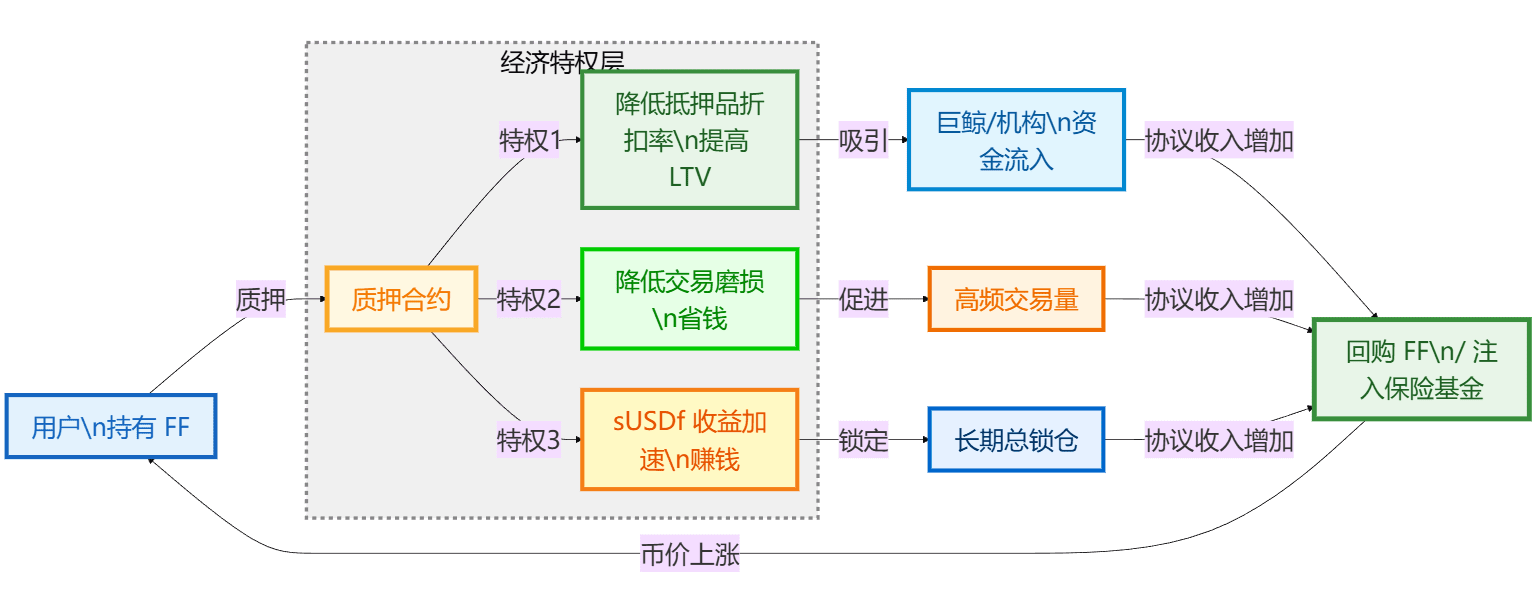
The key point of this structure is:
Privileges are not pure consumption, but recoverable production materials.
Institutions calculate very clearly: If they can squeeze out an additional 2–3% annualized through FF, then FF has a clear 'cash flow pricing.'
Protocol income forms a closed loop with FF.
A part of the transaction fees + minting fees can flow back to the insurance fund or FF-related incentives.
The more valuable the privilege, the scarcer FF is, the more stable the protocol → the more capital dares to enter.
The result is:
FF is not a 'speculative chip,' but the threshold that allows liquidity to voluntarily line up.
3. Breaking the curse of governance tokens that 'are mined and then dumped.'
In these past few years of DeFi, the most common scenario:
Day one: High APY, everyone rushes to mine.
Day seven: Selling pressure crashes to the floor, governance tokens drop to 0.
The root cause is simple: tokens are not truly bound to 'usage rights' and 'visible returns.'
Falcon's approach is to firmly bind FF and several scarce resources:
Quota scarcity:
Some high-yield delta-neutral vaults have limited capacity.
To prioritize, you must hold this FF ticket.
Allocation rights are scarce:
Who can have a higher LTV, who can use new assets first, and who can obtain positions in specific strategy pools.
These are all 'position values,' not empty talks of governance.
Information scarcity:
In the future, it is entirely possible to whitelist certain strategies and open positions early for FF stakers.
The result of this 'Utility Binding' is:
No longer is it about 'digging it up and selling it,' but rather 'digging it up and deciding whether to invest more to continue locking.'
FF has truly equipped itself with something: 'If you don't hold, you miss the opportunity.'
In the environment of 2025, where high-quality yield assets are severely scarce, this kind of 'priority entry rights' itself is the hardest premium logic.
4. FF: Falcon's decentralized black card.
If you see Falcon as an on-chain investment bank:
USDf = their savings and settlement currency.
sUSDf = their 'wealth management/strategy products.'
FF = their American Express black card.
What ordinary users can use are public zones, basic strategies, and standard LTV;
Those holding FF receive such treatment:
When allocating:
With the same collateral, obtain a higher limit.
Fewer haircuts mean higher capital efficiency.
During trading:
Frequent rebalancing and structuring LPs/market makers visibly save on fees.
On the yield side:
Preemptively enter the pilot positions of 'new strategies/new assets.'
During peak periods, only FF stakers may have slots.
Here is a very realistic but important point:
Falcon has not hidden 'differentiated experiences,' but has directly written them into the white paper and smart contracts.
Human nature is like this:
Everyone claims fairness, but in reality, they all want VIP channels.
Turning this human nature of 'wanting to be treated differently' into a moat for the protocol is itself a very DeFi operation.
5. The votes in hand are essentially the control over cash flow.
FF certainly also has the 'most traditional part': governance rights.
But here, governance is no longer a formal Snapshot checkbox, but is very practically tied to money:
FF holders can participate in decisions:
Which assets can be used as collateral, how LTV / Haircut is set.
What proportion of protocol income is injected into the insurance fund vs. buybacks/incentives.
Which new strategy or vault is prioritized (for example, leaning more toward CeFi or more toward DeFi).
In simple terms:
You are not just voting to decide 'what the homepage looks like,' but voting to decide 'how this protocol makes and spends money.'
The governance results feed back directly into FF's own value curve, which is a typical example of 'being responsible for oneself.'
This kind of Stakeholder Alignment solves an old problem:
In the past: Voting and positions were disconnected, 'I was ready to sell, why vote?'
Now: Every vote you cast is changing the rights statement of your 'black card.'
6. Who controls privileges, who controls liquidity.
In Falcon's narrative, USDf addresses 'stability,' sUSDf addresses 'yields,' while FF addresses **'who gets to split these two pieces of cake.'**
For the protocol:
FF is an operating system that tightly binds 'long-term capital + high-quality users.'
It uses transparent privileges to exchange for longer-lasting, more stable capital duration.
For holders:
FF determines your capital costs, available limits, and position priority in the Falcon system.
In the same strategy, you and others see the same chain, but get completely different results.
From this perspective, FF is not simply a 'governance token,'
but a decentralized membership card with three lines of small print:
Are you willing to bet a little more?
The protocol allows your money to run faster than others and stand ahead of others.
In the future DeFi competition, whoever can design this point more intelligently,
whoever can hold that most discerning and patient liquidity.
And FF has clearly chosen its position.
I am a meticulous analyst, one who looks at essence rather than chasing noise.

