
On August 20, 2025, Kite Network processed the 1 millionth micropayment in 100 milliseconds during a stress test. At the moment when a series of green checkmarks lit up on the monitor, CTO Scott Shi remembered those all-nighters at Uber—calculating ETA for tens of millions of passengers, real-time dispatch for drivers, squeezing an extra 10 milliseconds of delay for every request.
In his eyes, the flow of money is essentially no different from fleet dispatch: it’s not about 'whether a transfer can be made,' but 'whether real-time settlement can be achieved.' Traditional finance settles on a T+2 basis, and what Scott wants to do is accelerate the flow of money to 'near light speed.' Kite is the battlefield for this millisecond-level engineering philosophy on the blockchain.
From ETA to TPS: bringing 'real-time systems' into the machine economy.
At Uber, Scott faces a typical 'real-time system dilemma':
Tens of millions of passenger and driver positions change every second.
The system must give ETA, pricing, and the optimal route in milliseconds.
Once delays increase and predictions go wrong, users immediately get angry, and GMV drops directly.
This mindset was brought intact into Kite:
In the machine economy,AI agents are the 'passengers' and 'drivers', and payment channels are the 'roadmaps'.,
If settlements cannot achieve 'on-time delivery', then the so-called AI Agent economy is just a bunch of demos.
Thus, the core of Kite is not 'to recreate a high TPS public chain', but to answer a more nuanced question:
When you need to settle at the level of seconds and $0.000001 per transaction for AI agents, can the system still hold steady?
State channels: compressing one million interactions into a single settlement.
In this answer, the most crucial point is Scott's use of 'State Channels'.
In the world of Uber:
The positions of passengers and drivers are frequently updated.
These intermediate states will not always hit Visa.
Only at the moment 'the trip ends' is the card charged once.
Kite simply moved this model on-chain:
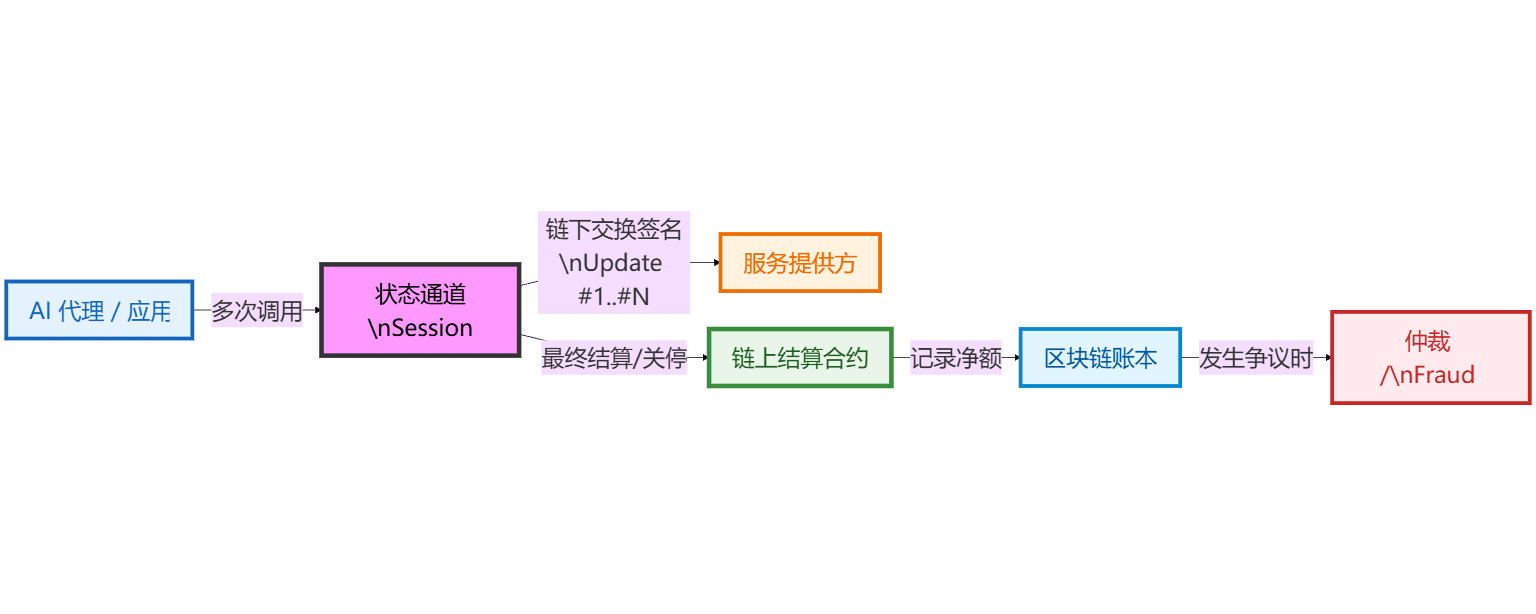
Between AI agents and service providers,
Every API call, every model inference.
All just exchange a signed state update once off-chain.
Only when:
Channel closed,
or have disputes,
or when settlement is needed,
Only write the final result to the chain once.
The result is two extremely brutal economic conclusions:
Effective cost per transaction ≈ $0.000001
But every interaction retains a traceable encrypted signature, with a complete 'driving recorder'.
Visualize it more intuitively with a picture:
For regulators and auditors, this structure makes sense:
High-frequency interactions off-chain reduce friction.
But each state update has a signature, is replayable, and verifiable.
When something goes wrong, it can fully 'reveal' the channel history on-chain to provide proof of fraud.
Fast, but not blindly running; cheap, but not without evidence.
Optimistic execution + slashing: writing 'fear' into milliseconds of speed.
Here comes the problem:
The reason traditional public chains are slow is that everyone has to 'suspect then confirm' at every step;
So how does Kite dare to make decisions in milliseconds while claiming safety without compromise?
Scott's answer is a very Web3 set of combinations: optimistic execution (Optimistic) + slashing.
System defaults:
Most nodes and agents are honest.
State updates 'go first', without getting stuck at every step.
But at the same time:
Each node participating in the settlement has a staked collateral.
Any party can submit proof of fraud during the dispute window.
Once verified, the malicious node's collateral is directly slashed.
To put it more vividly:
Kite does not send all police officers to the street to stop cars for inspection,
but lets the cars run first, while giving each driver a 'deposit that can be seized at any time' in the background.
This design brings three direct effects:
TPS improvement: because the vast majority of paths do not require hop-by-hop consensus.
Hardware requirements are not excessive: relying not on stacking servers, but on game theory to drive bad actors away.
Security can be quantified: the minimum cost of malicious behavior for attackers = the scale of the slashed collateral.
Kite's testnet data proves that this is not just talk:
Millions of micro-payments running under such an optimistic model, with node pressure coming from the network and I/O, rather than from 'consensus deadlock'.
What new species will be born when the transaction fee drops to one millionth of a dollar?
After solving engineering problems, the true Alpha begins to emerge.
$0.000001 per settlement cost directly opens up a batch of business models that cannot run in the Stripe / Visa world:
Computing power leasing billed by the second.
GPU and inference clusters are no longer rented by the hour but billed by the second / by token.
Token billing model inference.
it's not '19.9 USD unlimited use per month', but 'use how much, pay how much'.
Decentralized search / data API billed per request.
Pay $0.00001 per query, and AI agents can make B2B calls without any psychological burden.
Under traditional payment gateways, these models would be directly strangled by the **'minimum fee'**:
Visa/Stripe's $0.30 + 2.9% basic rate.
Makes any transaction below $5 inherently uneconomic.
Kite has broken this ceiling.
When the cost of micro-payments is compressed to a level that humans hardly perceive, AI can pay each other like threads without needing humans to buy packages or recharge cards in advance.
For Binance ecosystem and CreatorPad followers, this means:
You might imagine **'cheating in games by the second, charging per frame'**.
What you should really focus on is **'the strategic collaboration layer of AI agents settling in milliseconds'**.
Whoever occupies the settlement standard here has the chance to become the 'on-chain payment layer Stripe' of the AI era. Kite is laying the foundation for this.
Summary: In the machine economy, speed itself is an asset.
Returning to that simplest judgment:
In the era of the human internet, whoever solves the problem of 'how to deliver information quickly' becomes the giant;
In the era of the machine internet,whoever solves the problem of 'how to settle value in real-time' will become the underlying infrastructure.
Bitcoin solved the problem of 'money can be digitized and self-custodied';
DeFi solved the problem of 'money can be programmed';
Kite aims to solve the next step:
When the world is occupied by billions of AI agents, can money flow between them at millisecond speeds, safely and with low friction?
Scott Shi brought from Uber not just the three words 'high TPS', but a whole set of engineering thinking that treats real-time performance as the core product:
State channel compressing interactions.
Optimistic execution combined with slashing withstands malfeasance.
Turning every signature update into a replayable 'economic log'.
When you are trading KITE, instead of just looking at the token curve, it’s better to ask yourself a question:
If the AI era is really going to take off,
who will provide this group of 7x24 sleepless agents,
with a payment highway that isfast enough, cheap enough, and accountable enough?
I am like a person trying to find a sword in a boat. What I see on Kite's millisecond delay curve is the main road of the next round of cash flow in the machine economy.@KITE AI $KITE #KITE

