
Writing while monitoring the market is not easy; composing a comprehensive market analysis article from macroeconomic to technical aspects takes about 4 to 5 hours, unlike those KOLs who easily copy points everywhere. I hope everyone can like and support each other! Thank you 🙏
Now let's move on to today's topic:
The Bank of Japan is about to make its most aggressive interest rate decision in 30 years, tightening the liquidity faucet for global risk assets. The price of Bitcoin appears to be on the verge of collapse under the dual pressures of macroeconomic stress and technical resistance.
The Bank of Japan may raise interest rates by 25 basis points to a 30-year high this week, with market predictions placing the probability at 97%. This key macro decision is impacting the price of Bitcoin.
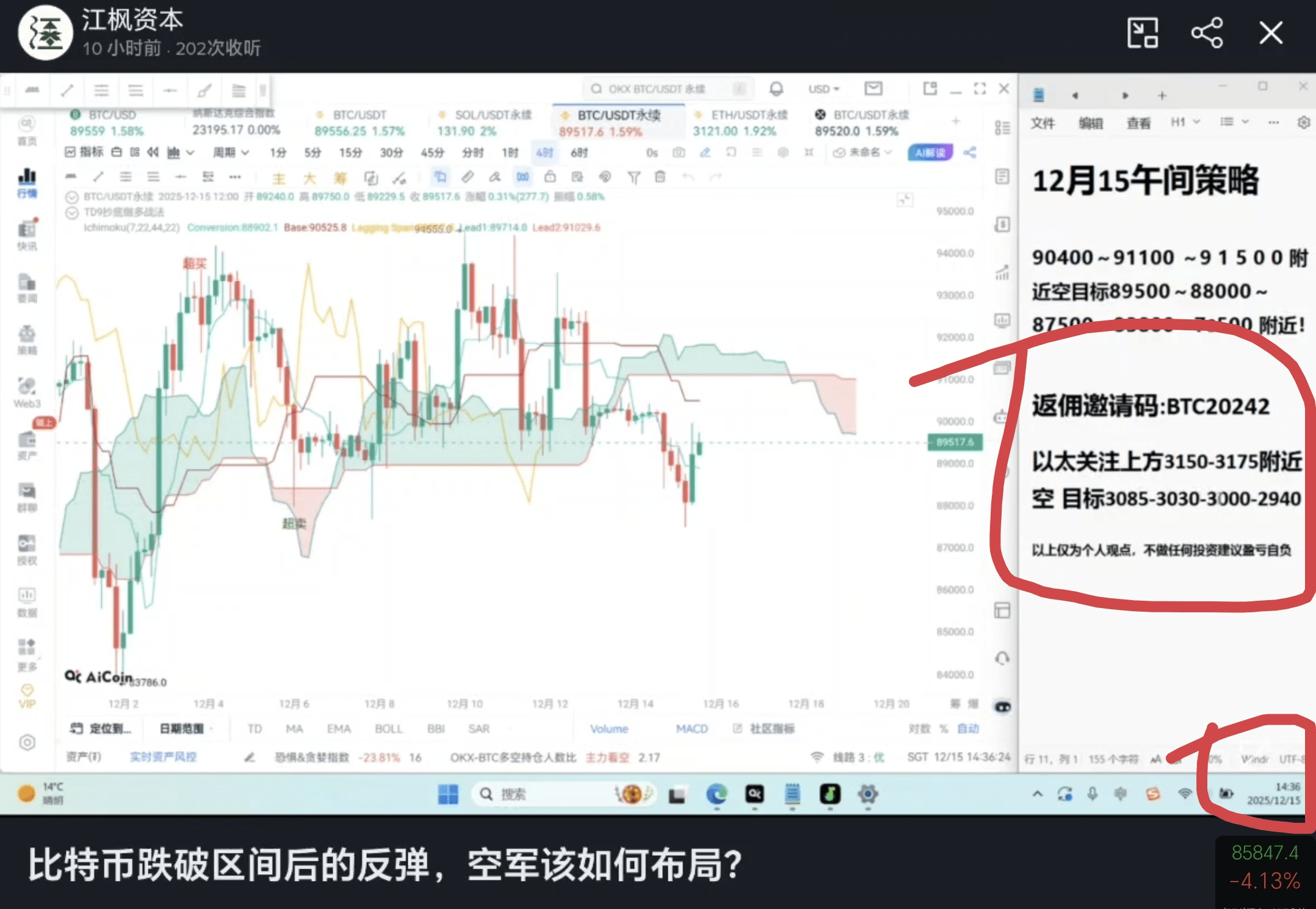
Yesterday in the live broadcast, I advised everyone to participate in shorts around 3150–3175. Today, the lowest came to 2870, which also yielded considerable profits. I mentioned in the article to participate in shorts around 904000, but unfortunately, Bitcoin's movement has been too weak, failing to hold the 90,000 level. So regretfully, I could not enter the market, but the shorts mentioned earlier around 94000 and the 92300–92800 shorts are still held after reducing positions! Now we need to pay close attention to the support at 838. Only a valid breakdown here will provide an opportunity to go to the 78500 level!
On the technical front, Bitcoin currently has Fibonacci support near 83800, which is also the previous low, creating a psychological support level. If it cannot hold here, it may drop to around 78500, even 74500, and 70800. Therefore, the current position is crucial. The Fibonacci retracement near 87500 is also a conversion line resistance on the Ichimoku chart, along with resistance at 88100 (0.618) and 89200 (baseline). The attached RSI indicator is currently severely oversold, so be cautious of a rebound. Therefore, do not blindly short; a prudent approach is to patiently wait for the price to rebound to the upper resistance levels to gradually position for short trades!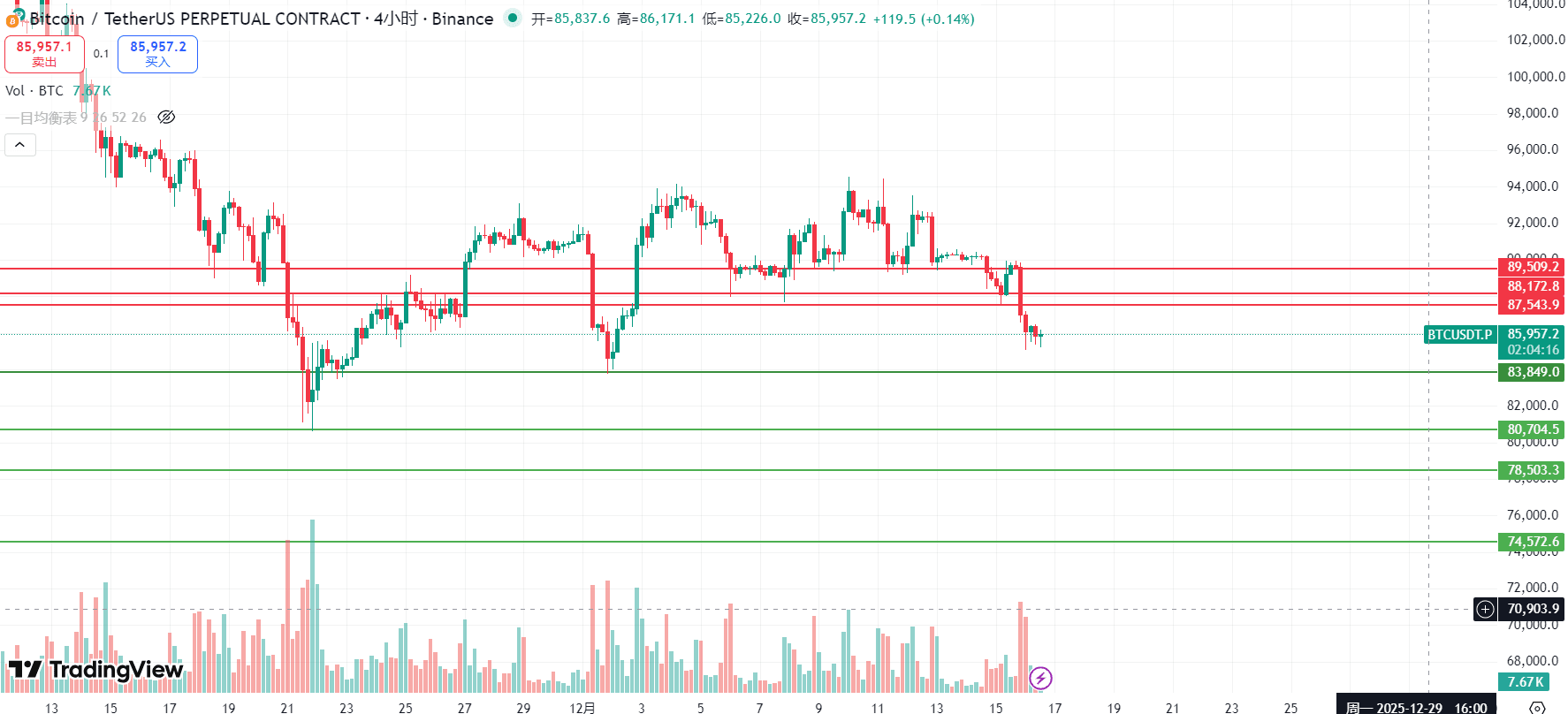
01 Macro bearish resonance
The current macro environment poses multiple pressures on Bitcoin, with the Bank of Japan's policy shift being the most prominent negative factor. According to historical data, in the 4-6 weeks following the last three rate hikes by the Bank of Japan, Bitcoin experienced declines of 20%-30%.
More critically, the Bank of Japan has confirmed that it will sell ETF holdings valued at approximately 550 billion USD starting January 2026. This indicates that liquidity tightening is not a short-term behavior but may be a long-term trend. The Federal Reserve's monetary policy also adds to market uncertainty. Although the Fed has completed rate cuts, there is a lack of clear guidance for the rate cut path in 2026. The market's focus has shifted to 'how many times can rates be cut in 2026, and will the pace be forced to slow down?'
02 Key technologies and on-chain signals
From a technical analysis perspective, Bitcoin is currently at a crucial decision point. Although there are signs of stabilization in the short term, the structure in the larger time frame remains bearish. On-chain data shows clear signs of capital outflow. On December 15, the net inflow of Bitcoin exchanges reached 3,764 BTC (approximately 340 million USD), marking a peak.
03 Market structure and capital flow
The current Bitcoin market exhibits clear structural weakness, with insufficient bullish forces and capital showing an outflow trend. Bitcoin spot ETFs are experiencing significant capital outflows, with a net outflow of about 350 million USD (about 4000 BTC) in a single day. The main outflow sources are Fidelity's FBTC and Grayscale's GBTC/ETHE. Another noteworthy signal is that Bitcoin performs relatively weaker during US trading hours. Statistical data shows that 'since the launch of BlackRock's IBIT Bitcoin ETF, holding after market close yields a return of 222%, but holding only during market hours results in a 40.5% loss.' There are also pressure signals from the miner level. Bitcoin's overall network hash rate has declined significantly, with F2pool data reporting that as of December 15, Bitcoin's total network hash rate was approximately 988.49 EH/s, down 17.25% from the same time last week.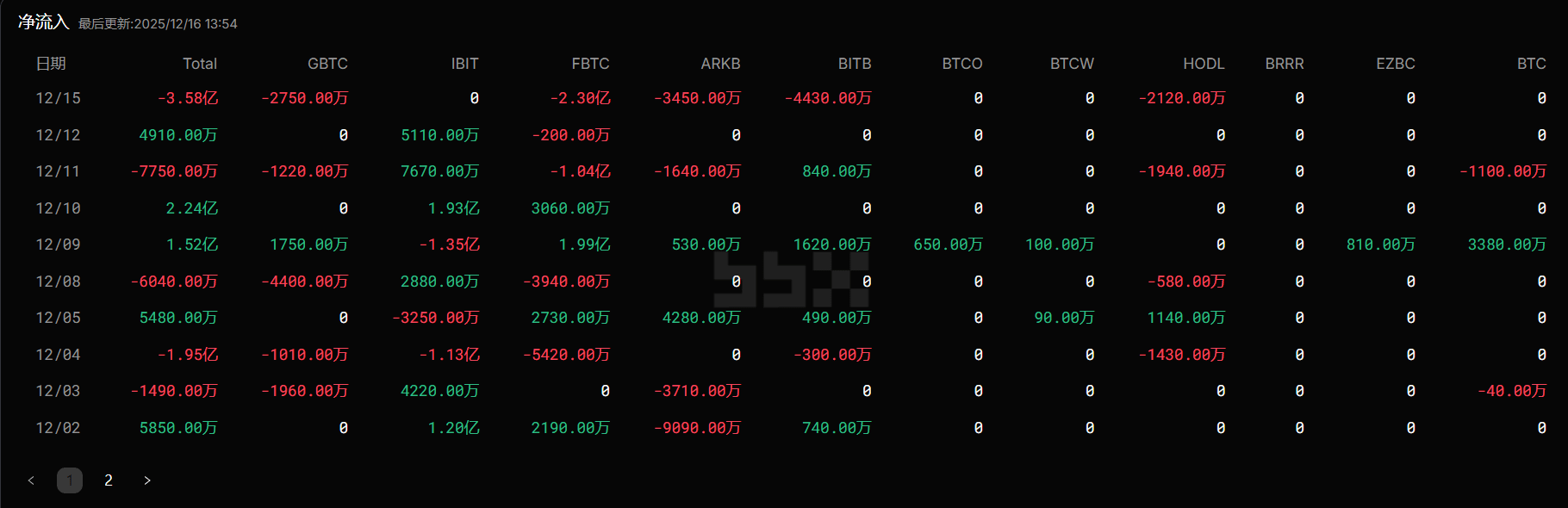
Specific trading strategy: Focus on shorting.
Based on the above analysis, consider shorting in batches near 87500–88100–89200, with targets around 85000 and 83800, suggesting a partial reduction here. A valid breakdown would lead to an 80% reduction near 78500, aiming for 74500 and 70800.
Position management and risk control suggest dividing total funds into 2-3 batches, building positions gradually near the upper resistance zone. Each position risk should be controlled within 1-2% of total funds. Bitcoin's total network hash rate is declining, corroborating market rumors of 'Xinjiang Bitcoin mines shutting down one after another.' Based on an average of 250T hash rate per machine, at least 400,000 Bitcoin mining machines have shut down recently.
On the price chart, the area between 80000-85000 USD is widely regarded as a key support zone. Once this support is breached, market focus will shift to the deeper 78000–72000 USD region.
The above analysis is solely my personal opinion and for reference only; profits and losses are at your own risk! Writing while tracking the market is not easy; writing a comprehensive analysis article covering everything from macroeconomic aspects to technical aspects takes about 4 to 5 hours, unlike those KOLs who casually copy points everywhere. I hope everyone will like and support more!
Written by: Jiang Feng Capital

