
When you are still looking at the net value curve of 'one a day' on Coingecko, self-comforting that 'the trend is still there', Wall Street's quantitative funds have already completed three rounds of hedging and rebalancing using millisecond-level NAV data.
This is not a bug; this is a feature of the financial market—information always rewards those who run fast first.
Lorenzo Protocol chooses to write this matter into the protocol design in a positive way.
It does not fantasize about eliminating information asymmetry, but instead opens up the 'real-time NAV' high-speed rail to the chain for the first time through a layered API + on-chain settlement architecture—institutions have dedicated lines, and retail investors finally have platforms. It took thirty years for the traditional fund industry to move from T+1 to T+0, but Lorenzo compressed this path into a version iteration with code.
Lorenzo's NAV engine: from T+1 to 'almost real-time'
First, clarify the subject: what Lorenzo is doing is not a 'wealth management DApp', but a continuously rolling NAV data pipeline.
At the base level, Lorenzo's data engine receives thousands of transaction, funding rate, and order depth data every second through WebSocket from CEXs like Binance and OKX;
In the middle, the FAL (Financial Abstraction Layer) will package these price flows with strategy positions, RWA tickets, and CeFi account balances, calculating the real-time net value for each strategy and each Vault;
At the top level, exposing different frequencies of 'views' for different types of funds:
Institutions / market makers: through high-frequency APIs, obtaining minute-level or even hourly NAV reports for risk control and hedging;
Ordinary users: what they see on the front end is a nearly real-time valuation curve, while the actual on-chain settlement UnitNAV is still updated daily or weekly.
The essence of this layer of design is to treat Lorenzo itself as a 'mini on-chain Bloomberg terminal':
The larger the funds, the less they need a higher APY, but rather a faster, cleaner NAV.
Layered information flow: the same pipeline, different entry points for games
In the real world, transparency has never been free.
Real-time NAV calculations require API fees, run risk control engines, and sustain high concurrency; these costs cannot be opened up indefinitely to everyone.
Lorenzo's approach is very straightforward:
Institution side:
Pay to access high-frequency APIs to obtain hourly NAV data streams;
Before a strategy's drawdown magnifies to 3%, rebalancing or reducing positions can be completed, rather than waiting until the next day's NAV announcement to find out that it has already 'lost through the report'.
Retail side:
What is seen on the front end is a valuation curve that follows the underlying price in real-time;
Even if on-chain redemption settlement is still T+1, you at least know roughly how much your position is worth at this moment, and you won't be completely blind in panic.
The same data pipeline, different refresh frequencies, is the 'class' in reality - but what is much better than TradFi is that this time the class is visible and understandable, rather than hidden in the fund manager's Excel.
For Lorenzo, this is not just UX, but a form of anti-run design:
When users know the approximate real-time net value of their assets, even if they cannot withdraw for a short time, the impulse to panic will be significantly reduced.
Technical breakdown of Lorenzo's NAV pipeline
How does this layered information flow run on-chain? It can be summarized with a simplified flowchart of funds and data:
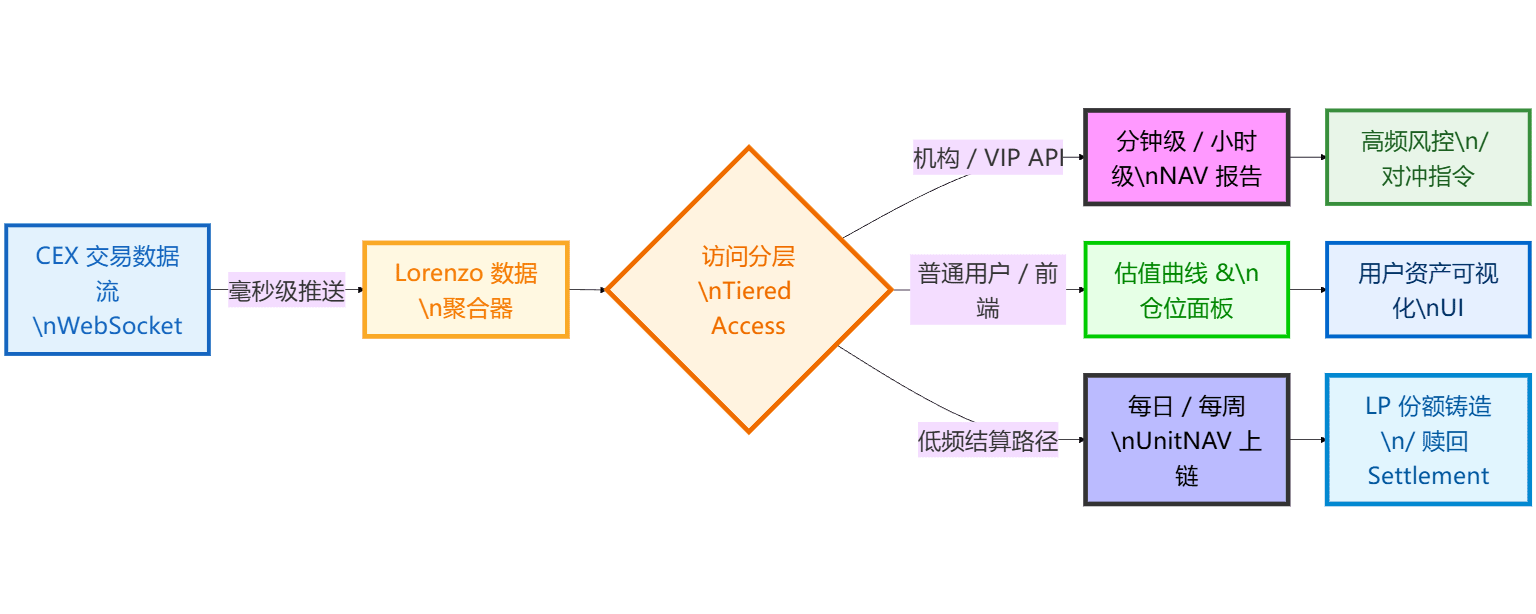
Several key points:
Data layer (A → B):
Lorenzo does not create its own market but aggregates prices, depths, and transaction volumes from multiple CEXs and on-chain DEXs, performs weighting and outlier removal to obtain 'strategy usable prices'.Access control layer (C):
Slicing the same NAV curve at different frequencies,
Institutions receive 'raw streams', ordinary users receive 'downsampled results', and on-chain contracts are only read once during the settlement window.Settlement layer (F → I):
Only when UnitNAV is confirmed and on-chain does the minting and redemption of LP tokens occur, resulting in real asset transfers—High frequency is information, low frequency is settlement.
The essence of this architecture is to insert a programmable buffer zone between the 'information layer' and 'settlement layer':
To make information as fast as possible and asset movement as stable as possible.
How does speed translate into yield, defense, and narrative premium?
From the results, Lorenzo's NAV engine has directly improved three things: yield, security, and narrative premium.
For institutions - losing less means earning more
Each Vault's drawdown and volatility can be tracked hourly, rather than retrospectively;
In extreme market conditions (e.g., a flash crash of BTC), using hourly NAV for risk control effectively breaks 'a full-day line' into '24 monitoring points',
Even a 2-3% reduction in intraday drawdown translates to hundreds of thousands of dollars in real cash at a billion-dollar fund scale.
For retail - visible drawdowns are more important than false security
Traditional DeFi strategies show you static TVL on the day of a crash, only updating the next day to inform you 'yesterday lost 18%';
Lorenzo will at least use a declining NAV line on today's chart to tell you:
'Yes, it's a loss, but still alive, and you can see where the position is at a glance.'
Such 'visible losses' can alleviate panic-style redemptions because you will no longer imagine everything as the worst-case scenario.
For protocols and BANK - data services themselves represent a new revenue line
Institutions are willing to pay service fees for high-frequency NAV; this income will ultimately flow into the protocol treasury, repurchasing BANK or supplementing the insurance pool according to established rules;
The result is: you are not just betting on whether strategies make money, but buying a 'cash flow pipeline' that provides data infrastructure for TradFi protocols and BTCFi products.
In other words, Lorenzo has turned 'transparency' into a commodity that can be sold and priced, rather than a free gift.
Those who need higher frequency and more dimensional data pay more, voting with their feet to promote protocol development.
Time is an asset: who is Lorenzo helping to reclaim time dividends?
The one sentence that this F0XX wants to clarify is:
On Lorenzo, speed is still a class, but for the first time it is written as public protocol parameters, rather than being locked in the black box of fund managers.
For institutions,hourly NAVis a necessity for risk control and position management,
They pay for the option to 'die a little less in extreme market conditions';For retail, 'near real-time valuation + daily settlement' is already a huge upgrade over traditional DeFi,
At least they will no longer be forced to follow the herd in an information black box.
Lorenzo does not pretend to have everyone on the same starting line; what it does is something more realistic:
Pull the information flow from T+1 to T+0;
Make 'who knows more' from a secret into a public term written in documents and API price lists;
Then partially distribute the toll rights of this information highway through BANK, a value black hole, to those who truly bet on the protocol for the long term.
Next time you refresh NAV, you might as well ask yourself:
"Is this net value line yesterday's history or a real-time ECG?"
In a world where time is an asset, those who see it earlier always have one more choice—
And Lorenzo is slowly taking this 'knowing a few hours earlier' right from a few hands and turning it into a financial service that anyone can purchase.@Lorenzo Protocol #LorenzoProtocol $BANK


