
Following yesterday's article, this piece focuses on the investment logic of the Polkadot ecosystem VC firm Scytale Digital and an introduction to the projects recently invested in by Harbor Industrial Capital, as well as the opportunities that will arise after the launch of Polkadot Hub!
Continue reading!
Projects that truly solve real-world needs must possess actionable commercial value
Dave: Mark, let's discuss the companies you are currently investing in. From your perspective, which directions, whether in infrastructure, application layer, or user reach and distribution, hold more opportunities at this stage?
Mark: I believe there is only one core theme this year, which is two words: revenue generation. Projects that can truly generate income mean they create real value and have the ability to capture that value—this is precisely what many projects in the current crypto industry are missing. We have clearly seen the market accelerating its differentiation.
Look at projects like Solana and Hyperliquid; the reason they can achieve such strong performance is fundamentally due to their sustainable real income, and this income can be returned to token holders. In contrast, many projects do not have such fundamentals, making it naturally difficult to support long-term value.
The project Acurast that we invested in within the Polkadot ecosystem is a very typical and noteworthy case. Acurast is about to welcome its TGE and is building a 'decentralized virtual data center' based on mobile security chips, with geographic positioning capabilities, completely decentralized features, and very broad application scenarios. The team is very satisfied with the technology stack provided by Polkadot and has fully leveraged its advantages.
Without revealing too many details, what I can share is that they have signed an MOU with a government of a certain country. This country is required by policy to achieve 'data localization,' but does not have sufficient data center infrastructure, and Acurast's solution happens to address this reality. It is expected that relevant information will be made public in the coming weeks after the formal contract is signed.
This precisely illustrates one point: blockchain-enabled products, as long as they truly address real needs, must have viable commercial value; otherwise, such cooperation could not possibly occur.
Now let's look at Polkadot's native token DOT. As Max just mentioned, the issuance pace and staking rewards of DOT will gradually be capped in the future, and the inflation rate will significantly decrease. At the same time, more and more applications and ecosystem projects will begin to use DOT directly. This means that on one side, demand continues to grow, while on the other side, supply is being strictly constrained.
So, although DOT is not performing well in the market currently, from a fundamental perspective, it still has considerable upside potential. This is why DOT holds an important position in our investment portfolio.
Why HIC invests in RWA projects Joinn
Christian: Very exciting. Next, I would like to invite Max to share further. I know you have recently invested in or are very optimistic about a project called Joinn. Can you discuss from the product perspective why you are optimistic about it?
Max: Of course, and thank you for mentioning this project. Today we are in Buenos Aires, and being able to announce our latest investment in the local company Joinn in the Latin American region is of great significance to us. In fact, the founder of Joinn, Leo, is sitting here, and their co-founder team is also present. They will later come on stage to communicate with Dave, so I won’t go into too many business details today.
But what I can share is that the reason we are very optimistic about Joinn is very clear: they are a team deeply engaged in the Latin American market focused on the 'distribution end'—specifically, how to truly push quality real-world assets to the market.
In my view, distribution is the most undervalued yet crucial link in the RWA track.
The long-term potential of RWA is almost self-evident. I believe that in the future, stocks, bonds, commodities, receivables, artwork, and real estate will gradually be tokenized. This is a very large real market, unlike meme coins or some NFT projects, RWA has solid real value support behind it.
In the Latin American region, on one hand, the availability of quality financial products remains limited, making it difficult for ordinary people to access high-quality assets; on the other hand, there are also many local financial products with highly attractive yields. Just like the example we discussed yesterday—the sovereign bonds of Ecuador currently have an annualized yield of up to 20%. For an issuer with relatively stable credit status, this is a very attractive return level.
If we can put these types of assets on-chain, tokenize the returns, and allow ordinary investors to participate through just one app, that would be a real and large-scale market opportunity. Joinn is doing just that.
This business logic is not complicated, but it is feasible and has been repeatedly validated by the market. That is why we are very fond of projects with clear logic, defined business models, and clear paths to revenue and profit expectations. Once we decide to invest, we typically choose to increase allocations to deeply participate and fully support project growth.
In fact, today there are several companies from our investment portfolio on site, such as Mandala Chain from Indonesia—we are one of their leading investors, and they maintain a very close partnership with the local government; in addition, there is also Kylix Finance, which is present. These are all projects we are optimistic about in the long term and are advancing alongside.
When the market only looks at BTC and ETH, what Polkadot needs to do is to stay at the table.
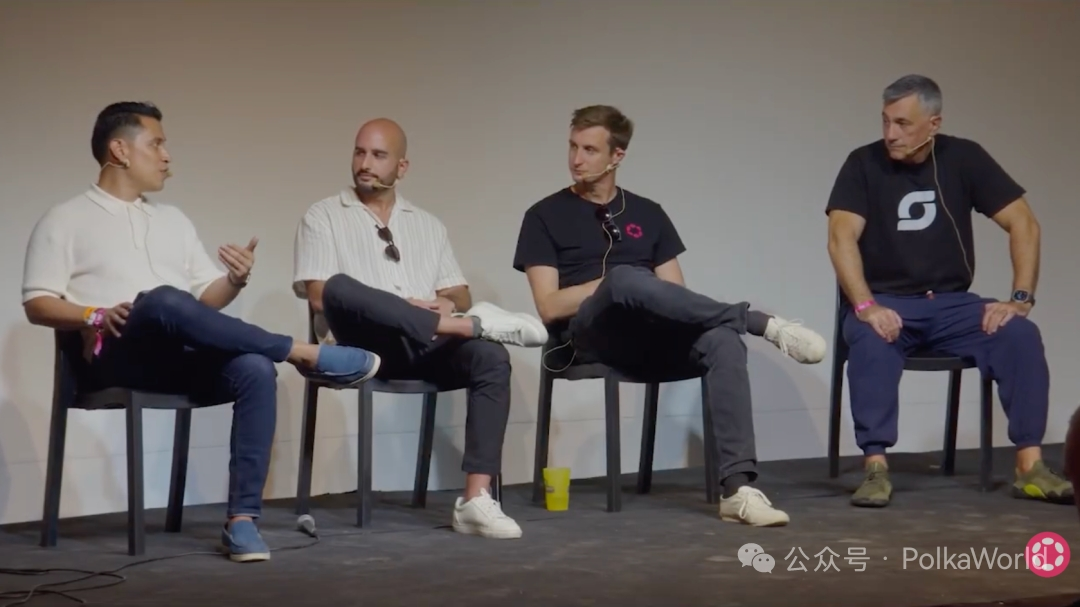
Christian: Dave, you recently led a new project focused on capital markets, frequently communicating with institutional investors, companies, and financial institutions. I would like to ask you to share: what is the real feedback you are hearing from these institutions? What are their most urgent needs right now? What kind of solutions are they looking for? And in these key concerns, how can Polkadot create value for them?
Dave: In my view, the entire industry is still in a 'education-first' phase. Even today, getting more people to expand their understanding from Bitcoin to Ethereum still requires considerable effort. We must repeatedly clarify to the market: what problems do these underlying protocols solve? What are their respective value propositions? From a long-term investment perspective, what returns can they bring to investors? This itself requires a systematic sorting process.
Therefore, one of our core strategies for external communication is to simplify the narrative—clearly positioning Polkadot as an infrastructure-based public chain. As everyone knows, Gavin and the Parity team have completed the construction of the underlying technology, and we are now in a critical phase: promoting scalable applications on top of this technology. The parallel chain architecture of Polkadot has significant advantages in throughput capacity, transaction processing speed, and development tools, but frankly speaking, its potential has still not been fully realized.
If we zoom out a bit, we find that the existing internet technology system itself is gradually showing bottlenecks. I believe that in the next five years or so, the entire industry will undergo a significant technological transformation, but at the same time, this transformation will also come with new entry barriers. So the question arises: if investors want to include digital assets in their asset allocation, how should they participate?
There is a very well-known financial advisor in the United States, Rick Edelman, who was one of the first to suggest that investors allocate 5% of their retirement assets to crypto assets; now he has even raised that proportion to 20%. But the question that arises is: how should this crypto asset portfolio be constructed? Naturally, it can include 'digital gold' like Bitcoin, and platform assets like Ethereum. But beyond that, projects like Polkadot, which are positioned as infrastructure public chains aimed at the 'next generation of the internet,' also possess strong appeal—only they need a longer-term, more systematic narrative framework to be understood by the market.
In this narrative, Polkadot undoubtedly plays a very critical role. So what we are doing now is actively participating in industry dialogue and continuously conveying three messages to the market: where we come from, what stage we are currently in, and through what paths the market can participate.
Whether through venture capital funds like HIC and Scytale indirectly investing in the Polkadot ecosystem, holding index products that include Polkadot weights, or future DOT ETFs that may emerge and simultaneously capture staking yields, these methods allow investors to gain returns while participating in network security maintenance. Looking further ahead, as the market matures, there may also be opportunities to allocate funds to Polkadot-based DeFi strategies through different fund managers to generate returns—of course, the entire industry has not yet fully reached that point.
At this stage, the market's attention is more focused on Bitcoin and Ethereum. But what we must do is to always stay at the table, ensuring that when the market's vision further opens up, Polkadot will undoubtedly become an option that cannot be ignored and is worth serious consideration.
Hub is driving Polkadot towards a more mainstream and user-friendly form.
Christian: We all know that Polkadot Hub will soon introduce EVM compatibility. What are your thoughts on this change? What new opportunities do you think it will open up for founders, funders, and venture capital firms in the Polkadot ecosystem?
Mark: I believe this will bring about a truly 'layer-level' transformation. Frankly speaking, based on our past experience in engaging and trying to invest in Polkadot ecosystem teams, this process has not always been smooth. But when the discussion turns to EVM compatibility, especially implementations that outperform existing EVMs, the whole story becomes very attractive.
I have learned that the Parity, Web3 Foundation, and Velocity Labs teams are closely collaborating to advance various integration tasks, aiming to introduce sufficient liquidity when Hub goes live. This is crucial: it will not only inject new momentum into DOT itself and the entire Polkadot ecosystem but also pave the way for the subsequent more disruptive JAM upgrade—though we currently cannot determine the specific launch time of JAM.
From a more macro perspective, Hub is driving Polkadot towards a more mainstream and user-friendly form. This is precisely the core shortcoming faced by the ecosystem in the past: strong technical capability, but too high a threshold for use and complexity of experience. This 'experience gap' has long constrained the expansion of the ecosystem, and the goal of Hub is to systematically eliminate this barrier.
Max: Yes, I completely agree with Mark's judgment. We are very optimistic about the Hub platform itself and view it as the core direction for Polkadot's future development. Currently, we are encouraging projects in our portfolio to formulate long-term strategies around Hub. As Mark mentioned, Polkadot is currently undergoing a critical transformation. Gavin also clearly stated in his speech today that Parity will more internally create user-facing products, which I believe is an extremely positive signal and indicates that Parity is continuing to take on the role of ecosystem leader. I am very confident in Gavin and the entire team's execution.
At the same time, a large number of third-party developers are still actively building very high-quality products within the ecosystem. The key question is: how to provide appropriate support for these teams so that they can fully leverage the core technological capabilities provided by Parity (e.g., personality proof and other infrastructures) without directly competing with Parity's self-developed products.
From a venture capital perspective, we are promoting a new attempt within the Polkadot ecosystem, which I call the 'VC Bounty' model. Its core logic is to gradually weaken the traditional no-return funding mechanism. In the past, Polkadot provided a large amount of funding through the treasury; although some successful cases did emerge, the overall effect was mixed and caused quite a bit of controversy. Our view is that when ecosystem funds are used to support project construction, the treasury should receive corresponding equity or project rights. I don't see this as a radical proposal; in fact, almost all mainstream ecosystem funds are adopting similar practices—using ecosystem funds to support projects while sharing in their growth returns.
In the past, the difficulty of implementing this model was largely due to the immaturity of the relevant financial and governance infrastructure. But now, we are working hard to fill these gaps. If anyone is interested in this model, feel free to reach out to me for in-depth discussions. In the long run, this mechanism can help builders obtain sustained funding support and ensure that the Polkadot treasury shares in the upside when projects succeed, creating a true virtuous cycle.
Dave: I fully agree with the views of the previous two speakers and would like to add a few points. First of all, the EVM-compatible Polkadot Hub will significantly lower the barriers for developers to enter the ecosystem while making it easier for external liquidity to migrate in. Today, blockchain industry liquidity is highly concentrated in a few leading protocols, but in my view, these protocols generally lack a true long-term strategic perspective.
Therefore, we need to proactively collaborate with some key projects—whether they are cross-chain bridges or DeFi protocols. Although we believe that Hydration is already one of the top DEXs currently, we must acknowledge that many institutional investors managing large-scale funds are already accustomed to using specific trading and lending tools and will not easily migrate in the short term.
This is precisely the value of Hub: we need to bring these 'tools that users are already familiar with' into Polkadot's unified entry. Whether trading on MorphoVault or Uniswap V3, experiencing chain games in projects like Mythical, or achieving cross-chain interoperability through Hydration's GigaDOT protocol, Hub should become a smooth and natural channel, allowing users to directly feel the value of the Polkadot ecosystem without needing to understand the complex underlying architecture.
Ultimately, the convenience of entry and the introduction of liquidity are key to ecosystem expansion. And achieving this goal is precisely the direction we are all working towards today.
Christian: Thank you all for your wonderful sharing. Finally, I would like to once again express my gratitude to each guest on stage for openly sharing their investment missions, core philosophies, and their firm confidence in the future of the Polkadot ecosystem.
Original video: https://www.youtube.com/watch?v=_ifwuQXAwN4&t=10s
PolkaWorld Telegram Group: https://t.me/+z7BUktDraU1mNWE1
PolkaWorld Youtube Channel:
https://www.youtube.com/c/PolkaWorld
PolkaWorld Twitter:
@polkaworld_org


