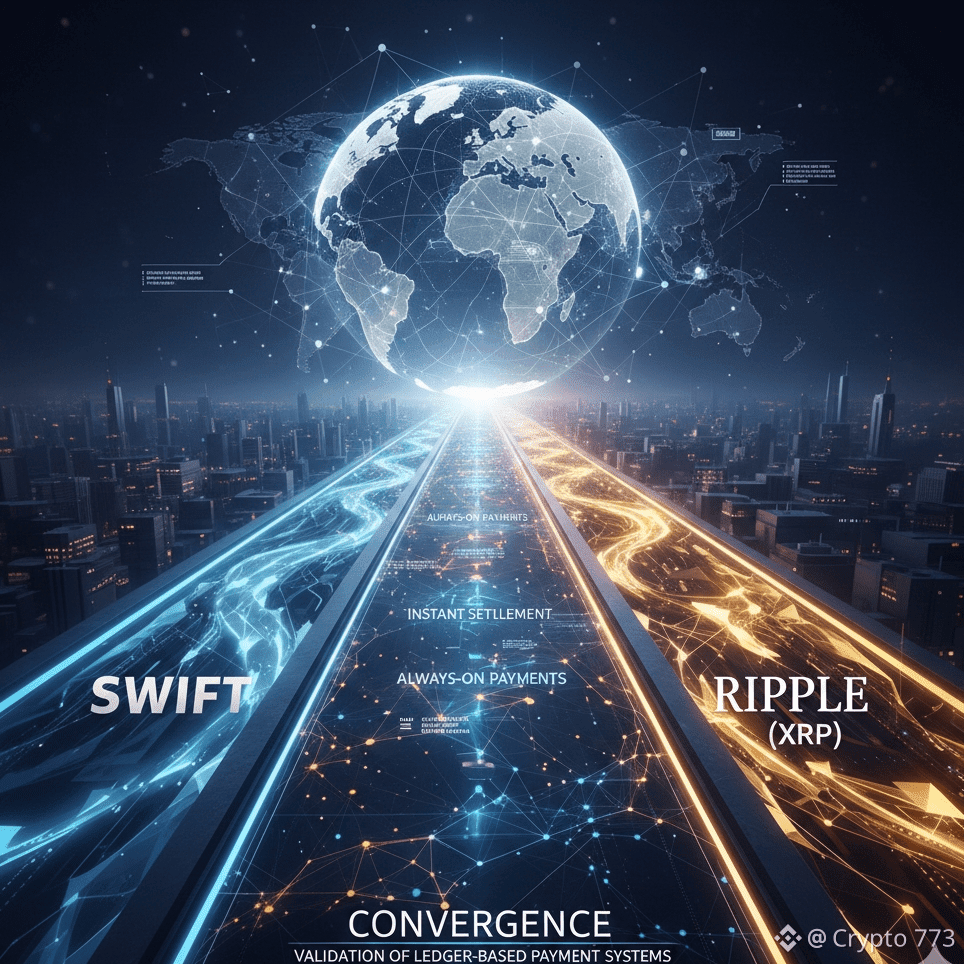
The global financial messaging cooperative, SWIFT, is reportedly re-evaluating the foundational elements of its payment infrastructure, a move that parallels the long-established design principles of Ripple (XRP), according to analysis by crypto commentator Chain Cartel.
The Core Shift in SWIFT's Narrative
SWIFT's recent public discourse has shifted its focus from merely secure financial messaging toward key concepts defining modern cross-border payments:
Shared, Real-Time Ledger: Establishing a single, synchronized source of truth for transactions.
Instant Settlement: Achieving finality of funds in real-time.
Always-On Payments: Ensuring continuous, 24/7/365 operational capability.
Chain Cartel argues that this terminology signifies a structural transformation rather than a standard technological upgrade. The described architecture is institutional, prioritizing reliability, finality, and interoperability for its banking network.
Convergence with Ripple's Framework
These newly articulated design principles are seen as remarkably consistent with the framework Ripple has spent over a decade developing. This framework centers on a neutral settlement layer that facilitates real-time finality for financial institutions while integrating seamlessly with existing infrastructure.
The emphasis on liquidity efficiency and operational certainty distinguishes this architecture from speculative public blockchain networks. The model is distinctly institutional, built to support continuous, high-volume operation.
SWIFT's Move Toward the Settlement Layer
A critical development is SWIFT's confirmed plan to directly integrate a blockchain-based ledger into its core infrastructure. This represents a significant evolution of its traditional role. Historically, SWIFT functioned purely as a messaging service, coordinating payments but leaving the actual settlement to external systems.
By adopting a shared ledger, SWIFT is now moving closer to becoming a settlement facilitator. This is interpreted as an acknowledgment that the legacy model of message transmission alone is no longer adequate to meet the demands of global real-time payments.
Validation, Not Competition
Chain Cartel frames this development not as a competitive threat to Ripple, but as a convergence of models. Both systems are ultimately designed to enhance the functionality of existing banks and payment rails. When technical specifications are examined without branding, the core objectives are remarkably similar.
The broader implication is that legacy financial infrastructure adapts by validating proven solutions through replication and subsequent integration. SWIFT's evolving strategy is thus seen as a major institutional endorsement of the ledger-based payment system model.
The post concludes that the market may not yet fully appreciate the significance of this alignment, but the technical and strategic direction toward a validated, ledger-based settlement system is clear.#Xrp🔥🔥 #USJobsData #WriteToEarnUpgrade