
APRO (AT) In the past few months, it has moved from the Bitcoin ecosystem to BNB Chain, and then to various exchanges and Binance event pages. Many people's first reaction is simply - “Another new narrative for oracles.” But if you extend the timeline a bit, you will find that the window period in 2025 is very strange: on one hand, protocols like EigenLayer are stacking TVL to tens of billions of dollars, and Oracle AVS is becoming a new hot spot; on the other hand, price oracles are directly named as one of the top risks in smart contracts by official security standards, and the chapter on Oracles in security reports is getting thicker and thicker.
For DeFi, RWA, BTCFi, and even AI Agents, oracles are no longer just "price-reading APIs," but rather the lifeline of the entire system. The problem is that most protocols today still understand oracles as simply "choosing a big name + feeding multiple sources + implementing a TWAP/TVWAP algorithm," resulting in a basic security model of a single-layer network + simple slashing, with extremely blurred boundaries of responsibility.
APRO's goal is straightforward: during this restaking frenzy and period of frequent oracle attacks, to upgrade Oracle security from a "technical parameter" to a "network service with a responsible chain of operations." The first layer consists of APRO's own OCMP node network responsible for data collection and aggregation. The second layer, directly connected to the EigenLayer, acts as an arbitrator and safety net, ensuring that high-risk data such as prices, RWA proof-of-reserves, and AI outputs are backed by a clear economic responsibility curve.
APRO: Rewriting the "Security Budget" in a Year of High Oracle Attack Incidence
In recent years, people have become desensitized to the term "oracle attack": from early price manipulation using flash loans combined with low-liquidity pools, to later arbitrage scripts specifically targeting oracle quotes, single events can easily involve tens of millions of dollars. The security community has even directly included Price Oracle Manipulation in the latest version of the key risk list for smart contract security, officially upgrading oracles from an "external dependency" to one of the core attack surfaces of the system.
Even more brutally, most projects' security budgets for Oracle are essentially decided on a whim: either using the "cheapest solution" or simply following the "industry default option." How to select nodes? How to screen data sources? Who has the authority to make decisions in extreme market conditions? Who bears the responsibility for incorrect pricing? These questions have hardly been seriously answered in past designs, resulting in the protocol thinking it has "already used a top oracle," while users still bear a large portion of the tail risk.
APRO's approach is to break down the problem: the truly fatal flaw isn't "a single price feed algorithm error," but rather "no one having a clear accountability loop for this error." Therefore, APRO didn't design its architecture as a single-layer network from the beginning, but explicitly made the oracle a "two-layer responsibility network":
The first layer consists of APRO's own OCMP node network, which is responsible for multi-source data collection, signing, and aggregation, running on multiple chains, multiple assets, and multiple scenarios.
The second layer uses EigenLayer as the "judgment and safety net," using the re-staking ETH security budget to support fraud validation in extreme cases, so that the "cost of error" is not only to cut node deposits, but can directly reach a higher level of security capital.
For DeFi protocols, this means one thing: when you choose APRO, when extreme market conditions, abnormal calls, or suspected attacks occur, there is not only a price feed logic behind it, but also a whole economic chain that can be traced back to the source, rather than relying on vague intuition such as "believing that nodes are afraid of being slashed".
More importantly, APRO wasn't just about providing price feeds for the EVM from the beginning. Instead, it designed its product matrix around three of the most promising sectors for the next few years: the Bitcoin ecosystem, RWA, and AI. From BTC L1/L2 to Ordinals, Runes, RGB++, Lightning Network, and multi-chain environments like EVM and TON, it unifies and abstracts "multi-source, multi-chain, and multi-format data" into a verifiable Oracle service. This explains why you see institutions like Polychain and Franklin Templeton, who work in both Crypto and TradFi, on APRO's funding list. They prioritize "responsibility structure" and "compliance narrative" over the accuracy of a simple price feed.
How does APRO's two-layer network, OCMP + EigenLayer, separate and distribute risks?
APRO Data Path: From the Real World, to OCMP, and then to On-Chain
First, break down the APRO data path in a language that traders can understand.
1. Real-world data sources
Prices, indices, reserve reports, company financial statements, liquidation events, and even AI model outputs are first standardized into structured/semi-structured data through APRO's adaptation layer.
2. OCMP Node Network Aggregation
Multiple independent nodes each pull data from different sources, sign it locally, and then perform a "P2P reconciliation + consensus" off-chain via OCMP (Off-Chain Message Protocol) to turn the original data into a signed aggregated result package.
3. APRO Aggregator Decision
- For scenarios like DeFi lending and stablecoins where "the latest price must be recorded," use Data Push:
Based on the deviation threshold and heartbeat interval, the new price is automatically written into the on-chain Aggregator contract;
- For scenarios like derivatives trading and quantitative strategies where latency and cost are more critical, use Data Pull:
The latest data is only fetched from the network when there is a request, reducing invalid writes.
4. On-chain consumption + PoR reporting
Price data enters APRO contracts on various chains and is consumed by lending protocols, DEXs, derivatives, insurance, liquidation robots, etc.
The PoR report writes the complete report hash on the blockchain, and the full text is stored in decentralized storage, making it convenient for the protocol and auditors to review at any time.
A simple structural diagram would be more intuitive:
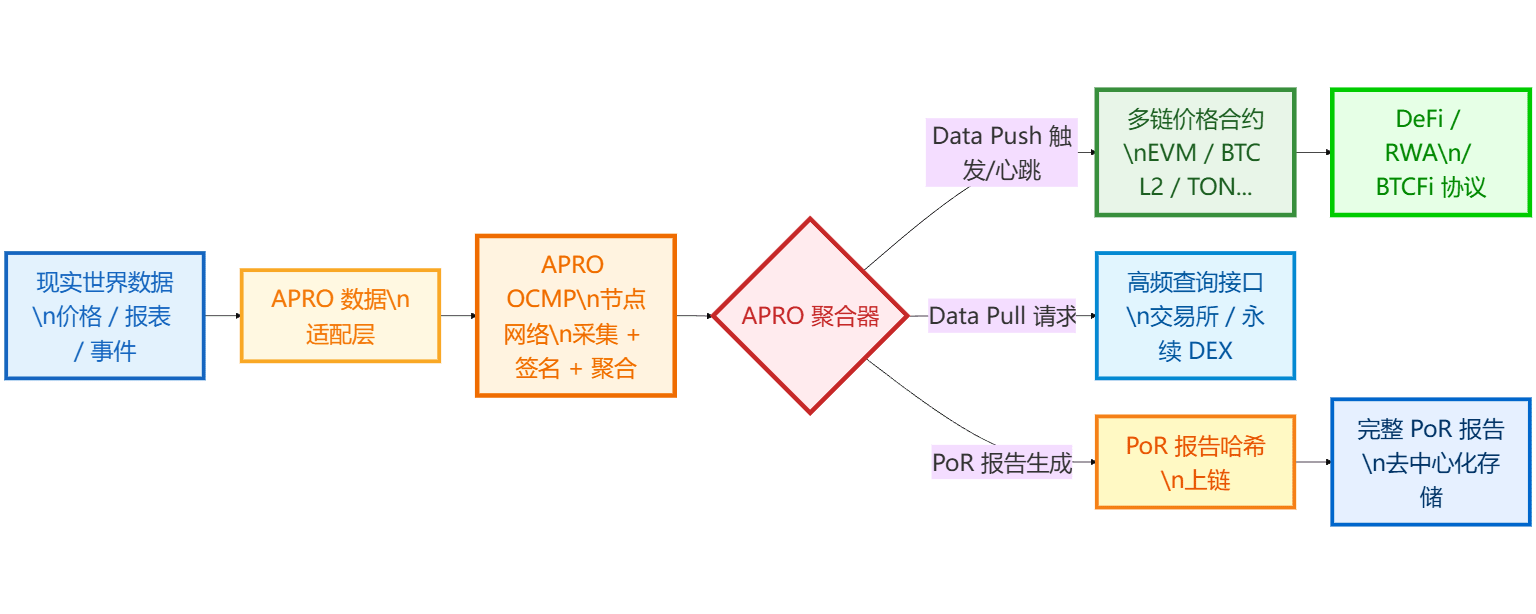
This process has two key points:
The data is first signed and aggregated off-chain before being written to the chain, to avoid everything piling up on the chain, which would cause delays and gas explosions.
APRO itself is only the first layer of the network; the real power of "last resort arbitration" is given to the second layer, EigenLayer.
APRO × EigenLayer: Putting the power of adjudication behind re-collateralized assets
APRO's second-layer network is essentially an "arbitration layer with a security budget".
Layer 1 OCMP network:
Nodes stake assets such as AT/ETH and are responsible for data collection and aggregation under normal circumstances. They monitor and report each other to ensure that the network can self-repair most of the time.Second layer: EigenLayer AVS:
When a serious disagreement arises between the customer and the APRO aggregator, or when a large-scale anomaly occurs between nodes (such as widespread pricing errors or latency exceeding thresholds), the dispute will be escalated to the EigenLayer's AVS Operator.
These operators use the re-staking ETH security budget to make the final decision—who is lying and who gets penalized.Challenge Mechanism:
Not only can nodes be reported, but users can also launch challenges by staking a deposit. If the challenge succeeds, the malicious node is slashed, and the challenger receives a reward; if the challenge fails, the challenger's deposit is forfeited. The significance of this design layer is:
Turn "finding errors" into a business with positive expectations, rather than relying on well-intentioned white hats.
With TVL restaking already reaching billions of dollars and EigenLayer becoming one of the default security layers, attaching APRO's arbitration layer to EigenLayer has several practical implications:
Oracle is no longer "the project's own little circle," but directly borrows the entire network's restaking security budget;
The cost of most bribery attacks has been increased to "bribing the entire AVS Operator", rather than simply bribing a few nodes;
The pricing of oracle risk is beginning to truly integrate with the restaking sector, rather than being confined to the internal models of a few oracle networks.
APRO's Push/Pull/PoR/AI: Breaking down different risks into different pipelines
In its product matrix, APRO actually breaks down data on "different risks/delays/compliance requirements" into four pipelines:
APRO Data Push: A "high-priority channel" for DeFi liquidation chains.
Suitable for scenarios such as lending, stablecoins, and collateral pools where a mispricing could lead to a chain of liquidations;
By controlling the write frequency through a deviation threshold and a heartbeat mechanism, a balance is struck between "avoiding excessive gas consumption" and "ensuring timely and sufficient pricing."
It can be combined with algorithms such as TVWAP to reduce noise in extreme market conditions, minimizing the impact of single-point matching anomalies.
APRO Data Pull: An "On-Demand Channel" for Derivatives and High-Frequency Trading
Derivatives, perpetual DEXs, and market-making robots are more concerned with millisecond-level latency and cost limits;
In Pull mode, data is only pulled from the network when it is called, and no unnecessary writes are made to the chain;
For developers, this is more like using a "verifiable data API gateway" rather than an oracle contract that is strongly tied to a particular chain.
APRO PoR: A "proof of reserves gateway" for RWAs and custodians.
Traditional Proof-of-Record (PoR) often stops at "generating a PDF audit report + some on-chain signing," making it almost impossible for ordinary users to verify the details;
APRO breaks down the PoR report into "report hash + report content + query interface", allowing DeFi protocols to call, verify, and trace back by field;
For RWA projects that issue dollar funds, government bonds, and commodity ETFs, this is equivalent to having an additional "machine-readable audit interface".
APRO AI Oracle: A "Cognitive Gateway" for AI Agents
When the AI agent needs to process unstructured data (legal terms, financial reports, regulatory notices, on-chain behavior patterns), APRO's AI layer can first perform parsing and judgment, and then output the results as an Oracle.
More importantly, these AI outputs are not "black box judgments," but can be linked to verification paths and dispute resolution mechanisms—who gave this conclusion? What model was used? On what data was it trained? Who compensates if it's wrong?
From a top-down perspective, these four pipes and the "two-layer network" overlap to form a very clear risk control network:
Delay, frequency, compliance level, and audit difficulty are no longer tied to the same set of parameters, but have become a "risk combination" that the parties to the agreement can actively choose.
APRO's Triple Impact on DeFi / RWA / BTCFi
APRO's Correction to DeFi Liquidation Chains
Many DeFi vulnerabilities of the past few years are essentially the result of "taking oracles for granted":
Some were reading prices on pools with extremely thin liquidity, and someone used a flash loan to swipe at an extreme point;
In some extreme market conditions, the oracle update is delayed by a few seconds, causing the liquidation robots to make collective misjudgments;
Others have sacrificed themselves by misusing data from testnets or incorrect sources.
In this environment, the first change brought about by APRO is that it makes the "oracle security budget" visible on the blockchain:
You can see directly how many nodes are behind this price feed and how much AT/ETH has been staked;
You can check whether it is connected to the EigenLayer arbitration layer, and whether it has challenge records and historical ruling data;
As you know, in extreme market conditions, if Oracle behaves abnormally, is there a sufficiently strong economic incentive mechanism to challenge it?
This transparency is crucial for protocols that are sensitive to liquidation. It means you can actually incorporate the "probability of oracle failure" into your risk model, rather than treating it as an abstract constant.
APRO complements the RWA and PoR narratives
RWA's biggest pain point in the past two years is:
On-chain assets are becoming more and more like "traditional finance," but off-chain proof of reserves is still very much like Web2—PDF reports, annual audits, and quarterly updates, which are difficult for ordinary users to even understand, let alone verify field by field.
What APRO does in the PoR field can be understood as a "three-step upgrade":
Transform PoR reports into machine-readable data interfaces, rather than human-only documents;
Write the report hash and key fields onto the blockchain so that the liquidation logic can directly depend on these fields;
Make information such as "who signed this report", "when it was updated", and "whether it has expired" searchable, instead of hiding it in the footnote.
At this level, APRO is more like turning the "audit story" of the RWA project into rules written into smart contracts, allowing liquidation and risk control to truly be "based on facts, not on press releases." For projects that plan to bring US stocks, Treasury bonds, commodities, and even real estate indices onto the blockchain, this link will become increasingly essential.
APRO's pivotal role in BTCFi + AI Agent
The Bitcoin ecosystem is currently experiencing a "feature explosion":
On L1, Ordinals and Runes have engraved their assets and artwork into UTXOs;
L2 uses various BTC Rollups and sidechains to build up smart contract capabilities;
Lightning Network, RGB/RGB++, and cross-chain bridges are attempting to truly "flow" these assets.
The problem is—it all boils down to one simple question: "How much is this Bitcoin asset worth right now?"
APRO incorporates Bitcoin L1/L2, Runes, Lightning Network, RGB++ and other modules into its oracle coverage, essentially paving a "trustworthy price highway" for the new world of BTCFi, avoiding the need for each project to maintain a bunch of fragile price feed scripts.
On the other hand, the AI Agent narrative is also on the rise: everyone is talking about "letting AI do trading," "letting AI run strategies," and "letting AI manage funds," but few people have seriously answered the question—is the market and event data used by these agents really credible?
APRO's AI Oracle and multi-source verification mechanism are actually filling this gap in the Agent economy:
AI can read verified prices, events, and PoR reports through APRO;
APRO can also serve as an "Oracle output by AI," writing the Agent's judgments onto the blockchain and providing dispute resolution and accountability.
The ultimate result is to upgrade "trusting a certain AI trading robot" to "trusting a cognitive network that has verification, arbitration, and economic penalties."
If we consider BTCFi and AI Agent as the two main tracks for the next few years, then APRO is clearly trying to position itself at the intersection of these two tracks, acting as a central hub that "understands both on-chain and data, and can also access restaking security budgets".
APRO/AT's cycle position and my perspective on this track
Going back to the original question:
With EigenLayer TVL soaring and oracle attacks being highlighted by official security standards at the end of 2025, where exactly does APRO/AT stand?
My assessment is that APRO is neither a pure meme that ignites a wave of emotions with a single buzzword, nor has it reached the stage of "becoming the default option for infrastructure." Rather, it is more like a lever that pushes the concept of "oracle responsibility" to the forefront.
If I were to consider APRO/AT as a long-term investment target, I would keep an eye on a few things:
Does APRO's multi-chain and multi-asset coverage continue to expand?:
It's not just about quantity, but more importantly, about the quality of the DeFi/RWA/BTCFi protocols that actually connect to it—whether they are escrowing real money, or just generating TVL through fraudulent means.Is the EigenLayer arbitration layer truly being used?:
Are there real-world challenge cases? Are there records of being slashed? These data are the evidence that the "responsibility structure" has been implemented.Are PoR and AI Oracle products creating a positive feedback loop within the institutional and agent ecosystems?:
How many RWA projects choose to use APRO's PoR interface? How many agent/transaction systems are willing to upload their output to APRO for others to verify?Do APRO/AT's token incentives and security budget match?:
In the oracle race, the ultimate competition is about "how much you pay for security," not "how well you tell a story." If APRO wants to establish a truly moat-like defense in the Oracle landscape, it must continuously invest more economic value in its two-layer network and arbitration mechanism.
This is not the kind of "get rich overnight" narrative, but rather a long-term experiment that slowly stitches together fragments such as AI, restaking, BTCFi, and RWA with responsibility and verification rules.
In the next cycle, if your focus is on "the oracle opportunity not transforming from a data tool into a true network of responsibility," then the APRO and AT line is at least worth keeping on your watchlist and reviewing from time to time for a systematic analysis—because what truly determines victory or defeat is not the next candlestick, but how far APRO has progressed in implementing this responsibility structure.



