
This wave of hotspots in 2025 feels a bit familiar:
On one side, restaking + EigenLayer turns the 'security budget' into a new asset; on the other side, AI Agent, RWA, BTCFi, and prediction markets are pushing on-chain demand to the ceiling. On the surface, it seems like four different narratives, but they are all stuck in the same bottleneck - either you trust the data, or the entire strategy is wasted.
The reality is that for most protocols, choosing an oracle today is still quite rough:
"Who to borrow from?" - Raising a hand is the old brand.
"Who to use for futures?" - Just copy the competitors.
"Who to find for RWA PoR?" - As long as it can output PDF, that's fine.
Almost no one treats Oracle as a business of "selling different products to different clients."
APRO/AT has been pushed back into the spotlight this round, partly because keywords like "AI Oracle + ATTPs + BTCFi + prediction markets" are good for riding the wave; but the more fundamental change is that—APRO has broken the oracle into several different business lines and then precisely sold them to five completely different client groups:
DeFi protocols, RWA projects, BTCFi, AI Agent ecosystems, and traditional institutions. (JuCoin)
This article will no longer discuss "APRO vs Chainlink / vs Pyth," nor talk about technical selection clichés, but will analyze APRO's layout from the perspective of "how this business earns safety money."
APRO: Breaks the oracle into "multi-business line" security services
What is the narrative of traditional Oracles?
"We are more decentralized"
"We have lower latency"
"We provide more accurate pricing"
It all sounds right, but for each specific client, it is not detailed enough. Lending protocols need "liquidation without explosion," RWA needs "the audit lawyer's nod," AI Agents need "truth that machines can understand," BTCFi needs "Bitcoin's chain to also have usable price language," and institutions want "compliance reports + accountable responsibility chains."
APRO's approach is more like a company that packages security services:
First, unify the technical foundation—a two-layer structure of off-chain computation + on-chain verification; (JuCoin)
Then, based on scenarios, break out different product lines: Data Push, Data Pull, RWA PoR, AI Oracle + ATTPs; (docs.apro.com)
Finally, target different client groups to discuss integration, fees, and safety budgets.
Simply draw a relationship map, and it looks like this:
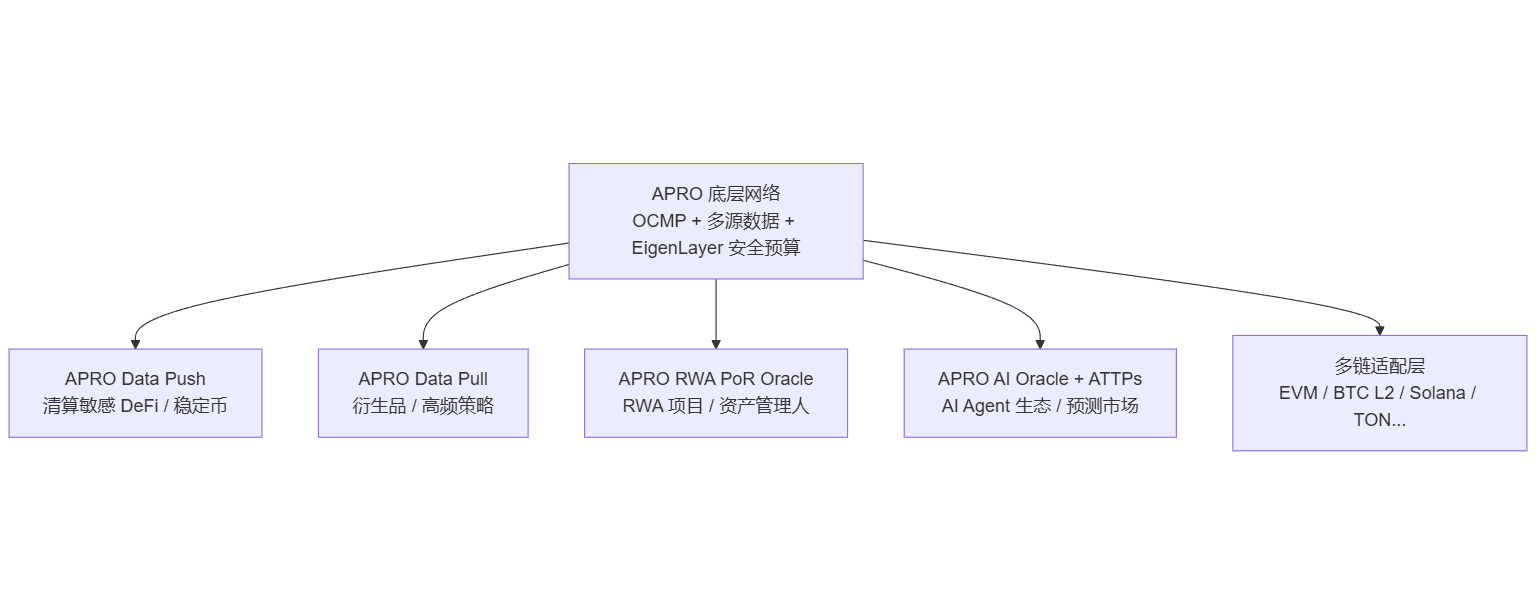
The key difference is:
APRO does not only sell "price feeding," but rather customizes products by separating risk and responsibility—who is most sensitive to delay, who is most sensitive to compliance, who is most sensitive to interpretability, and provides them with different Oracles.
APRO's product matrix: four lines serving five types of clients
APRO Data Push: A "mandatory safety valve" for DeFi / stablecoins
For lending protocols, stablecoin protocols, and liquidation robots, APRO Data Push is the main course they genuinely care about:
Core logic:
When prices deviate from set thresholds, or when the heartbeat time arrives, APRO nodes will automatically write the latest price into the on-chain contract;
Before each write, multi-source aggregation and signature verification have already been conducted off-chain to prevent dirty data from being pushed directly to the contract. (docs.apro.com)
Why is this line suitable for DeFi?
Liquidation in DeFi is a rigid event—making a mistake once is not just "temporarily losing a bit," but rather a chain liquidation;
For them, gas is just a cost item, but Oracle errors are a "life-or-death switch."
APRO provides the protocol with a tuning knob through a combination of deviation thresholds + heartbeat frequencies:
"How much gas are you willing to pay for more frequent updates in exchange for a greater degree of extreme market protection?"
The significance for AT:
The calling frequency of Data Push directly determines the basic revenue pool of APRO (pricing fees + subscription fees);
For protocol parties, this is a safety budget that can be written into risk models and quantified.
In other words, APRO Data Push is selling a part of "safety costs you dare not save."
APRO Data Pull: Providing "on-demand market lines" for derivatives and high-frequency trading
Derivatives DEX, self-operated market making, and strategy trading care more about latency + calling costs, rather than writing prices to the chain every second. This is the position of APRO Data Pull:
Working method:
APRO maintains a set of real-time updated multi-source price views off-chain;
Derivatives or strategy systems only initiate requests for the latest jump from APRO when needed;
Calls can use off-chain signatures + on-chain verifications or aggregate checks locally across multiple nodes. (JuCoin)
Adaptation scenarios:
Perpetual contract exchanges, options AMMs, high-frequency market-making robots;
These scenarios will make hundreds or thousands of risk control judgments per second, making it impossible to write states to the chain every time.
APRO's advantages:
The reality basis of multi-chain adaptation + multi-asset coverage (40+ public chains, 1400+ data sources) makes this line not just a PPT, but a product that can already serve real TVS. (Gate.com)
You can understand APRO Data Pull as:
"A high-speed market line for strategy traders, equipped with signatures and accountability capabilities."
APRO RWA PoR Oracle: A "machine-readable auditing officer" for asset issuers
For RWA projects and custodial institutions, the real pain point is not "how to go on-chain," but rather—
"How to serve the three groups of auditors, regulators, and liquidation engines simultaneously."
APRO's RWA PoR Oracle specializes in this matter:
Three-layer structure:
Report generation and hash chaining: After generating the PoR report, the hash is written into the on-chain contract, and the original text exists in decentralized storage;
Field-level interfaces: APRO provides APIs so that DeFi protocols can call by fields—reserve ratios, custodians, audit times, etc.;
Historical tracing: Each report update generates a new hash, forming a complete historical link, facilitating liquidation and compliance reviews. (docs.apro.com)
Problems solved:
Turning "PDF reports + legal footnotes" into states that smart contracts can understand;
Allowing lending protocols to base their liquidation decisions not just on team narratives, but rather tied to real PoR fields.
Next-generation RWA Oracle:
APRO has also specifically launched an AI-enhanced version of PoR targeting "non-standard RWA," introducing large models to understand complex reports and contract terms, and abstracting out machine-verifiable fields. (foresightnews.pro)
This line is essentially selling:
"An auditing interface that reassures regulatory lawyers and is understandable by liquidation robots."
Once this runs smoothly, it will become a source of high stickiness and high bargaining power income for APRO/AT.
APRO AI Oracle + ATTPs: The "truth channel" for multi-Agent networks
Now almost everyone is shouting that AI Agents need to go on-chain, need to trade, and need to manage funds.
But one reality is: Is the data used by Agents trustworthy? After Agents make decisions, can it be verified on-chain?
APRO's AI Oracle + ATTPs are specifically designed for this line:
Technical foundation:
ATTPs (AgentText Transfer Protocol Secure) is APRO's self-developed "Agent communication protocol," equivalent to providing a dedicated "HTTPS" for multi-Agent networks;
AI Oracle is responsible for extracting information from price, social media, on-chain behavior, and even external documents, first using AI models for semantic induction off-chain, and then feeding the results in structured formats to Agents or on-chain contracts. (foresightnews.pro)
Recent hot topics:
In December, APRO announced that AI Oracle would officially support external collaborations, allowing Agents to call data sources such as prices, social media, key signals, and random numbers through ATTPs; (foresightnews.pro)
Previously, it also organized a whole season of "AI Agents on Chain" innovation camps with BNB Chain and BeWater, concentrating AI projects on APRO's data layer. (Tencent News)
Actual value:
For Agents: You are no longer just a "script that randomly grabs APIs," but rather have a data channel that is verifiable, accountable, and replayable;
For on-chain contracts: When you want to reference "the judgment results of a certain Agent," you can know which data channel it came from, and if issues arise, you can trace back to specific responsibility points.
This line is actually selling:
"Agents must not only be smart but also accountable for their own understanding."
And APRO aims to be the clearing house of this "cognitive responsibility chain."
The influence of APRO on DeFi / RWA / BTCFi / AI Agent / institutions
APRO for DeFi and BTCFi: Making Oracle configurations adjustable trading parameters
In DeFi and BTCFi protocols, APRO's existence changes:
Oracles are no longer a "fixed external dependency," but rather a risk parameter that you can actively optimize.
Lending protocols can configure different APRO Data Push strategies based on assets and pools:
High-frequency assets: low deviation threshold + high-frequency heartbeat
Long-tail assets: higher thresholds + fewer heartbeats, saving gas but with higher safety margins
BTCFi protocols (BTC L2, Ordinals, Runes, etc.) can directly integrate APRO's data coverage in the BTC ecosystem without having to maintain a bunch of chaotic scripts themselves:
APRO is already one of the leading Oracles in the BNB Chain and Bitcoin ecosystem, which means new projects can directly stand on a unified price semantics instead of each keeping their own accounts. (Gate.com)
From a trader's perspective, this brings about two changes:
The Oracle setup itself becomes an "adjustable position"—you can write it into the risk parameter system;
The demand for AT from protocols is tied to the actual TVS running on it, rather than just a pure narrative.
APRO's perspective on RWA and institutions: PoR is no longer just PR material
The past PoR of RWA projects was mostly like PR materials for media and regulators:
Users rarely read through dozens of pages of reports;
DeFi protocols can only "trust that this PDF is fine";
The responsibilities of auditing firms for errors are also quite vague.
APRO RWA PoR Oracle has turned this into a callable interface issue:
For issuers:
You must convert every PoR update into structured fields and pass them to APRO;
APRO will help you write hashes to the chain, complete report storage, and field indexing; (docs.apro.com)
For DeFi protocols:
You can write conditions directly into the liquidation logic:
"When a certain RWA reserve ratio < X% is reached, stop increasing positions / raise discount rates";
"When reports exceed Y days without updates, trigger risk warnings or automatic downgrades."
For institutions (especially asset managers like Franklin Templeton that engage in RWA):
APRO turns questions like "Is the report trustworthy? Is it up to date?" into quantifiable technical indicators rather than a pile of emails and PDFs. (foresightnews.pro)
At this point, what APRO/AT earns in RWA is not just oracle fees, but the "RegTech bargaining power" of audit automation + risk visualization.
APRO in the AI Agent ecosystem: Turning Agents into qualified counterparties
AI Agents wanting to take over more funds and permissions from protocols have one prerequisite:
On-chain participants must regard you as a "qualified counterparty," rather than an incomprehensible script.
The path provided by APRO AI Oracle + ATTPs is:
All critical data called by Agents flows through this signed, aggregated, and verifiable channel of APRO; (foresightnews.pro)
Key decisions output by Agents can be written back to the chain through APRO, carrying metadata (what source was used, what model, what time window);
When a certain Agent behaves abnormally, you can trace back through this link to see where the problem occurred—
Source data?
Model?
Or the intermediate transmission layer?
The game behind this is actually quite simple:
Without a layer like APRO, Agents will always be a "black box";
With APRO, Agents can at least take a step towards "transparent black boxes"—you may not fully understand their thought processes, but you know what data they consumed and in what environment they made decisions.
In the narrative of "AI + on-chain," this represents an independent premium that APRO can sustain.
Three things I will monitor for APRO / AT next
Finally, as usual, a more subjective ending. This time, without saying anything about "endgame imagination," let's just discuss "three signals worth monitoring."
1) APRO's product line revenue structure: Which line is actually making money?
Data Push is a necessity, focusing on the speed of coverage for sensitive assets in DeFi / BTCFi liquidation;
Data Pull and AI Oracle are more like edge products, needing to look at real calling volumes and contracted clients;
RWA PoR Oracle is directly linked to institutions and the auditing market, being the slowest yet heaviest line.
For AT, whether the future market value can break free from the constraints of "pure narrative" largely depends on:
Which product line will become the main source of cash flow and whether the revenue structure will be healthier than traditional Oracles.
2) How many "irreplaceable applications" is APRO truly tied to?
The old problem in the Oracle industry:
No matter how well you do, if the protocol can switch to another provider painlessly at any time, your moat will be very thin.
APRO has already done extensive integration across multiple chains + multiple tracks:
40+ public chains and 1400+ data sources, multiple BTC L2s and the BNB Chain ecosystem can see APRO's presence; (Gate.com)
AI Oracle and ATTPs are actively recruiting a batch of top Agent projects to co-build standards; (foresightnews.pro)
RWA PoR is starting to collaborate with institutions that truly have asset scales. (foresightnews.pro)
If we can see in the future:
Certain DeFi protocols' risk control heavily relies on the PoR field of APRO;
Some AI Agent projects only release key signals on APRO's ATTPs network;
The liquidation and pricing logic of certain BTCFi protocols is explicitly tied to APRO's specific pricing model;
Then the "irreplaceable premium" of APRO / AT in this track will gradually be priced in by the market.
3) APRO / AT's own attitude towards "safety budget"
Ultimately, what Oracles compete on is one statement:
"How much of your own money are you willing to spend for the safety of others?"
APRO hangs its network on EigenLayer, which means it implicitly accepts the market pricing mechanism for re-staking safety budgets; (OKX)
The role of the AT token in the network (staking, penalties, fee payments, governance) will determine the "internal leverage ratio" of this safety budget; (meme insider)
If we see APRO willing to continue investing more revenue and more token value back into the "safety budget" rather than just discussing AI / BTCFi / RWA stories, then the pricing of APRO / AT in my mind will gradually shift from "high volatility narrative coin" to "safety infrastructure asset."
From the perspective of a transaction that seeks a sword by carving a boat, the APRO / AT line has not yet reached its end.
It is neither one of the earliest Oracle veterans nor a pure Meme that arrived late to ride the wave, but rather attempts to reconstruct the oracle into a business of "selling security by scenario."



