

#lorenzoprotocol @Lorenzo Protocol $BANK
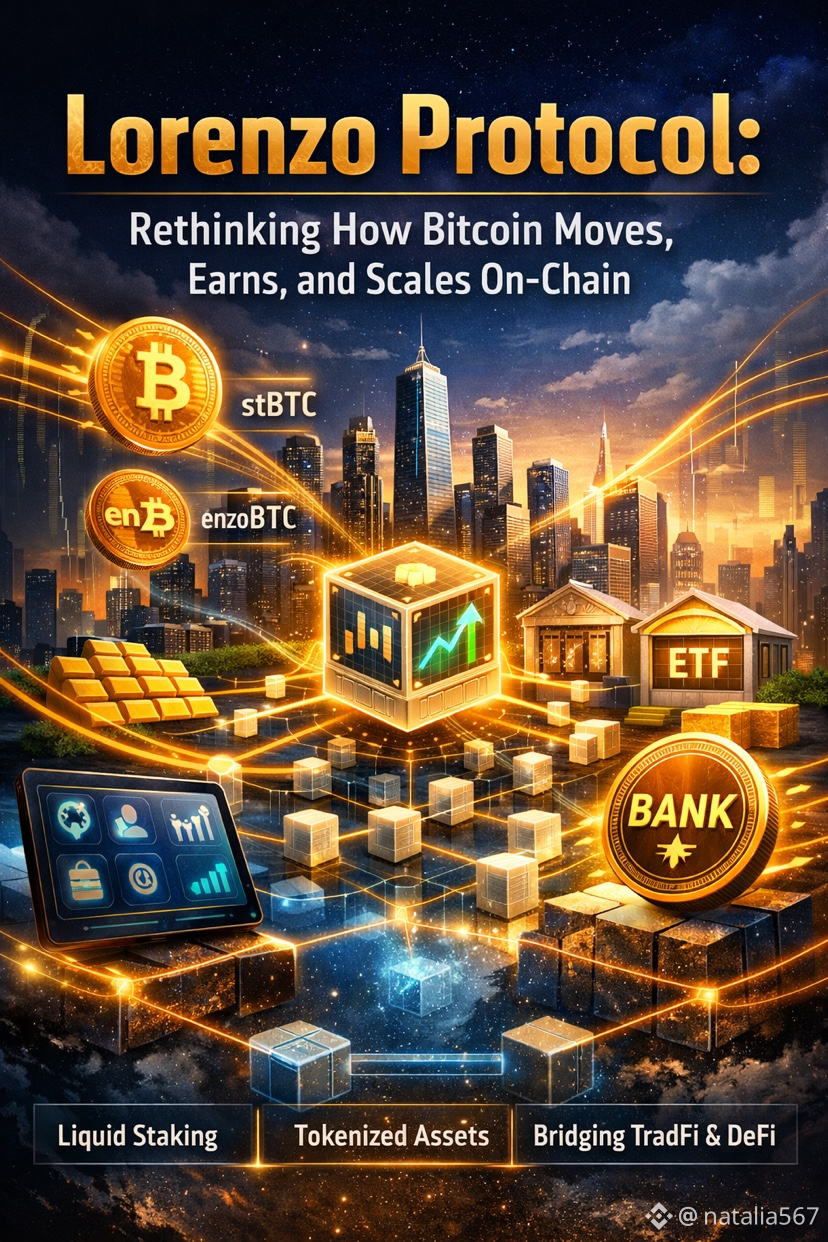
For most of its life, Bitcoin has done one thing exceptionally well: store value.
What it hasn’t done well—by design—is move inside modern financial systems. Bitcoin doesn’t natively plug into DeFi, structured products, or capital-efficient strategies. When BTC earns yield, it usually comes at the cost of liquidity, flexibility, or transparency.
Lorenzo Protocol is built to challenge that tradeoff.
Rather than treating Bitcoin as a static asset that must be locked away to generate returns, Lorenzo approaches $BTC as a form of productive capital—one that can earn, circulate, and interact with on-chain financial markets without losing its core properties.
A Different Take on Bitcoin Finance
Lorenzo isn’t trying to turn Bitcoin into Ethereum, nor is it another short-term yield platform. Its focus is infrastructure.
At a high level, Lorenzo acts as a Bitcoin-native liquidity and asset management layer. It allows BTC holders to access yield-generating strategies while keeping their capital liquid and usable across decentralized applications.
The key idea is simple but powerful:
earning yield should not mean giving up control or composability.
Making Bitcoin Liquid Without Making It Fragile
Traditional Bitcoin yield models usually rely on locking assets inside opaque systems. Once BTC is deposited, it’s stuck—unable to be traded, used as collateral, or moved elsewhere.
Lorenzo flips that model.
When users participate in Lorenzo’s Bitcoin strategies, they receive liquid, on-chain representations of their position. These tokens continue to earn yield while remaining fully transferable.
This approach unlocks several advantages:
Bitcoin stays economically active instead of idle
Capital efficiency improves across DeFi
Users retain flexibility instead of choosing between yield or liquidity
In practical terms, Bitcoin becomes something you can use—not just hold.
Tokenized Bitcoin, Built for Modern DeFi
Lorenzo introduces multiple Bitcoin-linked assets designed for different use cases.
One represents yield-bearing Bitcoin, allowing holders to earn while remaining liquid. Another is optimized for cross-chain and DeFi compatibility, enabling Bitcoin exposure to flow into lending markets, trading venues, and structured products.
These assets aren’t just wrappers—they’re financial primitives that let BTC participate in on-chain economies without breaking trust assumptions or usability.
Structured Finance, Rebuilt On-Chain
Where Lorenzo really differentiates itself is in how it packages financial strategies.
Instead of forcing users to manage individual positions across multiple protocols, Lorenzo introduces tokenized strategy products—on-chain instruments that resemble traditional funds but operate entirely within smart contracts.
These products bundle different yield sources into single, tradable tokens. Exposure that once required institutional access or complex manual execution becomes accessible through simple on-chain ownership.
It’s not about chasing yield.
It’s about structuring it.
The Role of BANK
Every financial system needs coordination. In Lorenzo’s case, that coordination happens through the BANK token.
BANK governs how the protocol evolves—what strategies are introduced, how risk parameters are set, and how incentives are distributed. Over time, it also aligns long-term participants with the growth of the ecosystem through governance rights and potential economic participation.
With a capped supply of 2.1 billion tokens, BANK is designed to support sustainability rather than short-lived speculation.
Who Lorenzo Is Really For
Lorenzo’s design serves multiple audiences without compromising on complexity or transparency.
Bitcoin holders gain access to yield without surrendering liquidity.
DeFi users receive Bitcoin-based assets that actually integrate into on-chain markets.
Institutions and advanced allocators get structured, auditable financial products without relying on opaque intermediaries.
It’s a rare overlap—Bitcoin minimalism meeting modern financial engineering.
Risks Are Real—and Acknowledged
Lorenzo doesn’t pretend structured finance is simple. Tokenized strategies require understanding, and smart contracts carry inherent risks. Regulatory frameworks around on-chain financial products are still evolving.
But these risks aren’t hidden. They’re part of the design conversation—addressed through transparency, modularity, and governance rather than marketing promises.
Why Lorenzo Matters
#Bitcoin doesn’t need to change its base layer to evolve.
It needs systems that respect its design while expanding its usefulness.
Lorenzo Protocol is building one of those systems.
By treating Bitcoin as liquid, composable capital—and combining it with on-chain financial structures—Lorenzo points toward a future where BTC isn’t just stored…
it moves, earns, and participates in a broader financial economy.
Not louder.
Not faster.
Just smarter.


