
Blockchain is evolving from a simple ledger to a global settlement layer for complex systems, but it needs reliable, intelligent data to function. First-generation oracles struggled to deliver speed, low cost, and high fidelity (accuracy) simultaneously—the dreaded Oracle Trilemma.
APRO is a next-generation oracle architecture built to solve this, not just by linking data, but by verifying it with embedded intelligence. It does this through a powerful, two-layer design that separates the heavy lifting of data processing from the final, immutable settlement.
This separation is key for engineers and product managers who are building the next wave of Web3: applications that need institutional-grade data quality for high-stakes decisions like lending liquidations, RWA tokenization, and AI-driven automation.
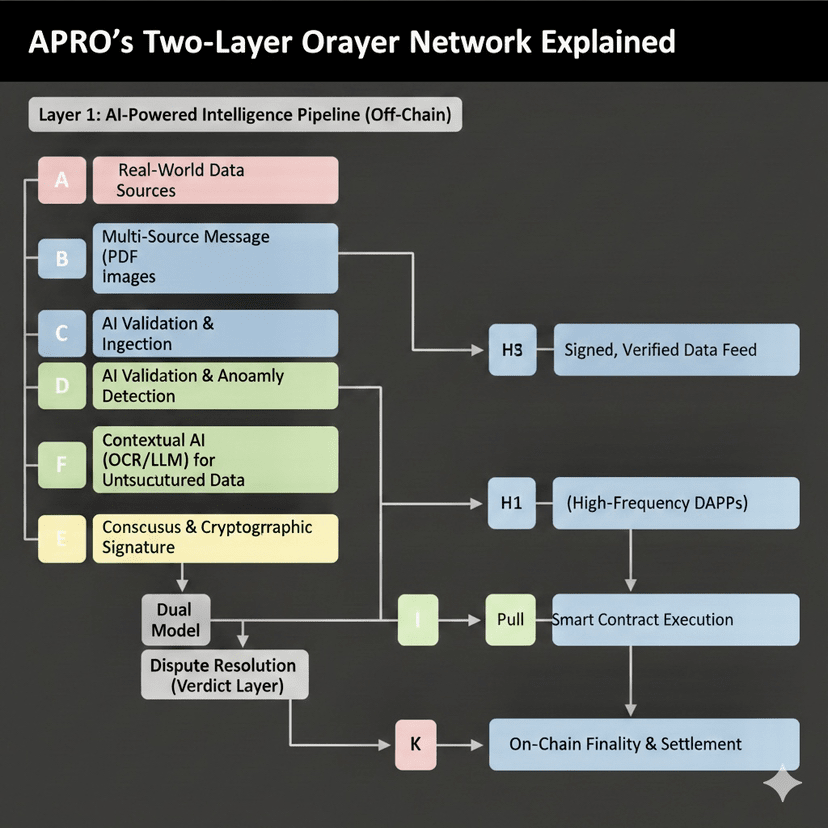
Layer 1: The AI-Powered Intelligence Pipeline (Off-Chain)
Think of Layer 1 as a hyper-efficient, secure data factory. This is where the magic of high-fidelity data is created. It operates off-chain to be fast, flexible, and cost-effective, handling complex computations that would congest any mainnet.
Layer 1 Role: Data Acquisition, Validation, and Transformation
The primary function of this layer is to ingest raw, messy real-world data and transform it into a cryptographically verifiable, structured output ready for the blockchain.
• 1. Multi-Source Ingestion: It pulls data from a multitude of independent, verified sources via the Off-Chain Message Protocol (OCMP), eliminating the "single point of failure" risk of a lone data feed.
• 2. AI-Driven Validation & Anomaly Detection: This is APRO's unique differentiator. The layer employs sophisticated AI models (including OCR/LLMs for unstructured data) to:
• Detect Outliers: Immediately flag data points that deviate drastically from the consensus.
• Contextual Accuracy: For complex assets, the AI can interpret documents, like financial statements or proof-of-reserve audits, turning PDF text into auditable data.
• 3. Consensus and Signature: Data is aggregated and nodes reach a consensus. The resulting data feed is then cryptographically timestamped and signed, establishing its final, verifiable truth before it touches the chain.
Real-Life Example: RWA Tokenization
Imagine a decentralized platform tokenizing a real estate portfolio.
• Challenge: The smart contract needs the portfolio's current Net Asset Value (NAV) to execute trades or liquidations. This data sits off-chain in structured and unstructured formats (legal documents, appraisal reports).
• Layer 1 in Action: APRO's AI Pipeline ingests the appraisal reports (unstructured PDFs/images) using an OCR/LLM-based model, extracts the crucial valuation data, cross-references it with local property index feeds (structured data), detects any discrepancies, and outputs a single, verifiably accurate NAV feed. This transformation is only possible by moving beyond simple price scraping.
Layer 2: On-Chain Settlement and Execution (The Final Arbiter)
Layer 2 is the blockchain interaction layer. Its sole purpose is finality and trust. It receives the pre-validated, cryptographically signed data from Layer 1 and ensures its seamless, tamper-proof execution on the smart contract.
Layer 2 Role: Trustless Delivery and Final Settlement
This layer is designed for security and flexible integration across various blockchain environments.
• 1. Verifiable Finality: It acts as the final settlement layer. Because the heavy computation and validation happened in Layer 1, Layer 2 only needs to verify the cryptographic signature of the feed before it's written into the smart contract's state. This makes on-chain transactions cheap and fast.
• 2. Dual Delivery Model: Developers gain flexibility based on their DApp's needs:
• Data Push: Essential for high-frequency applications like Perpetual Futures or Lending Protocols that need constant, live price updates (e.g., triggering a liquidation when the collateral ratio hits a threshold).
• Data Pull: Allows DApps to request data only when necessary, conserving gas and reducing on-chain congestion for lower-frequency applications like insurance claims or governance votes.
• 3. Dispute Resolution: A minimal, on-chain mechanism exists to audit the Layer 1 process, acting as a "Verdict Layer" for transparency and final conflict resolution, ensuring the system remains trustless.
Real-Life Example: Automated DeFi Vaults
Consider an automated yield-farming vault that needs to periodically rebalance its assets.
• Challenge: The vault must execute a complex, conditional swap only if a particular set of market factors (e.g., volatility index and asset price correlation) meet a pre-defined condition.
• Layer 2 in Action: The conditions are calculated with high-fidelity inputs verified by Layer 1. Layer 2 receives the final, signed output. The Layer 2 execution environment (often a specialized execution network built on APRO) then uses this trusted data to trigger a multi-step, cross-chain task (e.g., "Bridge ETH to Polygon, swap to stablecoin X, and deposit into Vault Y"). The entire transaction is verified and settled on the target Layer 1 chain.
Unlocking Trust and Value
The APRO two-layer architecture is a paradigm shift. It moves the oracle model from being a simple data relay to a Decentralized Intelligence Layer. By offloading the intelligence (AI validation) and keeping the finality (on-chain settlement) separate, APRO delivers what the next generation of Web3 demands: speed, low cost, and the verifiable, high-fidelity data of the real world.
This is not just about a better oracle; it’s about enabling entirely new product categories, like fully decentralized autonomous agents that can act on complex, real-world events with the same trust as a smart contract.
How do you see APRO's ability to handle complex, unstructured Real-World Asset (RWA) data changing the landscape for institutional adoption of DeFi?

