

Coinbase's latest report shows that Generation Z and Millennials are actively turning to non-traditional investment paths centered around crypto assets, reshaping the future of personal wealth accumulation and market structure in America through higher engagement and risk tolerance.
Article author, source: Coinbase
For decades, the path to wealth accumulation for Americans has been roughly the same: find a good job, buy a house, invest in stocks, and then leave everything to time. However, the latest report (State of Crypto) shows that young investors no longer believe this set of rules applies to them and are actively changing their investment strategies.
Coinbase collaborated with Ipsos to survey 4,350 American adults, including 2,005 respondents with investment accounts, covering different age stages, aimed at understanding how they respond to the current market environment and the role crypto assets play in their investment strategies. The conclusion is clear: compared to any previous generation, Gen Z and Millennial investors are more actively involved in investing, more open to non-traditional assets, and more inclined to view crypto assets as a core component of their long-term financial future.
A generation that feels excluded from the traditional wealth ladder
Young investors are more optimistic about the overall economy than older investors, but they do not believe the existing system is designed for them. Nearly three-quarters of young adults (73%) indicate that it has become more difficult for their generation to accumulate wealth through traditional paths compared to traditional means, while the proportion among older groups is 57%.
Factors such as rising housing prices, increased student loan burdens, and stagnant wage growth have led young investors to be more inclined to believe that relying solely on real estate and stocks has made wealth growth difficult. Therefore, they are more actively seeking 'alternative ways to grow wealth.'
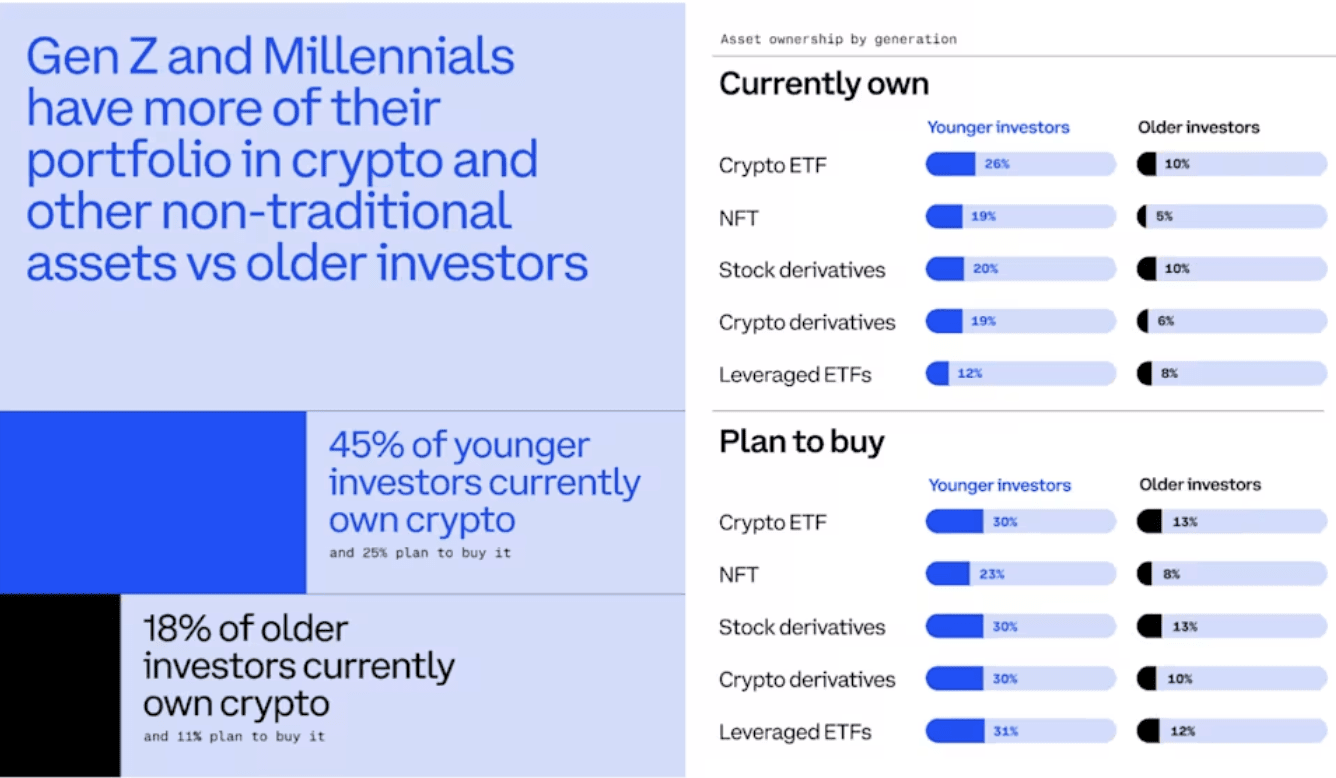
The proportion of non-traditional asset allocation is three times that of older investors.
This shift in perspective is directly reflected in asset allocation. Young investors indicate that about 25% of their portfolios are allocated to non-traditional assets, such as crypto assets, derivatives, NFTs, and other emerging financial products, while older investors allocate only 8% to non-traditional assets.
Different age groups show little difference in stock ownership ratios, but the real difference lies in their focus. Young investors are more inclined to actively seek returns that go beyond traditional dividend yields and are more willing to try new tools and markets to narrow the wealth gap.
Crypto assets are not a marginal allocation, but a core strategy.
The age difference is particularly evident in the adoption of crypto assets. Reports indicate that 45% of young investors already hold crypto assets, while the proportion among older investors is only 18%. Additionally, nearly half (47%) of young investors hope to gain investment opportunities in new crypto assets before the mass market, compared to only 16% of older investors.
For this group, crypto assets are not merely speculative tools but an important avenue to achieve 'catch-up growth.' 80% of young adults believe that cryptocurrency provides more financial opportunities for their generation; the same proportion believes that crypto assets will play a more important role in the future financial system. Among older investors, this recognition drops to about 60%.
This interest in new markets is not limited to spot crypto assets. Data shows that 80% of young investors are willing to be the first to try new investment opportunities, while this proportion is less than half among older investors. Young investors continue to show greater interest in new non-traditional products such as crypto derivatives, prediction markets, round-the-clock stock trading, initial token offerings, altcoins, and DeFi lending.
Insights for future markets
In short, young investors have undergone fundamental changes. They trade more frequently, are willing to take on higher risks in pursuit of higher returns, and are willing to allocate a certain percentage of their assets to non-traditional investment areas centered around crypto. At the same time, they are driving the industry towards platforms that are 'always-on, cover a wider range of assets, and align more with the internet-native experience.'
To meet the needs of a new generation of investors, Coinbase is creating the 'Everything Exchange' — a platform that supports trading any asset anytime, anywhere, while continuing to prioritize security, compliance, and responsible innovation as core principles.