
Last night's non-farm data was like a time bomb. On the surface, the number of jobs rebounded, but behind it lay cracks that couldn't be covered up—unemployment rates soared to a four-year high! The market instantly fell into a daze, seemingly good news, but actually hiding a deadly crisis. This 'good-looking' data is just a beautiful disguise, behind which lies the true reflection of economic fatigue, and investors are rushing towards the cliff!
At the moment the data was released, the market entered a small roller coaster. After the data was released, Old Chen immediately entered the market with a short position, leading fans to achieve a 50-point swing profit.

Old Chen's view remains unchanged: the short-term focus is on shorting, the higher the rebound, the better the buying point.
The current market is like the last calm before the storm, and the brief rebound is merely the tranquility in the eye of the storm. My bearish view remains firm, and I maintain an intraday operating mindset: rebound means short! This is not blind pessimism, but based on three mountains that are about to press down on the market, they are quietly approaching, and the market's collapse is about to break out.
The first mountain: The Bank of Japan's interest rate hike triggers global market turmoil.
On December 19, the Bank of Japan will make a key interest rate decision, expected to raise the policy interest rate from 0.50% to 0.75%. This decision will significantly narrow the interest rate gap between Japan and the U.S., and historical experience shows that similar central bank policy shifts often trigger severe reactions in global capital markets.
This interest rate hike may trigger a wave of 'carry trade' liquidations, where investors had borrowed low-interest yen to invest in high-interest assets, but this model is about to face a reversal, and a cross-market chain sell-off is imminent. The reshuffling of global capital flows may directly trigger large-scale market sell-offs, increasing market risks continuously.
The second mountain: Price turbulence caused by the rebalancing of the S&P 500 in U.S. stocks.
Currently, U.S. stocks, especially the S&P 500 index, are facing serious structural tests. The performance of the index is overly reliant on a few tech giants, with the top ten companies accounting for 40% of the index's weight. This extremely concentrated pattern makes the U.S. stock market very fragile; once these giants face large-scale sell-offs, price turbulence in the entire market will be unavoidable.
Recently, institutions such as Fairview Investing have publicly suggested that investors 'take profits' from the index and rebalance their portfolios. With the rebalancing day for the S&P 500 approaching this Friday, large-scale institutional operations in the market may trigger significant shocks, and the price fluctuations of tech stocks and related assets could be extremely intense. The current 'calm' is just the last struggle before the storm.
The third mountain: The Federal Reserve's interest rate cut expectations are 'uncertain'.
Although the Federal Reserve completed its third interest rate cut of the year on December 10, market expectations for future rate cuts remain shrouded in fog. Chairman Powell has made it clear that further easing policies will only be considered if inflation control is effective or the labor market shows significant weakness. However, the unemployment rate rising to a four-year high last night indicates increasingly apparent signs of economic weakness, yet there is still great uncertainty about whether the Federal Reserve will take more rate-cutting measures.
The market's excessive expectations for the Federal Reserve's easing policies may welcome a brutal correction. Premature optimism is destined to encounter a head-on blow in the future's bearish environment. For the market, this 'unsolvable' situation is even more dangerous.
Today's operating strategy:
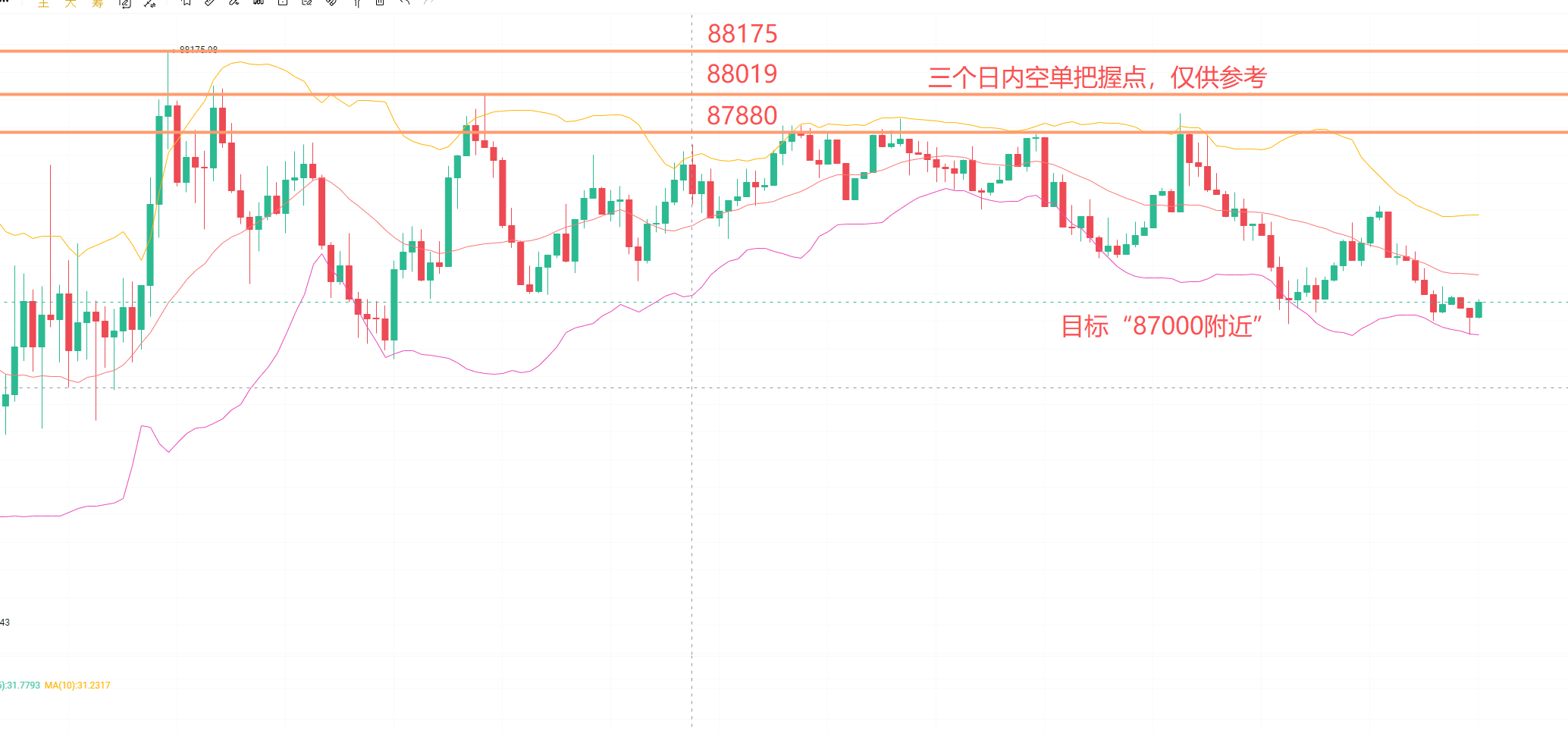
In the world of trading, direction is more important than speed. As market risks gradually accumulate, every rebound may be a moment when bears accumulate momentum. The current environment is just like that, with three major bearish factors intertwined; every bounce in the market is an excellent opportunity for short positions to establish.
It is recommended to adopt a phased layout strategy, decisively establishing short positions near key resistance levels, such as previous highs or important moving averages. If the market continues to rebound, maintain an increase-in-position strategy, gradually raising entry points, so that when the market crashes, the bears can achieve maximum profits.
Summary:
Bitcoin briefly rebounded to $87,000 after experiencing a severe sell-off, but for sharp traders, this is merely a moment of calm in the eye of the storm. Three key events are converging ahead, which will recalibrate the flow of global capital. Each struggle upward in the market is accumulating stronger momentum for the bears.
There are no gods in the cryptocurrency world, only smart people who can read the signals. Old Chen's articles do not boast or make empty promises; they only teach you practical survival skills. Follow Old Chen for daily strategies to get on board early.
