
1. RWA is booming, but why haven’t most projects seen real growth?
In the past two years, RWA has almost become one of the most certain main narratives in the crypto industry. Traditional financial institutions such as BlackRock, Franklin Templeton, Apollo, and WisdomTree have continuously pushed funds, government bonds, credit, commodities, and other assets into the on-chain world. The market also generally expects RWA to bring the massive asset scale of traditional finance into the crypto ecosystem. However, when looking at user growth and on-chain activity, many RWA projects have not fully delivered on this narrative. That’s because they address the question of "whether assets can be tokenized," but they haven’t truly solved the question of "whether people will actually use tokenized assets after they’ve been tokenized."
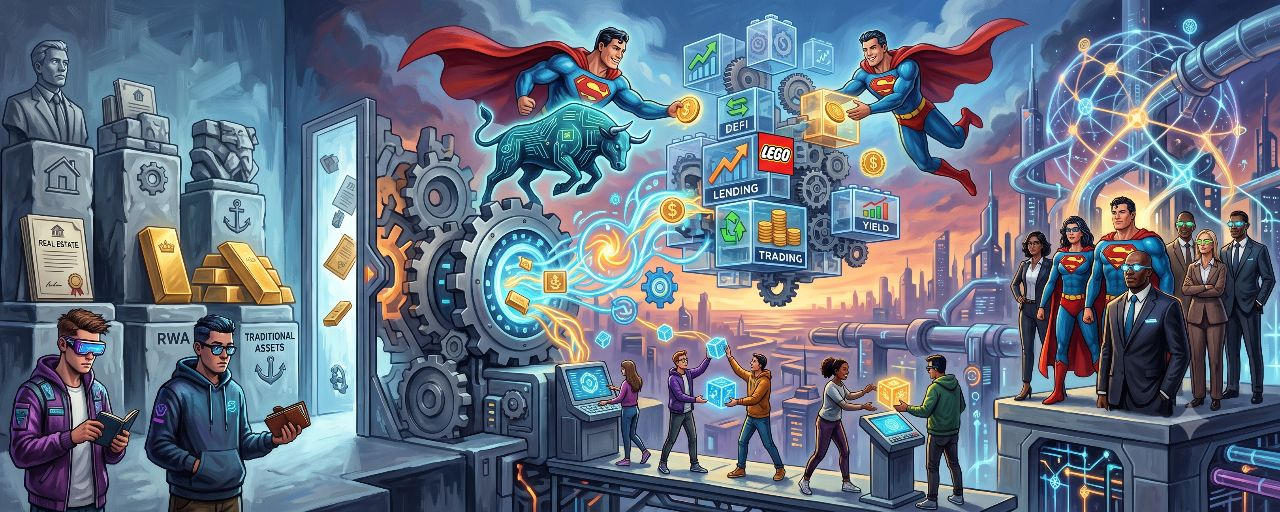
This is the core contradiction of RWA’s Phase 1: although assets have been moved onto the blockchain, most of the time they exist only as a kind of static certificate. After users buy in, there is a lack of subsequent financial use cases. DeFi protocols also struggle to design lending, trading, yield aggregation, or derivative strategies around these assets. As a result, many RWA products achieve Tokenization in name but fail to enter the most important composability network in the crypto world. Messari’s research on Plume also points out that many of today’s problems with RWA are not a lack of assets themselves, but that these assets are often still fragmented, low-liquidity, high-friction to access, and lack crypto-native utility. Therefore, they are difficult to turn into real network effects. (Messari)
Plume’s entry point is precisely to redefine RWA from “asset issuance” into “asset financialization.” In Plume’s narrative, RWA is not simply wrapping real-world assets into a token and putting it in users’ wallets while waiting for redemption. Instead, these assets should enter an on-chain financial system that can be traded, lent, staked, composed, and redistributed. In other words, Plume isn’t building an asset display case—it is trying to construct a DeFi operating system for real-world assets.
Second, Plume’s first principles: don’t start by serving institutions—start by serving Crypto Native users
Many RWA projects’ intuitive path is to serve institutions first, because the source of real-world assets is in institutional hands. After institutions issue assets, they distribute the products to users through compliance channels. This path works in traditional finance, but there is a clear problem in the crypto world: if the assets cannot solve the real needs of Crypto Native users, then even with strong institutional branding, it is still hard to generate on-chain growth.
Plume’s counterintuitive approach is that the success paradigm for RWA should not only be judged by traditional financial assets themselves, but should return to the growth history of stablecoins. Stablecoins became the most successful RWA not because they initially convinced institutions with the grand narrative of “tokenizing real-world assets,” but because they precisely solved the most urgent problems for crypto users: trades need a stable unit of account; DeFi needs a base settlement asset; cross-border transfers require low-friction dollar liquidity; and users need on-chain tools to hedge risk. In other words, stablecoin growth did not start from institutional supply—it started from crypto-native demand.
Plume’s borrowing here is very obvious. It does not position itself as a permissioned platform that issues assets only for institutions. Instead, it emphasizes RWAfi, meaning Real World Asset Finance. This does not merely refer to RWA Tokenization; it means giving real-world assets financial utility on-chain. Messari’s positioning of Plume is similar: Plume is an RWA-dedicated blockchain and ecosystem built for crypto-native users. Its core focus is to make tokenized assets accessible, usable, and integrable in DeFi from day one. (Messari)
Behind this is a very clear growth philosophy: institutional assets themselves are not growth; user demand is growth. Asset size is not growth; asset utilization is growth. Compliance entry is not growth; the financial scenarios that allow users to interact repeatedly are growth. Therefore, Plume’s early strategy is not simply chasing “how many assets are connected.” Instead, it re-wraps RWA around yield, liquidity, leverage, and composability that are familiar to Crypto Native users. What users feel is not “I bought a traditional financial product,” but “I gained a new on-chain yield and asset-allocation tool.”
Three, the true starting point of growth: not TVL, but product design
Plume’s product design can be understood as a three-layer structure: the asset entry layer, the yield usage layer, and the user entry layer. These correspond to Arc, Nest, and Portal respectively, and together they form Plume’s growth foundation.
Arc is more like Plume’s asset issuance and tokenization engine. It solves the problem of how assets are put on-chain, how they are compliantly wrapped, and how they become financial objects that can be called by on-chain applications. For RWA projects, asset issuance capability is obviously important, but Plume’s focus is not to stop at issuance itself. Instead, through Arc, it standardizes assets so they can enter subsequent on-chain financial scenarios.
Nest is currently Plume’s most critical growth product, because it fulfills the function of transforming “static assets” into “yield assets.” Plume’s official blog has repeatedly introduced Nest as RWA yield infrastructure. For example, EtherFi’s partnership with Plume provides users with a tokenized RWA yield entry supported by Superstate USCC through the Nest Vault infrastructure. (plume.org) The key significance of this kind of product design is that it does not require users to understand complex traditional asset structures; instead, it re-wraps RWA into yield products on-chain that users are more familiar with.
If we say the user path for traditional RWA products is “buy an asset—wait for yield—redeem and exit,” then the path Plume wants to drive is “buy an asset—receive yield certificates—enter DeFi—keep generating liquidity and composable yield.” This means users are no longer holding only a certificate of a real-world asset, but a chain-based financial building block that can continue to enter lending markets, yield markets, and liquidity markets. This design is crucial for growth because it turns a one-time asset purchase into continuous on-chain interaction.
Portal solves the user entry problem. Plume’s official materials describe Portal as an entry point to experience RWAfi. Through it, users can discover dApps, protocols, institutional-level yield opportunities, and various RWA assets. (plume.org) This may look like only a front-end entry point, but it is extremely important at the growth layer. One of the biggest problems with RWA is that the user understanding cost is high, entry points are fragmented, and product structures are complex. Without a unified entry, it is hard for users to transition from “knowing about Plume” to “actually using Plume.”
Therefore, Plume’s growth is not driven by a single product explosion. It is driven by product structure that lowers users’ cognitive cost, and by connecting asset issuance, yield acquisition, and on-chain interaction into a closed loop. What it truly wants is not to make users “see RWA,” but to make users “use RWA like DeFi.”
Four, the growth flywheel: why Plume is getting faster and faster?
Plume’s growth flywheel can be summarized like this: institutional assets enter; the assets become composable yield products through Nest; users enter the ecosystem because of the yield; users and capital bring liquidity; liquidity attracts more DeFi protocols and institutional assets; and ultimately a positive loop forms between asset supply and user demand.
The first layer is institutional assets entering. Plume has already obtained funding support from institutions such as Brevan Howard Digital, Haun Ventures, Galaxy Ventures, Lightspeed Faction, Superscrypt, HashKey, and Laser Digital. Its $20 million Series A completed in December 2024 shows the shared interest from traditional finance and crypto capital in its RWAfi direction. (prnewswire.com) Such capital endorsements provide not only funding, but more importantly help Plume secure institutional assets, compliance resources, and networks in the financial industry.
The second layer is assets becoming DeFi Lego. Plume’s core is not simply showcasing institutional assets, but bringing those assets into Nest, lending protocols, yield strategies, cross-chain infrastructure, and wallet entry points—so that RWA shifts from “investment products” to “financial primitives.” If this step works, Plume’s asset scale will not just be static TVL; it will translate into multi-dimensional on-chain activities such as trading, lending, staking, and yield combinations.
Third is user growth. BeInCrypto cited RWA.xyz data, saying Plume holds a very high market share by number of RWA holders, and at one point surpassed Ethereum to become the network with the most RWA holders. However, at the same time, its asset value scale remained relatively limited. This suggests that in its early stage, Plume was more like it built a user-side advantage through low barriers, broad distribution, and high user participation, rather than first aiming to accumulate large amounts of institutional assets. (BeInCrypto) From a growth perspective, this matters because it means Plume’s advantage is not just “having assets,” but “having a large number of users willing to participate in RWAfi.”
Fourth is liquidity growth. When the user base expands, protocol operators are more willing to integrate with Plume because protocols need users and capital. Institutions are also more willing to deploy assets to Plume because institutions need distribution and liquidity. Plume’s official website also emphasizes that its goal is to convert assets into global financial tools with crypto-native use cases, and it showcases key metrics such as asset pipelines, ecosystem partners, and TVL. (plume.org)
The fifth layer is more institutions entering. When a network already has users, protocols, liquidity, and yield scenarios, the motivation for institutions to enter is no longer just “trying to go on-chain,” but “gaining a new distribution market.” This is the most critical part of Plume’s growth flywheel: it tries to make institutions go on-chain not for the narrative, but to reach real on-chain demand.
Five, ecosystem growth: Plume isn’t chasing TVL—it is building a network
Many public chains emphasize TVL in their early growth, but Plume’s growth logic is more like building an ecosystem network. The value of RWAfi is not determined by a single asset; it is jointly determined by the asset issuers, yield protocols, lending protocols, wallets, cross-chain protocols, data services, and compliance services. RWA.xyz’s introduction of Plume also highlights that it is a full-stack L1 and ecosystem purpose-built for RWAfi, with an EVM-compatible environment, and 180+ projects building on its network. (RWA.xyz)
The key to this kind of ecosystem growth is that Plume is not just adding partner logos—it is trying to make each type of collaboration serve asset utilization. The asset issuer provides the underlying assets. Nest turns those assets into yield-bearing products. DeFi protocols provide lending, trading, and liquidity scenarios. Wallets and Portal lower the user entry barrier. Cross-chain protocols expand the asset distribution reach. Compared with single-point growth, this kind of multi-party network is harder to build, but once it forms, it is easier to create a moat.
For example, when Plume launched a $25 million RWAfi ecosystem fund in 2025, official information stated that its network already has 180+ projects building, and emphasized that Plume provides an environment that is composable, EVM-compatible, and used to onboard and manage diverse real-world assets. (prnewswire.com) This shows that Plume’s understanding of the ecosystem is not “I issue assets and others come to buy.” Instead, it is “I provide assets and infrastructure, and ecosystem projects build financial applications around those assets.”
From a growth perspective, this kind of ecosystem strategy is more complex than simply chasing TVL, but it aligns better with RWAfi’s long-term logic. Because RWA’s endgame is not an asset-size leaderboard—it is who can get assets into the most application scenarios, have the most users repeatedly call them, and ultimately become part of on-chain finance.
Six, community growth: why is a testnet more important than mainnet launch?
Plume’s growth also has a portion that is easy to underestimate: before mainnet launch, it cultivated a cohort of early users through testnets, points, quests, community activities, and ecosystem incentives. This means Plume does not wait until after mainnet to start cold-launching; it has already completed user education and behavior training before mainnet goes live.
For RWA projects, community growth is especially difficult. Unlike Meme, GameFi, or NFTs, RWA does not naturally have strong virality. It is closer to a financial product, with a higher understanding barrier and weaker emotional sharing, so user participation is usually more rational. Therefore, Plume needs to transform the originally abstract RWAfi narrative into on-chain actions users can actually complete—such as connecting a wallet, participating in testnets, experiencing Portal, entering Vault, and interacting with ecosystem protocols—through points, quests, yield experiences, and ecosystem activities.
The essence of this approach is not simply scraping data, but training users to form the mindset that “RWA can be used like DeFi.” For a new public chain, the biggest fear at mainnet launch is not the lack of assets, but the lack of user behaviors. Plume, through continuous operations during the testnet phase, turns some users from spectators into participants, and then from participants into potential liquidity providers—laying the foundation for early mainnet growth.
Of course, there are risks as well: points and expectations of airdrops may bring short-term speculators. But from a growth strategy standpoint, Plume has at least captured one key fact: the mass adoption of RWA cannot rely only on institutional endorsements. It must be driven by actionable, perceivable, repeatable user quests that turn complex financial products into on-chain experiences users are willing to try.
Seven, Plume vs. Ondo
Plume is often compared with Ondo, but their positioning is actually different. Ondo is closer to an asset issuance and asset management platform. Its core advantage is tokenizing products like U.S. treasuries and yield-bearing dollar assets, and building market recognition through branding, compliance, and distribution capabilities. Plume is closer to a specialized chain and financial operating system built around RWAfi. Its goal is not only to issue one type of asset, but to provide an issuance, distribution, yieldization, and DeFi integration environment for a variety of real-world assets.
Therefore, Ondo’s logic is more like “bringing high-quality assets onto the chain,” while Plume’s logic is more like “forming financial markets on-chain with various real-world assets.” This does not necessarily mean they are zero-sum competitors. On the contrary, they may represent two different layers within the RWA space: Ondo leans more toward asset-side branding, while Plume leans more toward asset-side infrastructure and use-case design.
This difference also determines that their growth metrics are different. When evaluating Ondo, the market focuses more on asset size, product yield, compliance structure, and issuance capability. When evaluating Plume, besides asset size, it is also necessary to pay attention to the number of users, the number of protocols, asset composability, on-chain interaction frequency, and the depth of ecosystem collaborations. Simply put, Ondo is more like selling assets, while Plume is more like building a market.
Eight, the biggest challenges ahead
Plume’s growth logic is clear, but it still faces three categories of core challenges.
First is the asset quality challenge. The easiest problem in the RWA space is to package growth with the quantity of assets, but the differences in risk, liquidity, transparency, and user needs across different assets are enormous. Treasury bills, private credit, commodities, receivables, GPU revenue rights, and real-estate equity cannot simply be compared under a single growth metric. If Plume wants to build trust long-term, it must prove that the assets it introduces are not only numerous, but also high-quality at the underlying level, with risk disclosures clear enough and revenue sources transparent enough.
Second is the user retention challenge. In Plume’s early user growth, points, airdrops, and incentive factors are unavoidable. But what ultimately determines long-term value is whether users still want to use Nest、Portal, and ecosystem protocols after incentives decline. If users come only for short-term rewards, growth will drop after the rewards end. If users stay because of yield, asset allocation, and DeFi composability, then Plume’s user base will shift from activity traffic to financial liquidity.
Third is the challenge of balancing compliance and openness. RWA naturally requires compliance, KYC, asset custody, legal structures, and cross-border regulatory support, but the crypto world also pursues openness, composability, and permissionless innovation. Plume’s difficulty is that it must both reassure institutions when issuing assets and make DeFi developers and ordinary users feel sufficiently open. Over-compliance may cause it to lose crypto-native energy; over-openness may increase regulatory and asset risks.
Conclusion
If you only understand Plume as an RWA Layer1, you will underestimate its ambition. What Plume is truly trying to build is an on-chain financial operating system for real-world assets. Its core task is not merely moving assets onto the chain, but giving assets a new life on-chain: making them usable, composable, tradable, lendable, yield-generating, and ultimately part of the DeFi world.
This is also Plume’s biggest difference from many other RWA projects. Many still stay within the Tokenization narrative, emphasizing assets being put on-chain, institutional endorsements, and market size. Plume, however, focuses on Financialization—how, after assets go on-chain, they can generate ongoing financial activity. The former answers “where the assets are,” while the latter answers “how the assets flow.”
Therefore, Plume’s growth cannot be explained by a single metric. It comes from a composite flywheel among asset supply, user demand, ecosystem protocols, yield products, community operations, and institutional partnerships. If this flywheel can keep turning, Plume’s moat will not just be a particular asset, a particular partner, or a particular funding round; it will be a multi-party network built around RWAfi.
Ultimately, the winner in the RWA space may not depend on who put assets on-chain first. It may depend on who can truly turn real-world assets into financial primitives usable in the crypto world. This is the direction Plume is betting on.