

From institutional adoption to regulatory progress, the current positive momentum is strong and far-reaching, making it difficult to be obstructed in the long term.
Author: Bitwise
Article translated and sourced from Golden Finance
2025 will be a memorable year in the cryptocurrency field—marked by both highlights and lows.
On the positive side: Driven by strong institutional demand and a series of favorable regulatory developments, Bitcoin, Ethereum, Solana, and Ripple (XRP) all hit new all-time highs (at 126,080 USD, 4,946 USD, 293 USD, and 3.65 USD respectively). Stablecoins and tokenization have become household terms, as major financial institutions like Morgan Stanley and Merrill Lynch open investment channels for cryptocurrency ETFs, and several billion-dollar-valued cryptocurrency companies like Circle, Figure, and Gemini complete IPOs and go public.
On the negative side: Major cryptocurrencies, including the four assets mentioned above, have all dropped significantly from their highs; as of the writing of this article, their prices have all declined this year. Some smaller altcoins have fallen by 50% or more. The negative impact of falling prices—due to concerns over the 'down year' indicated by Bitcoin's historical four-year cycle, signs of long-term holders selling, increasing discussions around quantum computing risks, and the overall macroeconomic environment—has severely hit market sentiment.
We believe that in 2026, the bulls will have the upper hand. From institutional adoption to regulatory progress, the current positive momentum is strong and far-reaching, making it difficult to be obstructed in the long term.
Against this backdrop, we present the following top ten cryptocurrency predictions for 2026.
1. Bitcoin will break the four-year cycle and hit new all-time highs.
2. Bitcoin's volatility will be lower than that of Nvidia's stock.
3. With accelerated institutional demand, ETFs will purchase more than 100% of the new supply of BTC, ETH, and Solana.
4. Cryptocurrency stocks will outperform tech stocks.
5. The open contracts volume on Polymarket will hit a new all-time high, surpassing levels seen during the 2024 elections.
6. Stablecoins will be accused of undermining the stability of emerging market currencies.
7. The asset management scale of on-chain vaults (also known as '2.0 version ETFs') will double.
8. ETH and Solana will hit new all-time highs (if the CLARITY Act is passed).
9. Half of the Ivy League endowment funds will invest in cryptocurrencies.
10. The U.S. will launch over 100 cryptocurrency-linked ETFs.
Additional prediction: The correlation between Bitcoin and stocks will decrease.
Prediction one: Bitcoin will break the four-year cycle and hit new all-time highs.
Historically, Bitcoin has exhibited a four-year cycle pattern, meaning that after three significant 'up years,' it is followed by one year of significant correction. According to this cycle, 2026 should be a correction year.
But we believe this will not happen.
In our view, the factors that previously drove the four-year cycle—Bitcoin halving, interest rate cycles, and the boom and bust driven by leverage in the cryptocurrency market—have significantly weakened compared to previous cycles.
Halving events: By definition, the impact of each subsequent Bitcoin halving is half as strong as the previous one.
Interest rate factors: Significant increases in interest rates in 2018 and 2022 impacted prices; however, in 2026, we expect interest rates to decline.
Market crash risk: After the record liquidation event in October 2025, the leverage level has relatively decreased, coupled with an improved regulatory environment, significantly reducing the likelihood of a major market crash.
More importantly, we believe that as Morgan Stanley, Wells Fargo, Merrill Lynch, and other platforms begin to allocate cryptocurrency assets, the institutional inflow wave that will be initiated by the approval of spot Bitcoin ETFs in 2024 will accelerate in 2026. At the same time, we anticipate that the regulatory shift that supports cryptocurrencies after the 2024 elections will benefit the cryptocurrency field, with Wall Street and fintech companies beginning to seriously embrace cryptocurrencies.
We expect the combined effect of these factors will push Bitcoin to hit new all-time highs, making the four-year cycle a thing of the past.
Bitcoin's performance: Four-year cycle
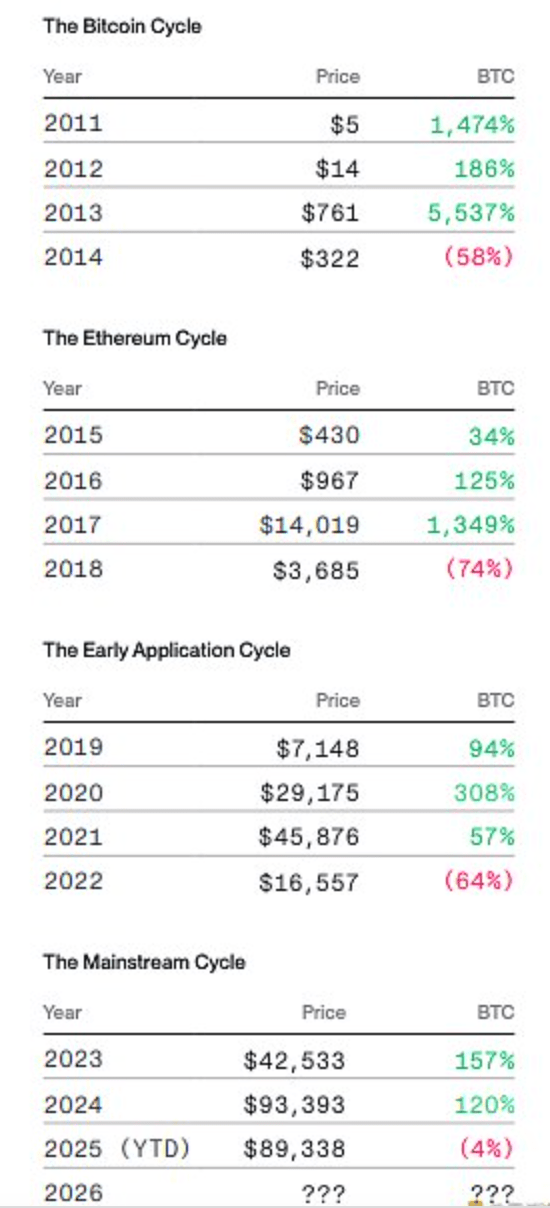
Prediction two: Bitcoin's volatility will be lower than that of Nvidia.
If you have been in the cryptocurrency field long enough, you may have heard the saying: 'I would never invest in an asset as volatile as Bitcoin.'
We are already familiar with this. It is one of the most common criticisms from Bitcoin skeptics.
Does Bitcoin have volatility? Certainly. We do not deny that.
But is Bitcoin's volatility higher than that of other assets that investors are eagerly pursuing? Recently, it has not been.
In 2025, Bitcoin's volatility was lower than that of one of the most popular stocks on the market—Nvidia.
In the longer term, Bitcoin's volatility has steadily decreased over the past decade. This shift reflects that, with the emergence of traditional investment tools like exchange-traded funds (ETFs), the fundamental risks of Bitcoin as an investment asset have diminished, and the investor base has become more diversified.
We believe this trend will continue into 2026.
Volatility comparison: Bitcoin vs. Nvidia
1-year rolling annualized volatility
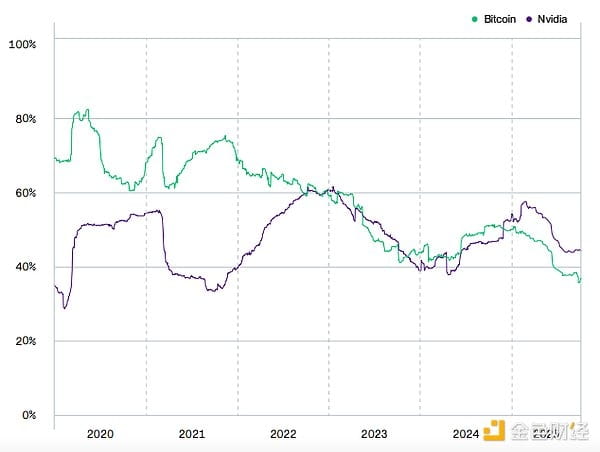
Source: Bitwise Asset Management, data from Bloomberg. Data range: December 31, 2019, to December 5, 2025. Note: The U.S. abandoned the gold standard, and after the launch of gold ETFs in 2004, gold also underwent a similar transformation. We explored the similarities of these trends in a recent report (Bitcoin Long-Term Capital Market Assumptions).
Prediction three: With accelerated institutional demand, ETFs will purchase more than 100% of the new supply of BTC, ETH, and Solana.
For example, since the launch of the Bitcoin ETF in January 2024, these popular investment tools have acquired 710,777 BTC. During the same period, the Bitcoin network produced only 363,047 new BTC. One does not need a PhD in economics to conclude that 710,777 is much greater than 363,047. It is no surprise that Bitcoin's price increased by 94% during this period.
Looking ahead to 2026, we have a clearer expectation of new supply in the market. Based on current prices, the expected new supply is approximately:
166,000 BTC (15.3 billion USD)
960,000 ETH (3 billion USD)
23,000,000 Solana (3.2 billion USD)
Meanwhile, more large financial institutions are preparing to open cryptocurrency ETF investment channels to clients. It is not hard to imagine what impact this will have on demand. This does not mean prices will necessarily rise; existing holders may still sell their held cryptocurrencies. But this lays a solid foundation for prices in 2026.
Comparison of U.S. spot cryptocurrency ETF purchases (demand) with new issuance since launch (supply)

Prediction four: Cryptocurrency-related stocks will outperform tech stocks.
In the past three years, technology stock investors have performed well, with a return of 140%. They must be quite satisfied.
However, investors in cryptocurrency-related stocks are even more delighted. The Bitwise Crypto Innovators 30 Index—composed of listed companies that provide core infrastructure and services for trading, securing, and maintaining crypto assets and their underlying platforms—saw an increase of up to 585%.
We expect this trend to accelerate in 2026.
The increase in regulatory clarity from the U.S. government makes it easier for regulated cryptocurrency companies to operate and innovate. This is already showing results, such as Coinbase restarting initial coin offerings (ICOs) and Circle launching its own Layer-1 blockchain.
We expect that a more optimistic regulatory environment will give rise to new products, new revenue sources, and mergers and acquisitions.
We believe that in 2026, cryptocurrency-related stocks will perform well enough to shake Wall Street.
Return comparison: Cryptocurrency-related stocks vs. tech stocks
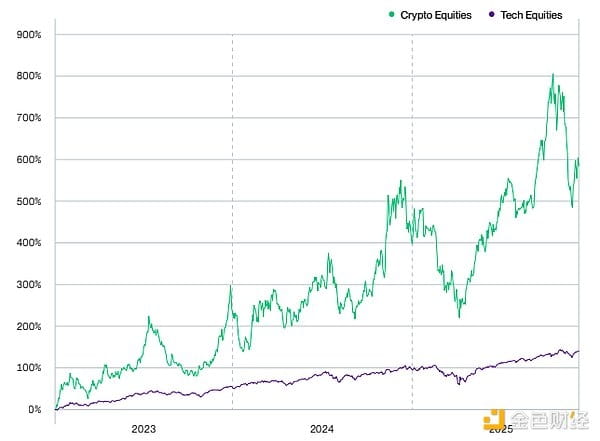
Source: Bitwise Asset Management, data from Bloomberg. Data range: December 31, 2022, to December 5, 2025. Note: 'Cryptocurrency-related stocks' are represented by the Bitwise Crypto Innovators 30 Index; 'tech stocks' are represented by the Nasdaq 100 Index.
Prediction five: Polymarket's open contracts will hit an all-time high, surpassing levels seen during the 2024 elections.
Polymarket is set to experience a breakout moment in 2024. This popular prediction market reached open contracts of 500 million USD during the 2024 U.S. elections, but fell significantly to just 100 million USD after the elections. Many wonder: does Polymarket need another presidential election to return to its previous highs?
We believe there is no need. We expect Polymarket to easily break its historical record in 2026.
There are three reasons:
U.S. market opening: Although U.S. residents previously could not bet in this market, Polymarket has become a household name in the U.S. This situation will change in 2026—the platform began opening access to U.S. users in early December. We expect betting across various themes, from politics and economics to sports and pop culture, will significantly boost platform activity.
Institutional support and operational upgrades: Polymarket recently secured a 2 billion USD investment from the Intercontinental Exchange (the parent company of the New York Stock Exchange). The company is using these funds to upgrade operations, such as signing authorization agreements with the National Hockey League (NHL) and integrating data directly into Google Finance. They are pushing for scaling development.
New market expansion: Polymarket has entered the mainstream with political markets, but has also achieved steady growth in other areas such as sports, pop culture, cryptocurrency, and economics. With the U.S. midterm elections approaching, political topics are regaining focus, and the platform will ramp up efforts in 2026.
Polymarket: Open contracts categorized by type
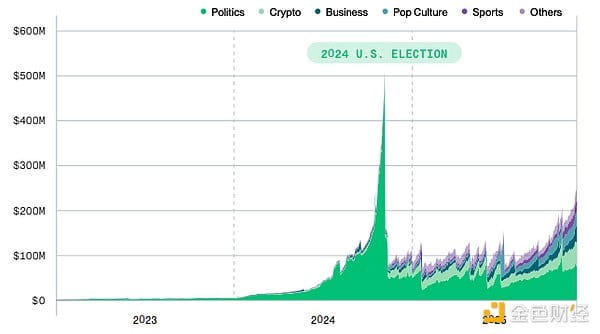
Source: Bitwise Asset Management, data from Blockworks Research. Data up to December 5, 2025. Note: Open contracts refer to the total dollar value of all unfulfilled bets at a given moment.
Prediction six: Stablecoins will be accused of undermining the stability of emerging market currencies.
Stablecoins are rapidly developing.
Dollar tokenization represented by USDT and USDC had a market size of 205 billion USD at the beginning of the year. Today, this market size has approached 300 billion USD and may reach 500 billion USD by the end of 2026. In other words, the scale of stablecoins is large enough to have a significant impact.
This is good news: Stablecoins are a higher quality, cheaper, and faster way to transfer funds. What reason is there not to be optimistic?
However, for central banks in countries facing high inflation, there are many areas that require caution.
Multiple studies show that the adoption of stablecoins is primarily concentrated in emerging markets, with usage surging in areas with the highest inflation rates. This is because, among other uses, stablecoins allow people in high-inflation countries to easily convert funds into relatively stable dollar savings instead of their local currency. For example, in Venezuela, the exchange rate of its currency, the Bolívar, against the dollar fell by about 80% in 2025.
For savers, converting funds to stablecoins is an excellent choice, but it's not good for central banks—it means funds are leaving their control. The Bank for International Settlements (BIS), a coalition of central banks, warned its members earlier this year: 'The widespread use of stablecoins may undermine the monetary sovereignty of the relevant jurisdictions.'
As cryptocurrencies enter the mainstream, we expect that one or two countries will explicitly blame stablecoins for their currency issues. Of course, this statement is not correct; if a country's currency is sound, its people would not turn to stablecoins. However, this will not prevent these countries from issuing warnings.
Market size of stablecoins
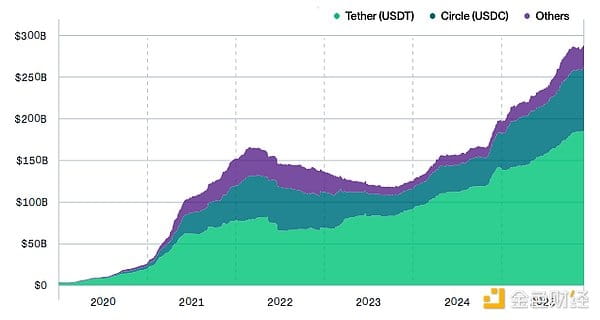
Source: Bitwise Asset Management, data from The Block. Data range: January 1, 2020, to December 5, 2025. Note: 'Others' include stablecoins such as BUSD, crvUSD, DAI, FDUSD, FEI, FRAX, GHO, GUSD, HUSD, LUSD, MIM, PYUSD, TUSD, USD1, USDD, USDe, USDP, and USDS.
Prediction seven: The asset management scale (AUM) of on-chain vaults (also known as '2.0 version ETFs') will double.
Most people have not heard of on-chain vaults, but this will change in 2026.
Vaults are similar to on-chain investment funds. Users deposit assets (usually stablecoins like USDC) into vaults, and third-party 'managers' allocate funds in various ways to generate returns, primarily focused on decentralized finance (DeFi).
On-chain vaults began to rise significantly in 2024, with asset management scales growing from less than 100 million USD to 2.3 billion USD. In 2025, market attention surged, peaking at an asset management scale of 8.8 billion USD, but volatility spikes in October 2025 led to losses from poorly managed strategies.
Since then, the asset management scale of the vault has receded, but this situation will not last long.
We believe this is a painful but necessary maturation process. If billions of dollars are to be managed through on-chain vaults, institutional-level risk management will become a fundamental requirement.
We believe that in 2026, a batch of high-quality managers will enter the market, attracting billions of dollars in inflows into their managed vaults. The speed of development in this area will be so rapid that it will attract the attention of mainstream financial media. Media outlets like Bloomberg, The Wall Street Journal, or Financial Times will have one that refers to vaults as '2.0 version ETFs.'
Asset management scale (AUM): On-chain vaults
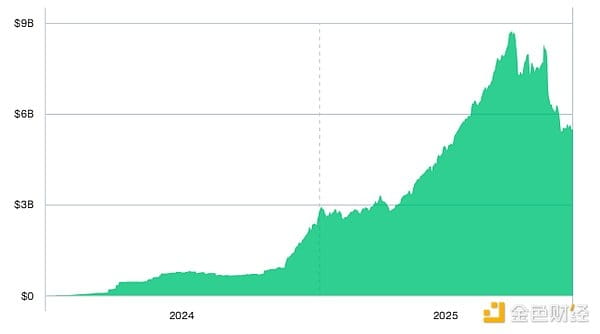
Source: Bitwise Asset Management, data from Blockworks Research. Data range: January 1, 2024, to December 5, 2025. Note: Data on the asset management scale of on-chain vaults is limited. The above includes the asset management scale of two leading on-chain vault platforms, Morpho and Euler.
Prediction eight: If the (CLARITY Act) passes, ETH and Solana will hit new all-time highs.
We are optimistic about Ethereum and Solana. Very optimistic. The main reason is that we believe stablecoins and tokenization are huge growth trends, and Ethereum and Solana are likely to become the biggest beneficiaries of this growth.
However, the recent growth of stablecoins and tokenization largely depends on the ongoing advancement of U.S. regulation. In 2025, the (GENIUS Act) focusing on stablecoins was passed, marking an important step forward. To achieve the next step, the U.S. Congress needs to pass market structure legislation in the form of the (CLARITY Act).
Market structure legislation will provide clear guidance for cryptocurrency regulation in the United States, including whether regulatory responsibilities are led by the U.S. Securities and Exchange Commission (SEC) or the Commodity Futures Trading Commission (CFTC). If the law fails to clarify these divisions, the attitude of U.S. regulatory agencies toward cryptocurrencies may change with new electoral results.
The outlook for the passage of market structure legislation in 2026 is mixed. If the (CLARITY Act) is passed, we believe it will trigger a bull market in the cryptocurrency market (in cryptocurrency terms, it will be 'stunning'). ETH and Solana will be the two major beneficiaries, with prices soaring to new all-time highs. If the bill fails to pass, a rethink will be necessary.
Potential gains after the passage of market structure legislation
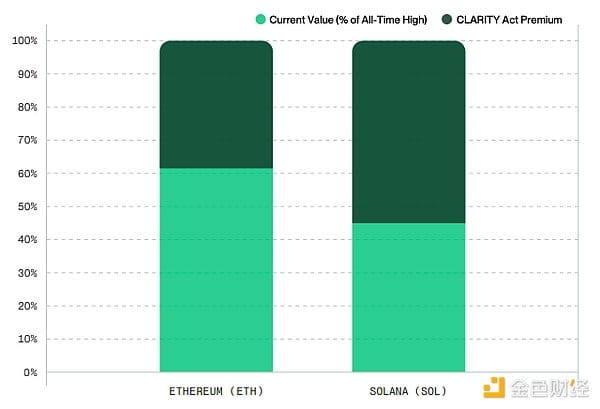
Source: Bitwise Asset Management, data from CoinGecko. Data up to December 5, 2025. Note: The historical highest price of Ethereum (ETH) is $4,946.05, and the historical highest price of Solana (SOL) is $293.31.
Prediction nine: Half of Ivy League endowment funds will invest in cryptocurrencies.
Earlier this year, Brown University became the first Ivy League endowment fund to allocate Bitcoin, initially buying about 5 million USD worth of Bitcoin ETFs. We expect more Ivy League schools to join this trend in 2026.
This trend is significant for two reasons:
First of all, it is evident that endowment funds control huge amounts of capital—recent statistics show a total of 871 billion USD. If they follow Harvard University's lead and allocate about 1% of their portfolios to Bitcoin, the impact will be significant.
Secondly, while less obvious but more importantly, endowment funds—especially those from Ivy League schools—are often trendsetters. For example, many believe that Yale's acceptance of hedge funds in the early 2000s propelled significant growth in the industry over the past 20 years. If Harvard and other Ivy League investments succeed, they could attract a large number of pensions, insurance companies, and other institutions to join the ranks of cryptocurrency investors.
In other words: 'Since Harvard University is allocating Bitcoin, maybe we should too.'
Asset management scale and Bitcoin allocation: Ivy League endowment funds
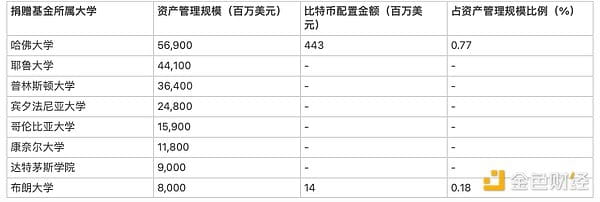
Source: Bitwise Asset Management, data from Forbes and Bloomberg. Data on endowment fund asset management scale is as of November 2, 2025; Bitcoin allocation data is as of September 30, 2025.
Prediction ten: The U.S. will launch over 100 cryptocurrency-related ETFs.
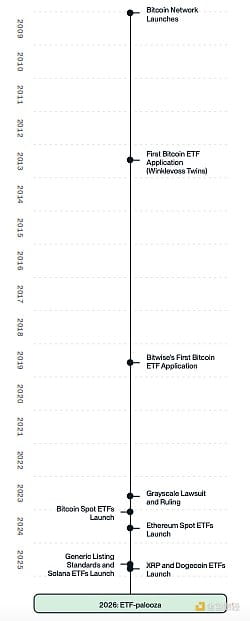
For over a decade, the U.S. Securities and Exchange Commission (SEC) repeatedly rejected cryptocurrency ETF applications. Subsequently, under pressure from court rulings, the SEC finally relented and approved the listing of a Bitcoin ETF in January 2024. Six months later, the door opened further with the official launch of an Ethereum ETF.
Today, the surge in cryptocurrency ETFs has already arrived.
In October 2025, the SEC issued universal listing standards allowing ETF issuers to launch cryptocurrency ETFs based on a set of common rules. Subsequently, the Solana ETF (with staking features) was quickly listed and attracted over 600 million USD in inflows within months. Products related to Ripple (XRP) and Dogecoin also followed closely. As of the publication of this article, more cryptocurrency ETFs are entering the market.
Looking ahead to 2026, we believe that a clear regulatory roadmap and the market's urgent demand for cryptocurrency ETFs will lay the foundation for an 'ETF frenzy.'
We expect that over 100 cryptocurrency-related ETFs will be launched, including spot cryptocurrency ETFs, cryptocurrency + staking ETFs, cryptocurrency-related stock ETFs, and cryptocurrency index ETFs.
Additionally, we believe that Bitwise will launch the number one ETF by inflow in 2026.
Timeline of cryptocurrency ETFs: 2009 to 2026
Source: Bitwise Asset Management.
Additional prediction: The correlation between Bitcoin and stocks will decrease.
Many people—especially in the media—often say that Bitcoin is highly correlated with the stock market.
But the data does not reflect this.
From a 90-day rolling correlation perspective, Bitcoin's correlation with the S&P 500 index rarely exceeds 0.50 (which is the conventional boundary between 'low correlation' and 'moderate correlation' in statistics).
In any case, we believe that the correlation between Bitcoin and stocks in 2026 will be lower than in 2025. The reason is that we expect that even if the stock market is troubled by valuation concerns and short-term economic growth issues, regulatory progress and institutional adoption—unique factors in the cryptocurrency field—will still drive cryptocurrency prices up.
Correlation: Bitcoin vs. S&P 500 Index (90-day rolling)
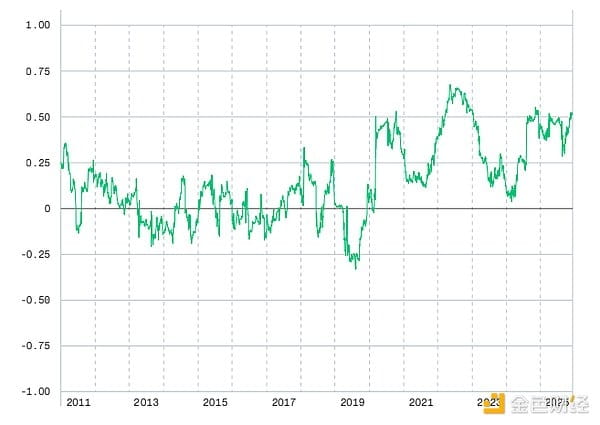
Source: Bitwise Asset Management, data from Bloomberg. Data range: December 31, 2010, to December 5, 2025. Note: Traditionally, the range of -0.5 to 0.5 is defined as 'low correlation' or 'no correlation.'


