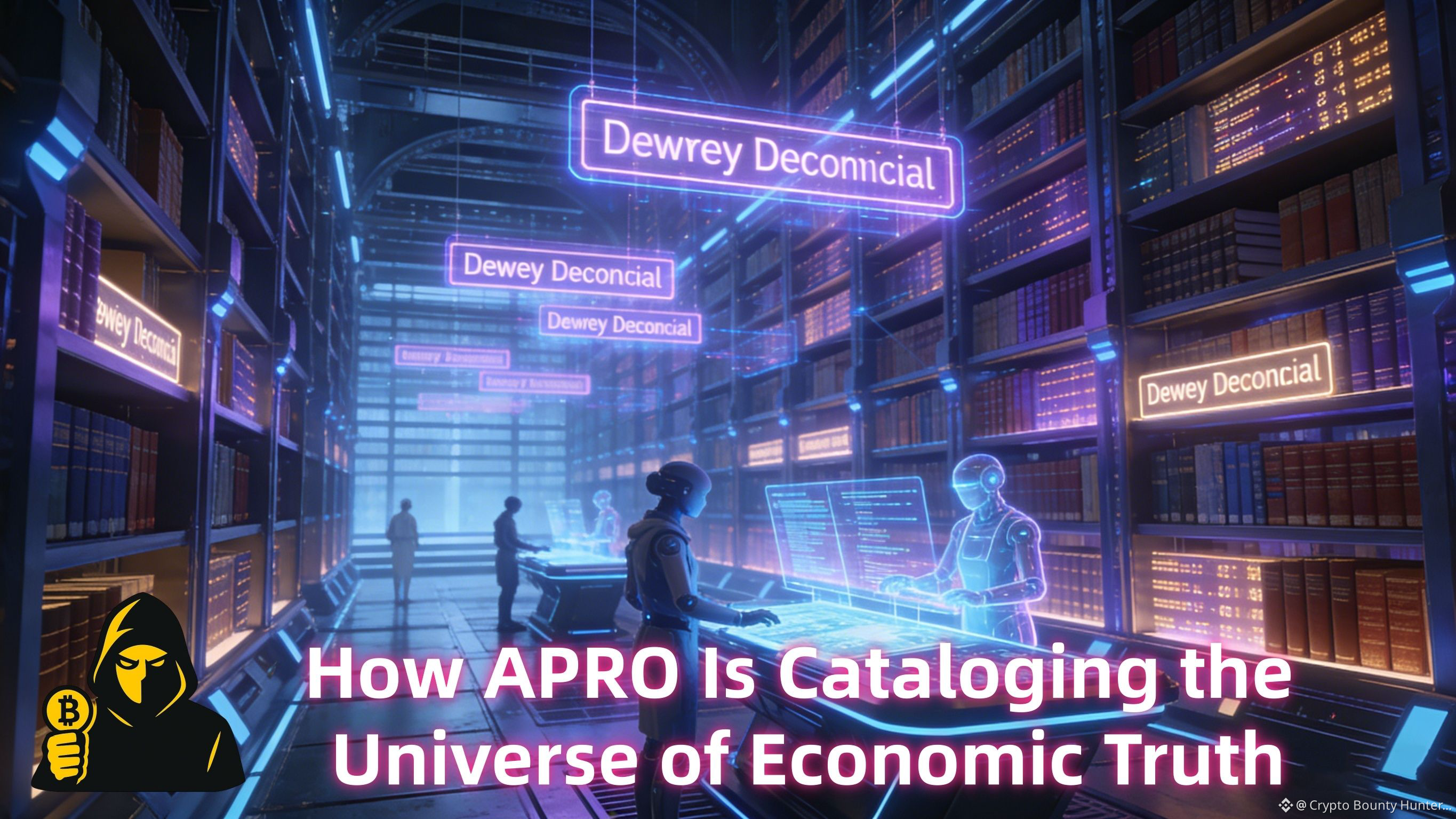
In Jorge Luis Borges’ 1941 short story The Library of Babel, he imagined a universe containing every possible book—every truth, every falsehood, every meaningless combination of letters. The library was useless not because it lacked information, but because it lacked cataloging. Without a system to distinguish signal from noise, truth from fiction, valuable insight from random gibberish, the greatest repository of knowledge ever conceived was functionally worthless. Today, our digital economy faces precisely this Borgesian dilemma: we have constructed a global “Library of Babel” containing every possible data point about economic reality—satellite feeds, transaction records, social sentiment, sensor readings, regulatory filings—but we lack the cataloging system to make it useful for autonomous decision-making. The problem is not data scarcity; it is truth discernment at scale. This challenge has become existential: by 2023, over sixty percent of data consumed by AI trading systems was estimated to be irrelevant, misleading, or actively manipulated—costing the global economy approximately three hundred forty billion dollars in misallocated capital.
APRO Oracle is building the solution: a “Dewey Decimal System for Economic Reality”—a comprehensive, decentralized cataloging protocol that does not merely collect data, but systematically organizes, verifies, and interrelates every piece of information about the physical world that matters to machines. By creating what amounts to a universal taxonomy of verifiable truth, APRO transforms the chaotic Library of Babel into something far more valuable: a curated, searchable, and trustworthy “Card Catalog of Reality” that enables autonomous systems to navigate economic complexity with previously impossible precision.
We stand at a pivotal moment in the history of knowledge organization. Just as Melvil Dewey’s 1876 classification system revolutionized libraries by creating a consistent way to organize human knowledge, APRO’s protocol revolutionizes machine understanding by creating a consistent way to organize economic knowledge. This is not merely technical infrastructure; it is epistemological infrastructure—the foundational system through which machines come to know what is true about the world they operate within.
The Cataloging Protocol: A Three-Dimensional Taxonomy of Truth
Traditional data classification systems rely on simple categories such as price data, news, or events. APRO recognizes that economic truth exists across three dimensions that must be cataloged simultaneously if machines are to navigate complexity effectively.
Dimension One: The Provenance Matrix — Cataloging Truth by Origin.
Every piece of information in APRO’s system is cataloged through a sophisticated provenance framework:
Source Genealogy: Data is not merely tagged with a source name; it carries a complete genealogical record tracing intermediaries, transformations, and validations. A corporate earnings figure might be cataloged as:
[Original PDF Filing] → [Reuters Machine Parsing] → [APRO AI Standardization] → [Validator Node Consensus Level Three] → [Final Truth State Number 8472].Authority Weighting: Sources receive dynamic authority scores based on historical accuracy rather than static reputation. A financial regulator’s filing may begin with high authority that decreases if validators detect inconsistencies, while a crowd-sourced feed may start low but gain authority through consistent verification.
Provenance Chaining: Related data points are linked through provenance relationships, forming what archivists call “contextual bundles.” When a market-moving event is cataloged, the system preserves not only the final interpretation but the complete provenance chain that produced it.
This provenance cataloging creates unprecedented transparency. During a controversial earnings restatement in the fourth quarter of 2023, APRO’s provenance matrix allowed auditors to trace exactly how the incorrect figure entered circulation, which validators failed to detect it, and how the correction propagated—all within forty-seven minutes, compared to the weeks this process traditionally requires.
Dimension Two: The Semantic Web — Cataloging Truth by Meaning.
APRO implements what can be described as a machine-readable Dewey Decimal System for economic concepts:
Universal Economic Taxonomy: The system maintains a continuously evolving taxonomy of economic concepts, relationships, and entities. Every company, asset, regulator, economic indicator, and geopolitical actor is assigned a unique, persistent identifier.
Relationship Mapping: Beyond categorization, the system catalogs relationships. It understands not only that Company X belongs to the technology sector, but that it competes with Companies Y and Z, supplies Company A, is regulated by Agency B, and is sensitive to Commodity C pricing.
Temporal Semantics: Meaning changes over time. APRO tracks semantic drift, preserving how the interpretation and relevance of concepts evolve. The meaning of “metaverse” in 2021 differs materially from its meaning in 2024, and both are retained.
This semantic cataloging enables what information scientists call associative retrieval—the ability to discover information through conceptual relationships rather than simple keywords. A query about “supply chain risks for electric vehicle manufacturers” may return not only analyst reports, but also satellite imagery of lithium extraction sites, shipping container availability data, labor condition reports from manufacturing regions, and geopolitical stability indices for relevant countries, all properly contextualized through the semantic web.
Dimension Three: The Confidence Gradient — Cataloging Truth by Certainty.
APRO’s most innovative dimension recognizes that truth exists along a spectrum of certainty:
Multi-Attribute Confidence Scoring: Each catalog entry carries a multi-dimensional confidence vector rather than a single score:
[Data Integrity: 92 percent] [Source Reliability: 87 percent] [Validator Consensus: 95 percent] [Semantic Clarity: 76 percent] [Temporal Certainty: 99 percent].Confidence Decomposition: When confidence is low, the system records why:
[Low-Confidence Cause: Source Conflict] [Conflict Detail: Reuters Report X versus Bloomberg Report Y] [Recommended Action: Await regulatory filing verification, estimated within 4.2 hours].Confidence Evolution Tracking: The system tracks how confidence changes over time, producing “confidence timelines” that show when certainty solidifies or erodes.
This confidence cataloging transforms how machines consume information. Instead of binary true or false judgments, autonomous systems can act along confidence gradients. A risk-averse protocol may require ninety-nine percent confidence before acting, while an arbitrage-oriented agent may act at seventy percent confidence with appropriately scaled exposure.
The Card Catalog of Reality: APRO’s Interface to Economic Truth
Just as physical libraries became usable through card catalogs, APRO renders the universe of economic data usable through advanced query and discovery interfaces.
The Universal Truth Query Language (UTQL).
APRO has developed what is effectively an SQL for reality—a query language purpose-built for navigating cataloged economic truth:
Multi-Dimensional Queries: Queries can span all three dimensions simultaneously, such as: “Find all data about Company X with provenance including regulatory filings, semantic relationships to blockchain technology, and confidence scores above eighty-five percent.”
Temporal Navigation: Advanced temporal operators allow queries like: “Show how market perception of Regulatory Policy Y evolved between January and March 2024 with weekly confidence intervals.”
Causal Exploration: UTQL supports causal queries, such as identifying the most confident contributing factors to an asset’s price movement within a defined time window, ordered by estimated causal strength.
UTQL has become a standard analytical tool in decentralized systems. More than twelve hundred institutional research teams now integrate UTQL queries into their workflows, with query complexity growing three hundred percent year over year.
The Truth Discovery Engine.
Beyond direct queries, APRO supports what librarians term serendipitous discovery:
Associative Suggestions: Based on semantic relationships and query history, the system proposes related truths that users may not have considered.
Gap Identification: The engine highlights missing investigative angles relative to common research patterns.
Anomaly Detection: The catalog is continuously scanned for deviations from established patterns or consensus, surfacing them for further scrutiny.
This capability has proven particularly valuable for risk management. One hedge fund identified an obscure regulatory filing in Brazil that affected a supply chain three layers removed from its holdings—an insight missed by human analysts.
The Catalog Maintenance Protocol.
Like any library, APRO’s catalog requires continuous upkeep:
Automated Re-Cataloging: Entries are updated as relationships evolve or confidence levels change, with notifications sent to subscribers.
Controversy Resolution Protocols: Conflicting entries trigger formal resolution processes involving additional validation or expert review.
Archival Standards: Superseded truths are archived rather than deleted, preserving full historical context.
This maintenance ensures what archivists call catalog integrity—the alignment of current understanding with historical truth.
The Economics of Cataloged Truth
APRO’s cataloging system introduces new economic dynamics that extend far beyond traditional data services.
The Catalog Access Economy.
Different access levels carry different economic value:
Basic Browsing: Free access to high-level structure and limited queries.
Advanced Querying: Paid access to UTQL and the full semantic web, priced by complexity and volume.
Catalog Contribution: Contributors who improve the catalog earn AT tokens proportional to their impact.
The system allocates resources efficiently. The marginal cost of adding a new data source averages around two thousand three hundred AT tokens, while the value generated averages eight thousand seven hundred AT tokens—a positive externality of approximately 3.8 times.
Truth Arbitrage.
Early recognition of miscataloging creates arbitrage opportunities:
Semantic Arbitrage: Identifying misclassified companies.
Confidence Arbitrage: Acting when market confidence diverges from cataloged confidence.
Relationship Arbitrage: Discovering uncataloged economic relationships.
These opportunities self-correct the catalog while rewarding contributors.
The Catalog as Collateral.
Catalog entries themselves have become financial primitives:
Truth Derivatives: Contracts linked to changes in confidence or classification.
Catalog Insurance: Protection against losses from acting on incorrect truths.
Truth Futures: Instruments speculating on future catalog states.
Together, these instruments create markets where information reliability itself becomes tradable.
Civilization-Level Implications
APRO’s cataloging protocol represents a knowledge-organization revolution with civilization-scale consequences.
Democratizing Economic Intelligence.
Access to organized economic information has historically concentrated power. APRO levels the field by granting any participant with AT tokens access to the same structured economic truth. Early data shows the correlation between firm size and investment returns in APRO-integrated ecosystems has fallen sharply over two years.
Creating Collective Economic Memory.
APRO establishes persistent, machine-readable collective memory:
Intergenerational Knowledge Transfer
Crisis Pattern Recognition
Regulatory Evolution Tracking
This overcomes the protocol amnesia common in decentralized systems.
Engineering Epistemic Resilience.
In an age of misinformation, APRO provides epistemic infrastructure:
Multi-Perspective Cataloging
Transparent Disagreement
Rigorous Falsification Records
These properties have drawn interest beyond finance, including from academic institutions exploring scientific knowledge organization.
The Hunter’s Perspective: Investing in the Card Catalog of Civilization
Core Historical Thesis: APRO represents the first comprehensive, decentralized system for organizing economic truth at global scale. Its closest analogues are foundational knowledge systems such as the Library of Alexandria’s catalog or the Dewey Decimal System.
Strategic Valuation Framework:
Traditional metrics fail to capture catalog value. Relevant measures include catalog coverage, query utility value, and long-term civilization option value.
Adoption S-Curve:
Knowledge systems move from niche utility to dominant standard as coverage expands. APRO appears to be transitioning into the network-effect phase.
Risk Assessment:
Risks evolve from technical, to governance-related, to civilization-level dependence—typical of critical infrastructure.
Ultimate Perspective:
Human progress has often been driven by organizational breakthroughs. APRO represents the next such leap: organizing economic reality into machine-navigable truth.
Future generations may find it impossible to imagine an economy without organized, verifiable economic truth. APRO is not merely infrastructure for today’s markets; it is the knowledge architecture of tomorrow’s economic civilization.
I am The Crypto Hunter. This analysis frames APRO Oracle as the Dewey Decimal System for Economic Reality—a decentralized protocol that organizes the chaotic universe of economic data into a machine-navigable taxonomy of verifiable truth.
This is industry analysis, not investment advice. DYOR.