

Imagine trying to send a physical gold container from New York to Tokyo. It's slow, expensive, requires armed security, and a lot of bureaucracy. Now, imagine if you could teleport this value instantly, converting it into light and reconverting it into gold at the destination.
For years, the crypto market treated XRP as just another speculative token, ignoring that it was not designed to replace Bitcoin as a store of value, nor Ethereum as a global computer. XRP was built to be the "oil" in the rusty gears of the global banking system. While retail chases dog memecoins, the XRP Ledger (XRPL) has been positioning itself as the neutral infrastructure for institutional money. The question is not whether XRP will "go to the moon," but whether it will become the invisible standard that moves the world's money.
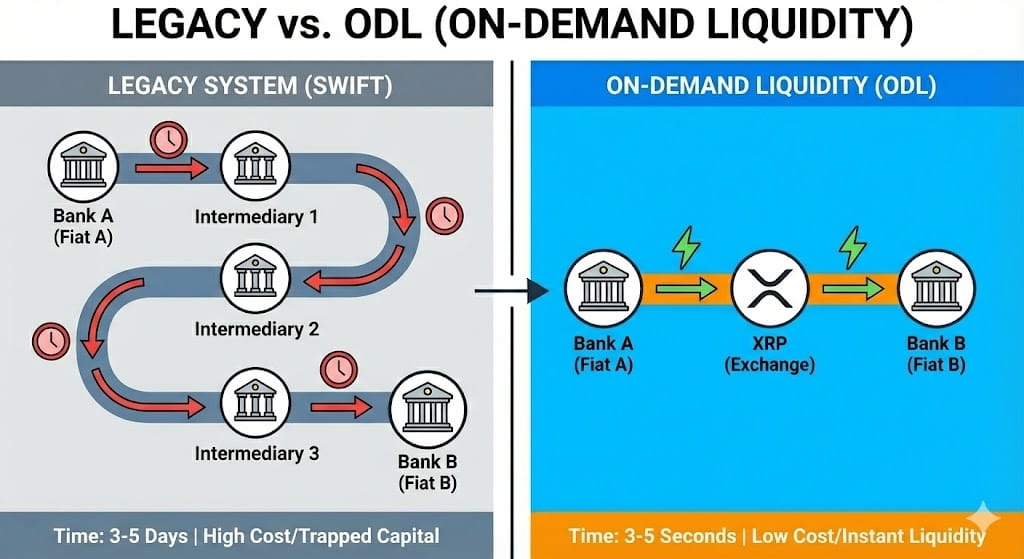
To understand the intrinsic value of XRP, we need to dissect the concept of ODL (On-Demand Liquidity). In the traditional banking system (the Nostro/Vostro legacy), banks need to keep trillions of dollars "sleeping" in accounts around the world just to pre-finance future transfers. This is dead capital.
XRP solves this by acting as a "bridge currency." It does not require mining (Proof-of-Work) or traditional staking. The XRPL uses a Federated Consensus Protocol, allowing settlement in 3 to 5 seconds with a negligible transaction cost (fractions of a cent).
Recently, the introduction of the XLS-30d amendment brought native AMM (Automated Market Maker) functionality to the Ledger. This is crucial. Unlike other blockchains where AMMs are external applications (dApps), on the XRPL, liquidity is integrated into the protocol. This means that any asset tokenized on the network (whether treasury bonds, gold, or fiat currencies) can be automatically exchanged using XRP as the central liquidity vehicle.
The Trend Factor: The Convergence with TradFi and RWA
We are at an inflection point. The market narrative has shifted from "Crypto Anarchist" to "Crypto Institutional." With large asset managers looking to tokenize real-world assets (RWA), the speed and certainty of settlement become the most precious commodities.
Ripple (the company) is strategically launching its stablecoin, the RLUSD. Many analysts have mistakenly seen this as a "replacement" for XRP. On the contrary, it is a utility multiplier.
Stablecoins provide the stable value preservation that conservative institutions require, while XRP provides the "highway" to move that value and the gas fees for the network. The combination of a regulated stablecoin with a decentralized bridge asset creates a perfect hybrid ecosystem for banks that want blockchain efficiency without extreme volatility on their balance sheets.
Verdict: Future Outlook
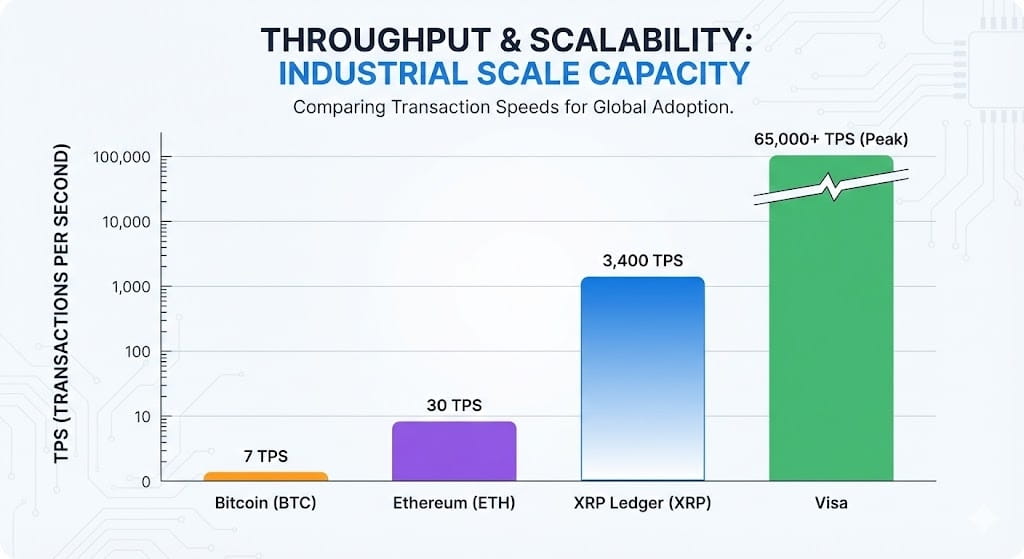
The regulatory noise that has suppressed the price of XRP for years is dissipating, giving way to metrics of real utility. The future of the asset depends less on retail "hype" and more on B2B (Business-to-Business) integration.
The Logical Projection:
If the XRPL captures just a fraction of 1% of the daily volume of interbank transfers (which exceeds 5 trillion dollars), the buying pressure generated by the need for ODL will create a supply shock. XRP is deflationary (transaction fees are burned), and as network activity increases, scarcity increases.
For the smart investor, XRP is not a short-term bet; it is a bet on the inevitable modernization of the global financial infrastructure. We are witnessing the transition from the "testing" phase to the "implementation" phase. Keep an eye on ODL volumes and Asian banking partnerships — that’s where the real game is being played.