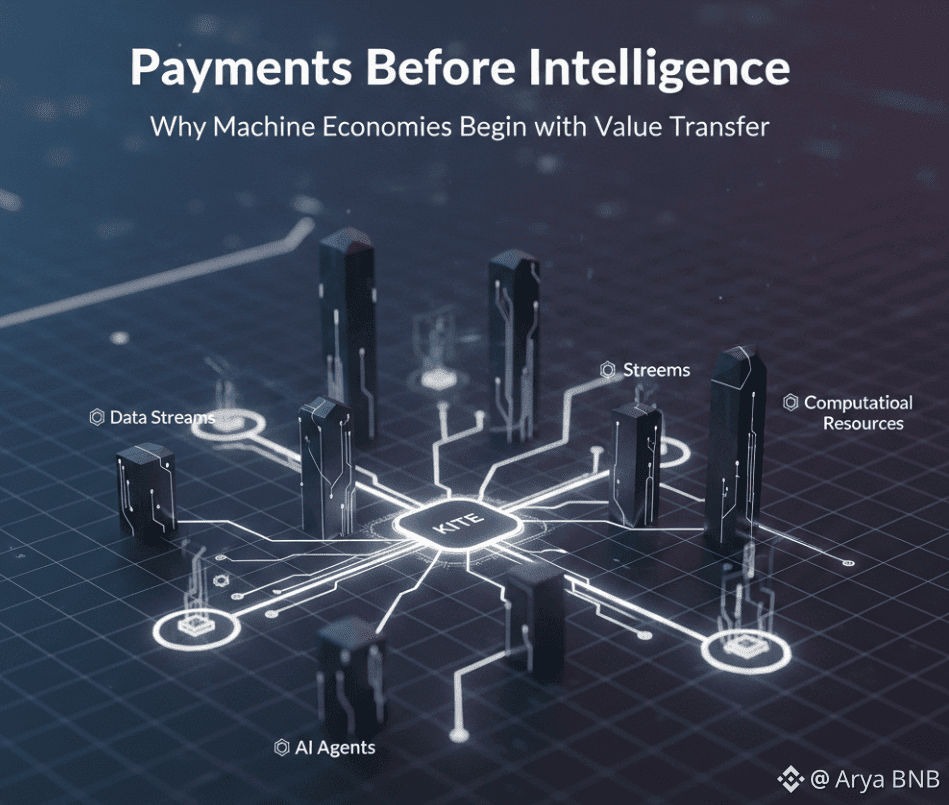
Long before intelligence reshaped economies payments did. Trade preceded institutions currency preceded regulation and value exchange preceded complex coordination. The same pattern is now repeating in the age of artificial intelligence. While much of the public conversation around AI focuses on models, reasoning and autonomy, the quieter and more consequential shift is happening at the level of economic interaction. Before machines can meaningfully cooperate, compete or self organize they must be able to exchange value. Examines why payments are not a secondary feature of agentic systems but the first primitive and why Kite is designed around this foundational truth.
The modern digital economy is still fundamentally human paced. Payments occur in batches approvals happen asynchronously and trust is mediated by institutions designed for human accountability. AI agents, by contrast operate continuously. They monitor signals adapt strategies and execute actions without pause. When such systems are forced to rely on human triggered payment flows or centralized intermediaries their autonomy collapses into dependency. The agent may decide what to do, but it cannot decide how to settle the cost of doing it. This mismatch creates friction that grows exponentially as agents scale in number and sophistication.
Kite approaches this problem by reframing payments as a native capability of autonomous systems rather than an external service. On Kite value transfer is not an afterthought layered on top of computation it is embedded directly into the execution environment. An agent does not merely call an API and later reconcile costs it transacts in real time settling value as actions occur. This immediacy transforms payments from a bookkeeping function into a coordination signal. When agents pay each other instantly prices become information incentives become programmable and markets become continuous.
This shift has profound implications for how economic behavior emerges among machines. In human markets, delays, friction and negotiation overhead shape outcomes as much as supply and demand. In machine economies these inefficiencies dissolve. Agents respond to price changes in milliseconds arbitrage disappears almost as soon as it forms and coordination becomes algorithmic rather than social. Kite’s real time Layer 1 design recognizes that these environments demand not just decentralization but temporal precision. A delayed payment is not merely inconvenient it distorts the decision making loop of autonomous systems.
Identity becomes inseparable from payments in this context. For humans trust is often inferred socially or institutionally. For agents trust must be explicit , verifiable and machine readable. Kite’s three layer identity model ensures that every payment is attributable not just to a wallet but to an agent operating within a defined scope and session. This allows counterparties to reason about risk programmatically. An agent can decide whether to transact based on who is acting, under what authority and for how long that authority remains valid. Payments, identity and permissions collapse into a single coherent system.
The KITE token functions as the connective tissue of this emerging machine economy. Its role is not limited to covering fees or incentivizing early participation. Instead KITE becomes a unit of coordination through which agents express preference, access resources and participate in governance. As token utility expands into staking and on chain decision making agents themselves can become stakeholders in the systems they depend on. This creates feedback loops where agents are not only users of the network but contributors to its security and evolution. Economic alignment shifts from static rules to adaptive participation.
What distinguishes Kite from earlier blockchain experiments is its refusal to anthropomorphize machines while still holding them accountable. Many systems either treat agents as fully sovereign actors introducing unacceptable risk or reduce them to mere extensions of human wallets. Kite occupies the space in between. Agents are autonomous, but bounded. They can transact freely but only within explicitly granted constraints. Payments enforce those constraints automatically. When funds run out authority ends. When permissions expire transactions cease. Autonomy is enforced not by trust but by design.
Over time this architecture enables forms of organization that are difficult to imagine through a human centric lens. Networks of agents may emerge that specialize, trade and coordinate without direct human oversight yet remain legible and governable on chain. Enterprises may deploy internal economies where agents compete for resources based on performance. Protocols may evolve where agents negotiate governance outcomes by staking value on forecasts or outcomes. In all cases payments remain the common language through which intent is expressed and enforced.
The history of technology suggests that the most enduring systems are those that align incentives before they optimize intelligence. Kite reflects this lesson. By treating payments as the first primitive of machine economies it builds a foundation on which more sophisticated forms of autonomy can safely emerge. As AI systems continue their transition from tools to actors the networks that succeed will not be those that think the hardest but those that settle value the fastest and the most transparently. Kite is building for that future one transaction at a time.