
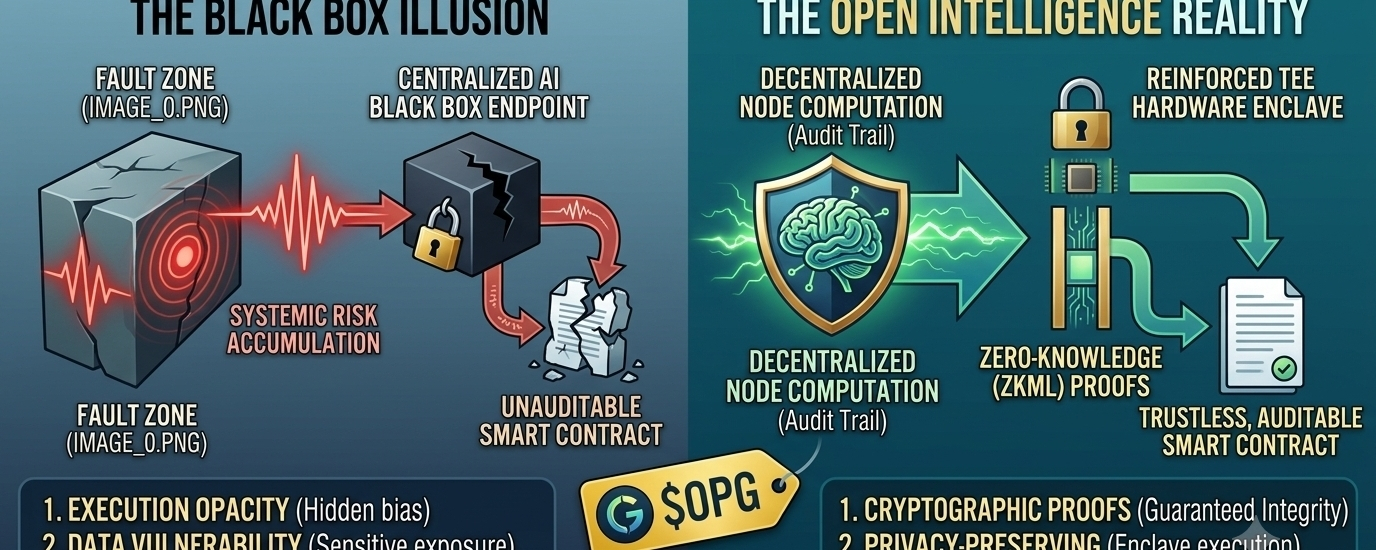
In traditional geodynamics, a dangerous myth occasionally surfaces—such as the structural misconception seen in the infographic 52719.jpg—claiming that active fault lines can act as "natural shock absorbers" to magically cushion nearby cities from destructive energy. As any structural engineer knows, this is a fatal error. Fault lines do not absorb stress; they accumulate tectonic tension until it violently releases, transmitting shockwaves through the entire system.
When a macroeconomic or digital "earthquake" hits the financial markets—forcing liquidations, shifting institutional liquidity, and triggering cascading stop-losses—a parallel psychological trap occurs. Many market participants think their portfolios are safe simply because they rely on massive, centralized "black-box" systems, treating them as structural cushions.
In reality, opacity doesn't absorb risk. It conceals it until the next major shockwave fractures the network.
📉 The Shockwaves of Centralized Opacity
When external macro stress tests or algorithmic corrections hit the Web3 ecosystem, centralized APIs and opaque AI models behave exactly like an active fault line. Instead of protecting your on-chain logic, they become the primary source of operational risk:
Tectonic Liquidation Cascades: When data is centralized, a single infrastructure outage or corrupted data feed can trigger cascading failures across interconnected smart contracts.
The Myth of the "Buffer": Believing that centralized tech corporations will protect your transaction privacy and execution integrity during high-volatility events is the digital equivalent of trusting a active geological fault to protect a city.
🛡️ The Earthquake-Resistant Fix: OpenGradient's Structural Rigidity
A city survives a major seismic event not by hoping for geological miracles, but by implementing strict seismoresistant engineering. In Web3 and AI, that engineering is precisely what the official account of @OpenGradient is building.
To withstand the inevitable shocks of the digital market, OpenGradient replaces blind trust with decentralized, mathematical infrastructure, establishing true Open Intelligence:
Reinforced Hardware Enclaves (TEEs): Computation is forced inside isolated, hardware-encrypted enclaves within node processors. Even during a massive market panic, external vectors cannot alter model weights or exploit input parameters, ensuring total execution integrity.
Cryptographic Structural Integrity (ZKML): By generating succinct zero-knowledge proofs, the network mathematically guarantees to the blockchain that every single inference was executed flawlessly, eliminating the "black-box" point of failure completely.
🧠 The Manager's Rule: Leave Emotion in the Dugout
When the charts start shaking and the market undergoes structural volatility, a disciplined trader doesn't rely on illusions or look for "miraculous" cushions. You build a solid defense.
De-leverage and Map Risk: Identify key institutional accumulation blocks on your charts during higher timeframes.
Automate the Shields: Deploy rigorous automation tools on Binance—like Limit and OCO (One-Cancels-the-Other) orders—to protect your capital programmatically, removing human panic from the equation entirely.
Speculative momentum eventually fades, but foundational infrastructure remains standing. Monitoring the utility, node locking mechanisms, and structural data integrity driving the token $OPG is the logical protocol for anyone managing risk with absolute discipline in this cycle.
When the market experiences structural shifts, do you rely on opaque centralized buffers, or do you evaluate the underlying engineering? Let's talk data and mechanics below! 👇
#OPG #BinanceSquare #Web3Infrastructure #RiskManagement #ZKML #LuisAnalista