
$XRP Significant changes in financial infrastructure rarely make headlines with dramatic market movements. Instead, they often develop quietly through regulatory approvals and institutional integration, laying the groundwork for long-term transformation.
While traders remain focused on short-term price action, deeper developments are reshaping the role of XRP within the U.S. banking system, signaling a structural change that could influence the market for years.
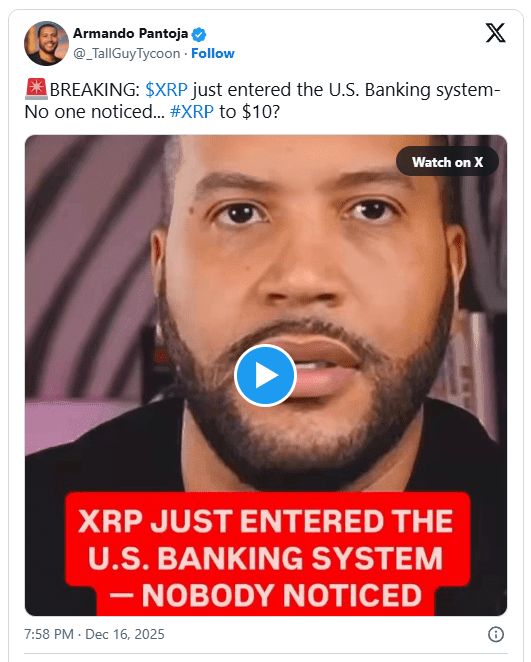
In a recent video shared on X, cryptocurrency commentator Armando Pantoja highlighted an underappreciated development. He explained that Ripple has received regulatory approval from the U.S. to operate as a bank, a move that, according to Ripple CEO Brad Garlinghouse, lays the groundwork for significant XRP growth in 2026.
Pantoja emphasized that this milestone is intended for banks and institutions rather than traders, noting that “This news is not for traders. It is for banks and large institutions.”
✨Ripple National Trust Bank: Redefining the Role of XRP Infrastructure
Pantoja elaborated on what bank approval means. Ripple's new entity, Ripple National Trust Bank, is not a traditional bank. “They are not going to accept deposits, they are not going to grant loans,” he explained.
Instead, it allows Ripple to securely custody digital assets, facilitate payments, and interact directly with other banks. In finance, trust is critical, and regulatory approval provides that credibility. With this status, Ripple can build and operate U.S.-based payment systems, placing XRP firmly within the financial plumbing layer rather than being a speculative retail asset.
This development positions Ripple to compete in areas historically reserved for traditional institutions. Traditional banks typically only work with trusted and regulated entities. Ripple's status as a trusted bank ensures institutional confidence, which could ultimately accelerate the adoption of XRP within formal financial networks.
✨Why the Price of XRP Has Not Reacted
Despite the importance, the price of XRP has not increased, a fact that Pantoja attributes to the nature of institutional adoption. These developments unfold slowly, often over months or years. As he pointed out, “Financial systems move slowly, and adoption takes time.”
Big changes in finance do not happen noisily. They occur quietly and then all at once.” The approval signals a structural readiness rather than immediate retail demand, meaning the market impact will be gradual.
✨Vanguard Opens Access: Institutional Money Flow
Another overlooked factor, according to Pantoja, is Vanguard's decision to offer XRP ETFs to over 50 million clients. Vanguard, which manages $11 trillion in assets, has historically been cautious with cryptocurrencies. The move signifies institutional confidence and introduces exposure to XRP for long-term investors through retirement accounts and advisory channels.
Pantoja stressed the importance: “Vanguard advisors do not rush. They review portfolios every few months. That means the money does not come in all at once. It comes in slowly over time.” This creates a constant long-term buying pressure rather than speculative spikes, a factor that could tighten the available supply of XRP while reinforcing price stability over time.
✨A Long-Term Perspective on XRP
Taken together, Ripple's bank approval and access to the Vanguard ETF reflect a gradual yet powerful structural shift. XRP is being integrated into regulated financial systems, allowing institutional adoption to progress quietly in the background. Pantoja notes, “This kind of money doesn’t sell in panic. It buys and holds long-term.”
While retail traders may not see immediate price spikes, these developments lay the groundwork for sustained growth. By the time the broader market recognizes the magnitude, the structural transformation may already be underway, potentially redefining XRP's trajectory for 2026 and beyond.
