


Global risk assets came under pressure on Wednesday. The three major U.S. stock indices closed lower, with technology stocks leading the decline; the Nasdaq and S&P 500 both dipped to near three-week lows. The cryptocurrency market experienced severe washouts, with Bitcoin rapidly rising and falling within hours, indicating tightening market liquidity and heightened sensitivity in sentiment.
Concerns over AI capital expenditures have become the core of selling pressure.
On Wednesday, U.S. stocks closed, with the Dow Jones Industrial Average down 0.47%, the S&P 500 down 1.16%, and the technology-heavy Nasdaq plummeting 1.81%. Market focus is on the sustainability of large capital expenditures in the AI field and investment returns. Cloud and chip stocks became the main sources of selling pressure, among which:
Oracle plummeted 5.4%, with market rumors that its data center partner Blue Owl Capital withdrew from a construction plan worth up to 10 billion USD, raising concerns about financing bottlenecks in AI infrastructure.
Nvidia fell 3.8% and Broadcom dropped 4.5%, dragging the Philadelphia Semiconductor Index down by 3.9%.
Alphabet (Google) fell 3.2%, with market rumors that it is cooperating with Meta to undermine Nvidia's dominance in the AI software ecosystem.
Ross Mayfield, an investment strategist at Baird Private Wealth Management, pointed out that market anxiety about AI is shifting from 'narrative' to 'financial reality', with the key being whether these high capital expenditures yield reasonable returns and whether they lead to excessive cyclical investment.
Bitcoin surged and plummeted, with both long and short positions being squeezed.
While U.S. technology stocks plummeted, the cryptocurrency market also experienced severe fluctuations. Bitcoin surged from about 87,000 USD to above 90,000 USD in just a few minutes during early trading in the U.S., then quickly fell back. At the time of writing, Bitcoin was around 86,000 USD, down about 1.7% in 24 hours.
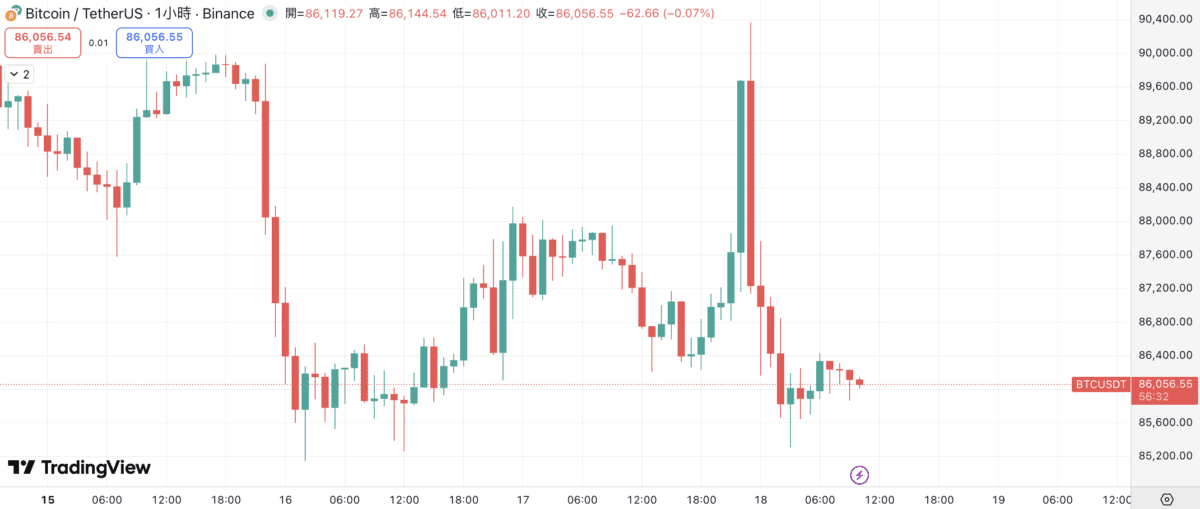
Severe price fluctuations have also triggered large-scale liquidations in the derivatives market. According to CoinGlass data, the amount of cryptocurrency derivatives liquidated in the past four hours exceeded 190 million USD, with long positions liquidated at approximately 72 million USD and short positions liquidated up to 121 million USD, indicating extreme uncertainty in market direction.
Hunter Rogers, co-founder of the Bitcoin yield protocol TeraHash, pointed out that the contraction of marginal liquidity is the main reason for the recent repeated market volatility. In an environment of insufficient liquidity, even slight selling pressure can be magnified into severe fluctuations. He further stated that whether Bitcoin can hold the 80,000 to 85,000 USD range will be a key observation point, potentially determining whether the market continues to consolidate or tests lower support.
AI correction, interest rate cut expectations, and risk appetite tug-of-war
Overall, the current market is in a phase of multiple intertwined macro factors. On one hand, the AI investment narrative shows signs of 'de-bubbling', suppressing technology stocks and risk sentiment; on the other hand, Federal Reserve Governor Christopher Waller recently made dovish statements, indicating that there is still room for rate cuts against the backdrop of a weakening job market, providing some support to the market.
In the short term, the market will continue to focus on the upcoming PCE inflation data to gauge the Federal Reserve's subsequent policy direction. Until the policy and growth outlook is clearer, both the U.S. stock and cryptocurrency markets may continue to see increased volatility, range-bound fluctuations, and defensive capital, which could remain the main theme.
Source
Source
