

Why optimizing every second and every performance point can turn a protocol into its own source of fragility.
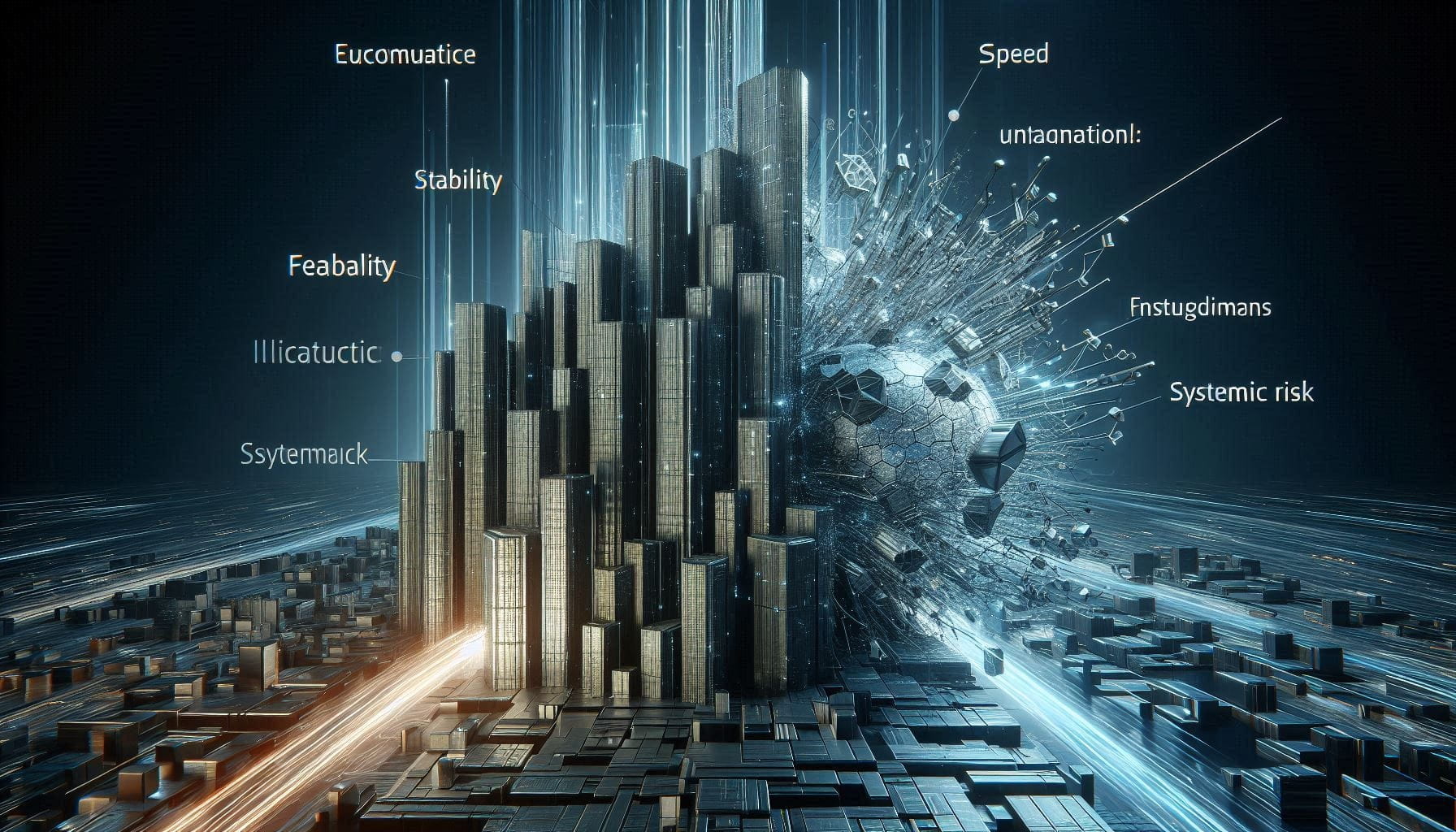
For years, efficiency was treated as an unquestionable virtue in DeFi. More speed, less friction, greater performance. Each technical improvement promised fairer, more liquid, and more accessible markets. However, as the ecosystem matures, an uncomfortable paradox emerges: the most efficient systems are not always the most resilient.
Many of the episodes of more severe stress did not occur in slow or poorly designed protocols, but in those that operated flawlessly.
Falcon Finance starts from this critical observation: when efficiency is pursued as an absolute goal, it can silently erode the system's resilience.
Efficiency as an unquestionable dogma
In DeFi, efficiency is often measured in clear metrics: instant execution, minimal spreads, capital always in motion, optimized APYs. The problem arises when these metrics become ends in themselves.
Extreme optimization generates systems where:
There are no natural buffers.
Reactions are immediate and homogeneous.
Capital behaves in a highly opportunistic manner.
Time ceases to be a variable of adjustment.
In this context, any shock —no matter how small— transmits without attenuation. Falcon Finance observes that efficiency without containment transforms stability into fragility.
Resilience: the virtue that is not measured
Unlike efficiency, resilience does not look good on dashboards. It does not maximize metrics in calm markets nor attract speculative capital in the short term. However, it is the property that defines which systems survive when the environment ceases to be ideal.
A resilient system:
Tolerates abrupt movements without collapsing.
Gradually absorbs stress.
Allows diverse responses.
Sacrifices extreme performance for stability
The dilemma arises when design exclusively prioritizes efficiency, eliminating precisely the elements that allow for resistance in adverse scenarios.
When optimizing means synchronizing
One of the most dangerous side effects of efficiency is synchronization. By reducing friction, all actors receive the same signals and react in the same way.
This translates to:
Simultaneous liquidations.
Coordinated withdrawals.
Cloned strategies running in parallel.
Liquidity that disappears suddenly.
The system does not fail due to slowness or errors, but due to excessive perfect coordination. Falcon Finance incorporates this reading into its architecture, understanding that temporal diversity is an essential component of resilience.
The hidden cost of eliminating friction
In theory, friction is bad. In practice, it serves a critical function: it introduces time, reflection, and asymmetry in responses. Eliminating it completely has structural consequences.
When there is no friction:
Getting out first is always the best strategy.
Remaining becomes irrational.
Capital does not distinguish between noise and signal.
The system goes into binary mode: all or nothing.
Falcon Finance does not demonize efficiency, but recognizes that some well-designed friction acts as a stabilizer, not as an obstacle.
Design for real markets, not ideal ones
Many protocols are optimized for liquid, calm, and growing markets. But real markets are cyclical, emotional, and asymmetric. Designing only for the best scenario is a form of risk.
A more systemic approach implies:
Accept trade-offs between performance and stability.
Design incentives that do not reward only escape.
Incorporate stress absorption mechanisms.
Think of collective behavior, not just individual.
Falcon Finance positions itself from this perspective: efficiency is valuable, but it cannot be the only design criterion.
Conclusion
The hidden dilemma of DeFi is not technical, it's philosophical. Pursuing absolute efficiency can weaken the foundations of the system. The protocols that survive the next cycle will not necessarily be the fastest or the most profitable in calm times, but those capable of withstanding when efficiency ceases to be an ally.
Falcon Finance understands that the real challenge is not choosing between efficiency or resilience, but consciously balancing them. Because in complex financial systems, what seems optimal in the short term can be lethal in the long.
@Falcon Finance $FF #FalconFinance #falconfinance
⚠️ Disclaimer: This content is for educational and informational purposes only. It does not constitute financial advice. Do your own research (DYOR).

