Ethereum is quietly 'becoming less'
Recently, there has been a noteworthy change on the Ethereum chain: the amount of ETH in exchanges has been continuously decreasing and has dropped to the lowest level since 2016. This is not due to retail investors panic selling, but rather resembles a 'quiet accumulation' led by institutions and long-term holders.
With the increasing demand for Ethereum allocation from institutions, enterprises, and #etf , more and more ETH is being transferred out of exchanges into cold wallets, staking contracts, or long-term reserve accounts, indicating a change in market structure.
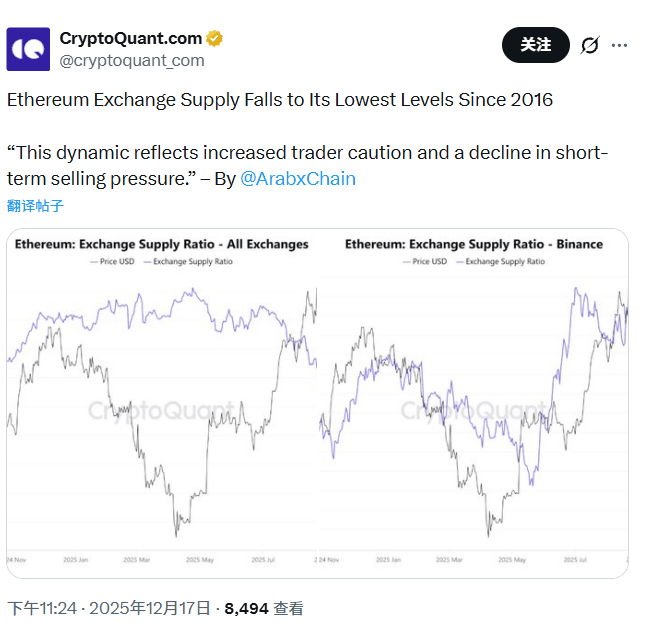
Exchange ETH supply has fallen to historical lows.
According to on-chain data provided by CryptoQuant, the exchange supply ratio (ESR) has now dropped to about 0.137, meaning that less than 14% of ETH still remains on exchanges, a level that has not been seen since the early stages of Ethereum in 2016.
At Binance, which has the highest trading volume, the situation is even more evident, with ETH's ESR having dropped to around 0.032, indicating that the amount of ETH available for trading and selling is rapidly decreasing. This is usually not a signal of active short-term trading, but rather a phase where chips are being 'locked away'.
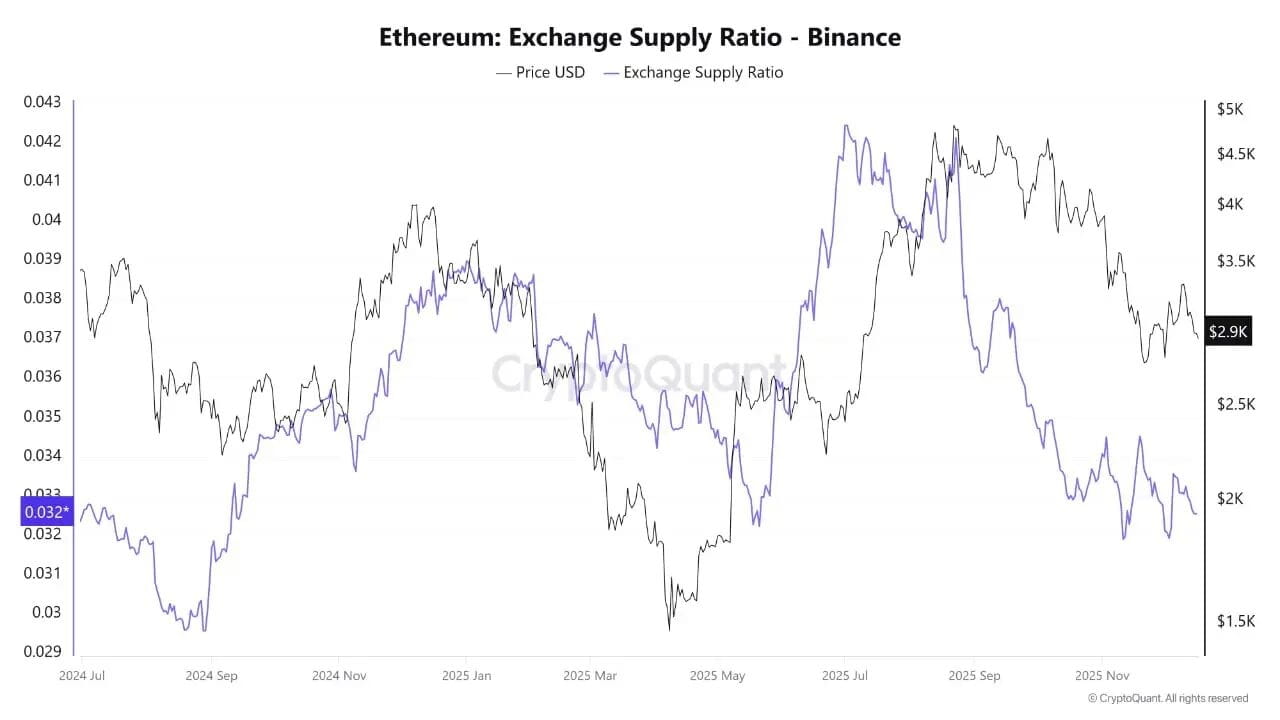
The willingness to sell is weakening.
CryptoQuant analyst Arab Chain pointed out that ETH is currently continuing to net flow out of exchanges, moving toward private wallets and on-chain protocols. This trend often appears after the market experiences volatility, when selling pressure eases and funds begin to absorb liquidity again, holders are more inclined towards long-term positioning rather than frequently entering and exiting the market.
Since mid-2024, the overall exchange's ESR indicator has been declining, while the price of ETH has been fluctuating in high and pullback ranges. This divergence indicates that sell pressure is decreasing, but the market is still waiting for new catalysts.
PoS and staking are currently 'locking' #ETH
After Ethereum transitioned to a proof-of-stake mechanism, staking has become an important variable. Currently, nearly 36 million ETH have been staked, and these tokens need to be transferred from exchanges to dedicated wallets or protocols, making them illiquid in the short term.
In other words, more and more ETH is being systematically locked up, which not only reduces market circulation but also changes investor behavior from 'always sellable' to 'long-term yield holding'.
Layer 2 is diverting liquidity.
In addition to staking, the development of Layer 2 ecosystems is also affecting the distribution of ETH. Layer 2 networks like Base, Arbitrum, and Optimism have attracted substantial funds and users, transferring ETH from centralized exchanges to on-chain and decentralized exchanges.
After the collapse of FTX, more and more users are choosing self-custody of assets, and the frequency of using DEX and on-chain protocols is continuously increasing, further compressing the ETH supply in exchanges.
Institutions are systematically positioning in Ethereum.
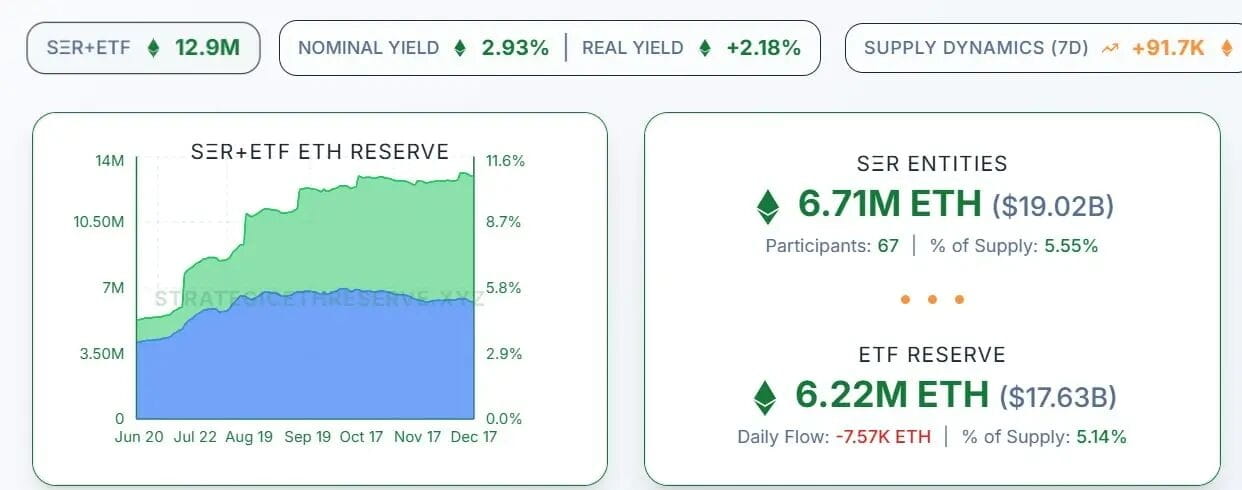
On-chain data shows that currently, about 67 listed companies, government agencies, and organizations are using Ethereum as a reserve asset, holding a total of approximately 6.71 million ETH, valued at nearly 1.9 billion dollars. At the same time, the amount of ETH held by Ethereum ETFs has also exceeded 6.22 million, with the proportion of total supply continuously rising.
These funds do not pursue short-term volatility but are more inclined towards long-term allocation, which is also an important reason for the continuous decline in exchange ETH supply.
Conclusion: Supply tightness, long-term logic still exists.
With decreasing exchange ETH supply and increasing institutional demand, a 'low liquidity, high demand' market environment is being shaped. While short-term prices may still be affected by macro and sentiment factors, structurally, the long-term supply-demand relationship of ETH is gradually tightening.
When sell pressure decreases while long-term buying persists, the market ultimately needs to rebalance everything through price. Ethereum may be gradually accumulating strength for the next phase of the market.