
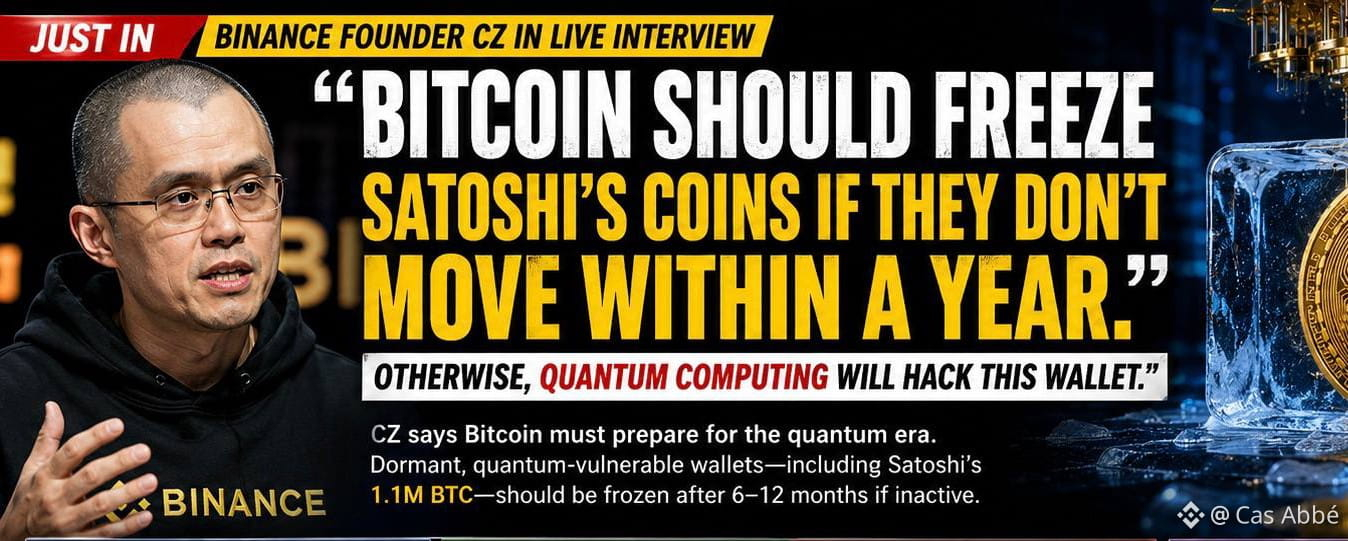

I never expected one sentence from CZ to spark one of the biggest debates Bitcoin has faced in years.
“Bitcoin should freeze Satoshi’s coins if they don’t move within a year.”
At first glance, it sounds outrageous.
Bitcoin was built on one simple promise: if you own the private keys, nobody can freeze your coins. So why would the founder of Binance suggest doing exactly that?
Because this isn’t really about Satoshi.
It’s about quantum computing. And whether Bitcoin should protect its principles or protect the network itself.
The discussion started after CZ explained that Bitcoin will eventually need to migrate toward quantum-resistant cryptography. He argued that once such an upgrade exists, every holder should have enough time roughly 6 to 12 months to move their BTC into new quantum-safe addresses.
If someone doesn’t move their coins after that window, including Satoshi Nakamoto’s estimated 1.1 million BTC, CZ believes the network should freeze those coins before a future quantum computer can steal them.
It’s based on a real technical concern.
Many of Bitcoin’s earliest wallets including a large portion believed to belong to Satoshi used Pay-to-Public-Key (P2PK) addresses. Unlike modern address formats, those wallets expose the owner’s public key directly on-chain.
Today, that isn’t a problem.
Tomorrow, it might be.
If a sufficiently powerful quantum computer is ever built, algorithms like Shor’s could theoretically derive private keys from exposed public keys, allowing an attacker to sign transactions without ever knowing the original secret. That’s why post-quantum cryptography has become an increasingly serious topic across cybersecurity not just crypto.
The numbers make the conversation impossible to ignore. Satoshi is widely estimated to control around 1.1 million BTC.
At today’s prices, that’s worth tens of billions of dollars. More importantly, it’s roughly 5% of Bitcoin’s entire supply.
If those coins suddenly entered circulation because someone cracked the wallets, the market shock would be unlike anything Bitcoin has ever experienced.
That’s the nightmare scenario CZ is trying to prevent. But here’s where things become incredibly controversial.
Bitcoin isn’t controlled by CZ. It isn’t controlled by Binance. It isn’t even controlled by Bitcoin Core developers.
Every rule change requires overwhelming consensus from the network itself.
And freezing coins even for security reasons would fundamentally change one of Bitcoin’s strongest guarantees.
Supporters argue the choice is simple.
Would you rather allow an unknown attacker with a quantum computer to steal more than a million BTC?
Or would you rather permanently lock dormant coins before anyone can exploit them?
To them, freezing abandoned quantum-vulnerable wallets protects every honest Bitcoin holder.
Critics completely reject that logic.
They believe the moment Bitcoin proves it can freeze one wallet, even Satoshi’s, the network crosses a line it can never uncross.
Bitcoin’s neutrality has always depended on one rule:
If you control the keys, you control the coins.
That’s why many in the community believe a forced freeze would damage Bitcoin’s credibility more than any quantum attack ever could. Community reactions over the past week have reflected exactly this divide, with strong arguments on both sides about security versus immutability.
There’s another important reality.
Most researchers don’t believe quantum computers capable of breaking Bitcoin exist today.
Many estimates still place that capability years possibly more than a decade away. That means this isn’t an emergency.
It’s preparation.
And history shows Bitcoin has always preferred solving problems long before they become existential.
Personally, I don’t think this debate is really about freezing Satoshi’s Bitcoin.
It’s about defining what Bitcoin actually is.
Is Bitcoin an unchangeable system where property rights are absolute, regardless of future technology?
Or is it a living protocol willing to evolve if doing so protects the network from catastrophic threats?
Because whatever decision Bitcoin eventually makes about quantum security won’t just determine the fate of Satoshi’s coins.
It could define Bitcoin’s identity for the next hundred years.