
Is MicroStrategy going to go bankrupt? MSCI may kick the 'cryptocurrency asset management company' out of the index, leading to forced sales of up to $15 billion in crypto assets by passive funds.
Does it sound scary? Don't panic just yet. Follow Classmate Octopus to check this news, and you'll find numerous flaws within.
First, how did the source of this matter come about? It actually stems from MSCI's own consultation announcement. It released a formal market consultation document on October 10, 2025.
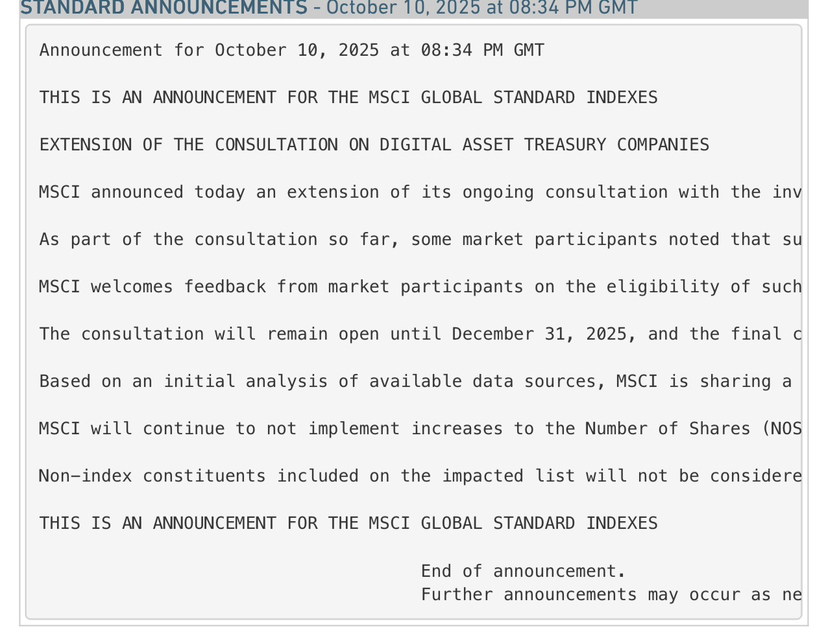 The original statement is: If a company's digital assets account for more than 50% of its total assets, then it 'may no longer be suitable' to continue being included in MSCI's global investable index (such as GIMI), and the classification method needs to be reconsidered. Note several key phrases: may reconsider, consult market opinions.
And this is not the first time MSCI has asked this question. Earlier (since last year), MSCI has repeatedly discussed a directional question with the investment community: should companies that hold a large amount of Bitcoin on their balance sheets be classified separately from traditional stock indices, instead of continuing to be mixed in with regular operating companies? This is not an executive order. It was packaged by certain people as an 'upcoming event that will lead to a 15 billion dollar sell-off.'
Second, how exactly is the so-called 15 billion dollar figure calculated?
It is not given by MSCI officially. It is actually a hypothetical list made by a certain opposing group (Bitcoin For Corporations (BFC)): if MSCI in the future does not like companies holding too much Bitcoin on their balance sheets, which companies might be 'affected', thus they put together a 'hypothetical list', and then calculated using index weight × passive fund size. It's really childish.
According to JPMorgan's own analysis, the real impact mainly comes from MicroStrategy, which estimates a outflow of about 2.8 billion dollars. This is completely different from the concept of "15 billion forced selling."
Third, why do I say "it's almost impossible for the kind of crash you imagine to happen"?
The reason is simple: MSCI will definitely announce rule changes in advance and take it slow, and passive funds won't liquidate just because of one news article. Even if there is a real adjustment, it's the stock weights that are sold, not Bitcoin.
Fourth, is it really that kind of news, always 'old wine in new bottles'?
Because this is an old trick used in financial markets for decades: using terms like 'rules', 'index', and 'regulation' that ordinary people do not understand but seem very authoritative to create panic; after retail investors panic sell,
Real large funds slowly buy in at low levels. Just a few examples: look at CME futures in 2017, the pandemic in 2020, China's mining ban in 2021, FTX in 2022, and the SEC suing exchanges in 2023—every time, the script is exactly the same.
The rules that truly change the market never first appear in panic headlines. They first show up on the balance sheets of institutions.
