
Trading setup
Key trading range**: `$0.100` - `$0.120`
Logic: This range is an area where prices have recently tested multiple times, with `$0.10` being an important psychological barrier, and `$0.12-$0.15` being a small resistance zone from the previous period.
*Target 1 🎯: `$0.150` (challenging the lower edge of the main oscillation range for 2024-2025)
*Target 2 🎯: `$0.200` (returning to a key mid-term resistance level, testing market confidence)
*Target 3 🎯: `$0.250 - $0.280` (impacting the mid-term forecast target for 2026, requires strong ecological favorable driving forces)
*Stop loss: below `$0.095` (a valid drop may lead to a return to a downward trend)
Core bullish logic (high-risk speculative narrative)
1. 'Bad news is fully priced in' and the speculative window brought about by legal events:
The core uncertainty that has plagued LUNA for years—the legal case of founder Do Kwon—is nearing its end. He has pleaded guilty to fraud charges, and the market expects a verdict to be delivered soon. At the same time, Terraform Labs has reached a hefty settlement with the SEC and has dissolved. This series of events has been interpreted by some market participants as 'the worst moment has passed', forming a typical 'bad news is fully priced in' trading logic, attracting speculative funds seeking extreme risk returns.
2. The independent reboot and deflationary supply model of Terra 2.0:
Unlike the old chain LUNC with a supply of trillions, the new chain LUNA (i.e., Terra 2.0) is a complete reboot, using a new limited token supply model of approximately 343 million tokens. This completely severs the fatal connection to the algorithmic stablecoin UST that led to the collapse of the original system, attempting to address the root problem of the 'death spiral' from a design perspective. The new chain focuses on staking, governance, and ecological development, providing a relatively clear (though fragile) foundation for value.
3. Community-driven weak recovery and market memory speculation:
The Terra ecosystem still retains a certain developer base and community consensus. Although its scale cannot be compared to its peak, the return of on-chain developer activity and some DeFi protocols forms a small spark in its 'revival narrative'. In the cyclical rotation of the crypto market, such targets with high visibility (even if negative) and deep-rooted investors are easily susceptible to short-term speculation and 'revenge trading' under specific market sentiments (such as late bull markets), causing significant volatility.
Market analysis
If the price can gain support in the range of `$0.100 - $0.120`, coupled with an increase in risk appetite across the entire crypto market or unexpected ecological cooperation news, the price may first attempt to break through the `$0.150` level. If it can stabilize, under the narrative of 'bad news is fully priced in', it cannot be ruled out that funds will push it to test `$0.200` or even higher levels. However, all upward movements should be viewed as extremely fragile rebounds, rather than a trend reversal.
Risk warning
It is essential to be fully aware that LUNA is one of the highest risk investment targets in the crypto world, with risks far exceeding those of ordinary altcoins. The essence of trading is betting on 'high risk appetite' and 'market game psychology', rather than investing based on fundamentals.
Be cautious of the following deeply ingrained structural risks:
The permanent damage to trust and the bankruptcy of narratives: The algorithmic stablecoin model represented by LUNA has completely collapsed in the minds of global regulators and mainstream investors. Regulatory bodies such as the United States and the European Union have listed it as a cautionary case, with extremely narrow long-term compliance development space. The labels of 'scam' and 'failure' will accompany this project for a long time, severely hindering the acceptance of any institutional funds and mainstream users.
The ecological foundation is extremely weak: Despite the new chain restart, the total locked value, user activity, and developer influence in the Terra ecosystem are far from their former glory. Compared to thriving public chains like Ethereum and Solana, its ecological competitiveness is almost negligible, lacking a solid foundation for value creation.
Extreme volatility and liquidity risk: Data shows that LUNA has dropped by 51% over 90 days, with volatility dominating the market. Its trading volume is relatively limited, and large trades can easily trigger significant price slippage. The recent weekly gain of up to 203% is essentially a short squeeze and speculative trading under liquidity scarcity, which may reverse at any time.
Ongoing selling pressure and centralization issues: Tokens held by the founding team face destruction or unlocking, and related legal events may also trigger unexpected sell-offs. At the same time, token distribution may still be relatively concentrated, posing the risk of 'whales' manipulating the market.
If the price breaks down below `$0.095` and cannot quickly recover, it means that the logic of a weak rebound has failed, and you must exit immediately, as there may be significant downside potential.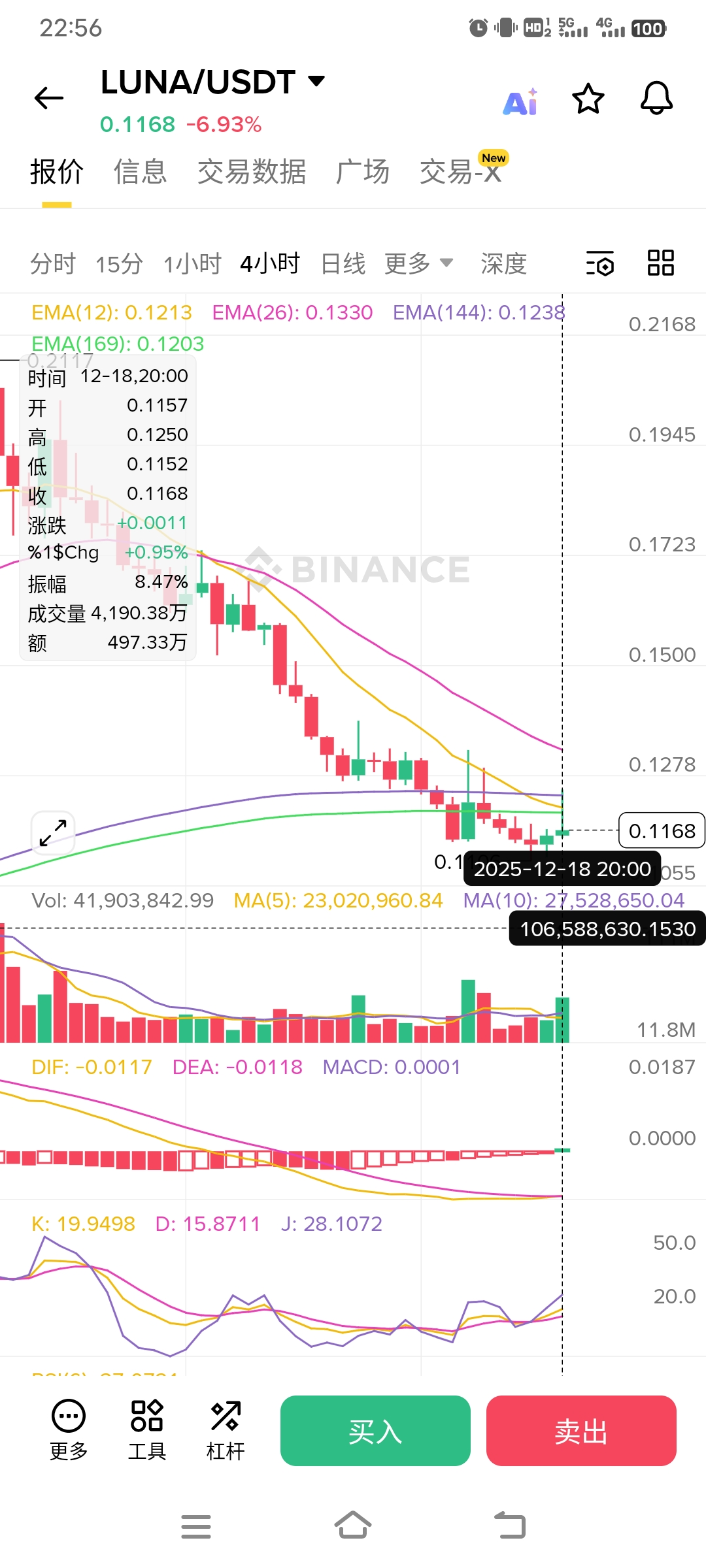
> Important statement: The above analysis is based on public market information and is an objective description of the speculative behavior of a high-risk asset under special market conditions, and does not constitute any investment advice. LUNA represents a historical trading symbol of an asset close to zero, with investment risks exceeding those of the vast majority of cryptocurrencies. You must understand that there is a high probability of losing all invested funds. Please make independent judgments, only participate with funds you can afford to lose, and be mentally prepared for total loss.
