

@Falcon Finance $FF #FalconFinance
DeFi was supposed to simplify finance.
Instead, for many users, it became a maze of vaults, incentives, rebalancing rules, and silent risks that only reveal themselves when something breaks.
Falcon Finance is interesting precisely because it does not try to win this complexity game. Its design feels aimed at people who no longer want to manage DeFi, but simply want systems that behave predictably under pressure.
To understand Falcon Finance properly, it helps to separate what it does from what it refuses to do.
DeFi Became Complex Because Risk Was Pushed to Users
Most DeFi protocols offer freedom, but with that freedom comes responsibility:
Choosing strategies
Monitoring positions
Managing exits
Reacting to market stress
Over time, complexity didn’t disappear — it was outsourced to the user.
Falcon Finance approaches this from the opposite direction. Instead of asking users to actively manage risk, it tries to structure risk at the protocol level, so that fewer decisions need to be made under stress.
This is not about maximizing yield.
It’s about minimizing decision fatigue and error.
Falcon’s Core Idea: Reduce Cognitive Load
Falcon Finance is built around a simple but rare principle in DeFi:
If users need to constantly think about what to do, the system is already fragile.
Rather than stacking features, Falcon focuses on:
Clear capital flows
Controlled interactions
Predictable behavior during low-volatility and high-volatility periods
This is why Falcon often feels “quiet.” It doesn’t chase attention because attention usually arrives with complexity.
Why This Matters Most in Sideways Markets
Sideways markets are where DeFi complexity becomes unbearable.
There is no strong trend to cover mistakes.
Rewards shrink.
Volatility appears in short bursts.
In these conditions:
Over-engineered strategies underperform
Incentive-heavy protocols lose users
Systems relying on constant activity start breaking
Falcon Finance is designed to remain functional even when nothing exciting is happening. That’s not a marketing choice — it’s an architectural one.
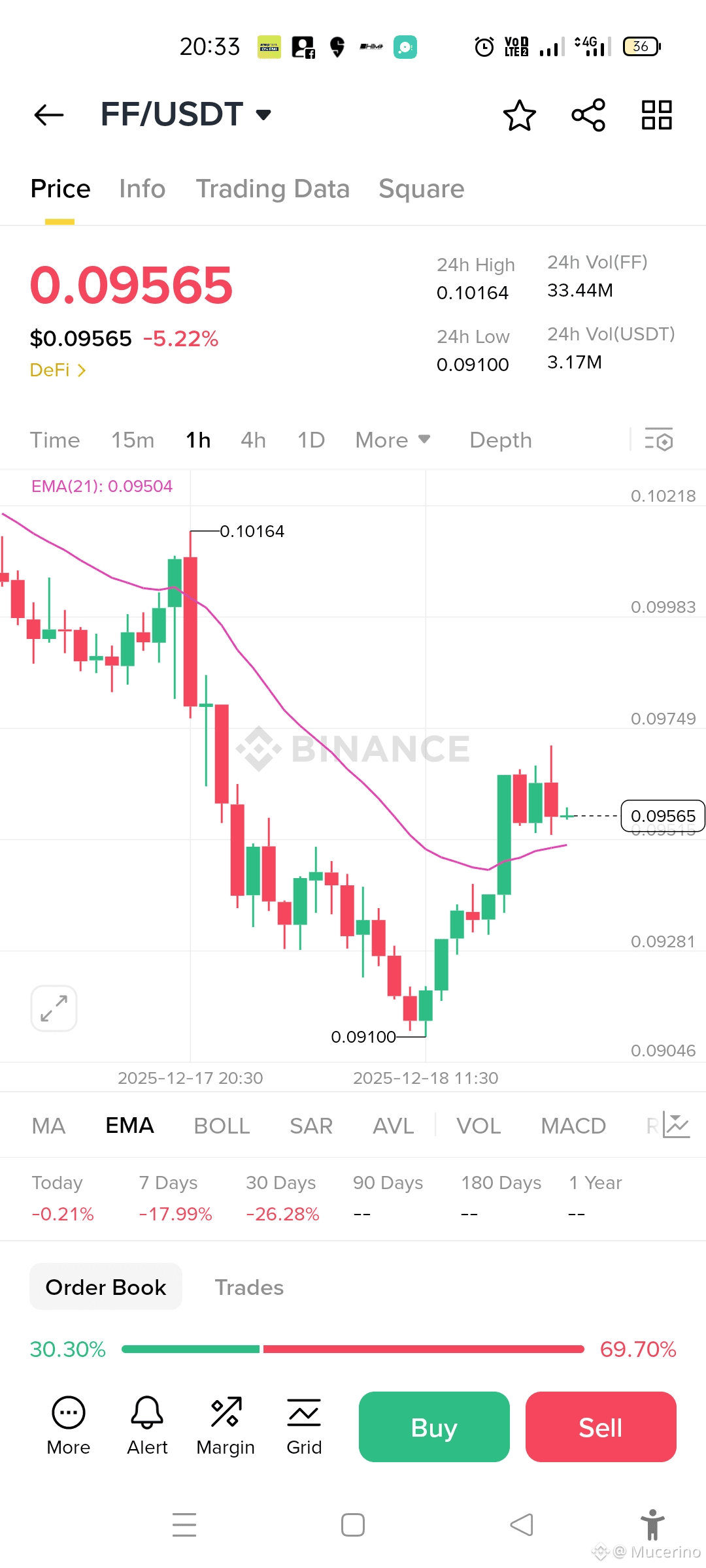
Reading the FF/USDT Chart Through This Lens
Let’s now look at the chart you shared, not as a trading signal, but as a reflection of market behavior.
1️⃣ Structure, Not Noise
On the 1H chart, FF shows:
A clear move down from ~0.1016 to ~0.0910
Followed by a measured recovery toward ~0.095–0.096
This is not impulsive price action. It’s controlled, range-bound behavior, which aligns with a market that is cautious rather than euphoric.
2️⃣ EMA(21) as a Decision Zone
Price is currently hovering very close to the EMA(21) (~0.0950).
This tells us two things:
Buyers are willing to defend higher lows
Sellers are still present near resistance
In complex DeFi narratives, price often violently rejects or overshoots averages. Here, price is respecting structure, which suggests balanced participation rather than speculation.
3️⃣ Higher Low After the Bottom
The bounce from 0.0910 created a higher low and a short-term higher high near 0.097–0.098, before consolidating.
This is typical of:
Accumulation phases
Market participants positioning cautiously
No aggressive distribution or panic
Again, this mirrors Falcon’s positioning: slow, controlled, non-reactive.
4️⃣ Volume and Sentiment
Order book data shows:
Buy pressure around 30%
Sell pressure around 70%
This imbalance explains why price struggles to break higher. But importantly, price is not collapsing. That usually means sellers are active, but not confident.
This kind of environment favors protocols that do not rely on hype cycles to function.
Why This Chart Matches Falcon’s Philosophy
The FF chart does not look exciting — and that’s the point.
It reflects:
A market pricing uncertainty
Reduced speculative behavior
Gradual positioning instead of emotional moves
For a protocol built to reduce DeFi complexity, this kind of price behavior is not a failure. It’s a natural consequence of not optimizing for attention.
Falcon Finance makes sense for people who are tired of:
Constant strategy switching
Monitoring dashboards every hour
Wondering what hidden risk they missed
Its value is not in outperforming the market every week.
Its value is in not demanding constant mental energy from users.
The chart reflects this reality:
No hype spikes
No collapse
Just controlled movement in a difficult market
For many DeFi users today, that kind of predictability is not boring — it’s relief.
And that is exactly who Falcon Finance seems to be built for.

