
1. Macro earthquake: The end of yen easing, where is the anchor for real assets?
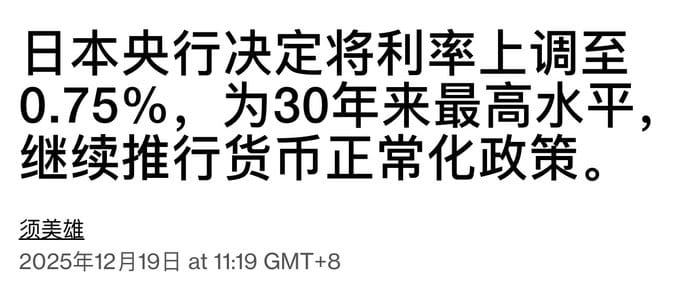
On December 19th, a landmark moment for global financial markets occurred: the Bank of Japan passed a resolution to raise interest rates by 25 basis points, pushing the policy rate up to 0.75%.
This is not just a number; it marks the end of an era. The Japanese policy rate has reached its highest level in 30 years, signaling the formal conclusion of the decades-long era of 'cheap yen' carry trade. As global liquidity tightens, all yen-denominated assets—especially Pokémon cards (PTCG), known as the 'king of alternative assets'—are facing unprecedented repricing pressure.
Volatility is opportunity. As traditional cross-border transactions become complicated due to exchange rates and interest rate hikes, Web3 provides a standard answer: RWA (Real World Assets) on-chain.
II. Jackson.io Enters RWA: Why is PTCG the Best Entry Point?
Among all emerging public chains, Sui, with its high performance and object model, has become fertile ground for RWA implementation. Jackson.io has announced that its RWA TCG business is officially launching, with the core application Cardz.game pilot version set to go live on January 1.
Why is the initial focus on PTCG?
Liquidity Revolution: Traditional TCG trading is constrained by logistics, physical wear and tear, and cross-border exchange rates. Through RWA technology, Jackson.io anchors physical cards on-chain, achieving asset digitization, allowing global collectors to instantly complete ownership transfers on the Sui chain.
2026 Key Cycle: 2026 marks the 30th anniversary of Pokémon, and according to historical patterns, the period leading up to the anniversary is the golden period for asset layout. 2025 will be the last wave of opportunities for global funds to 'ambush' key card assets.
III. Cardz.game: Not just a game, but a 'financial engine' for physical assets
The Cardz.game created by Jackson.io is not a castle in the air; it is a **'dimensionality reduction strike'** against the physical collectibles market:
Transparent Valuation: Using the immutable nature of blockchain, the status, rating, and circulation records of each card are fully transparent, eliminating counterfeit and hidden transactions.
Asset Elevation: Transforming expensive cards that originally lay in safes into liquid Web3 assets.
Risk Hedging: In the face of volatility caused by the yen interest rate hike, on-chain assets settled through $SUI or $USDC provide a natural hedging tool for global collectors.
IV. The 'Dealer' Mode Upgraded Again: JacksonLP's Profit Flywheel
Jackson.io's most competitive logic lies in its profit distribution mechanism. Whether in the original entertainment sector or the upcoming Cardz.game RWA business, the platform always insists: 100% profit buyback.
Generating Revenue: Fees, authentication costs, and transaction premiums in the RWA business.
Aggressive Buyback: The platform will use 100% of its revenue to publicly purchase $JACKSON on the secondary market.
Intrinsic Momentum: When external macro environments (such as Japan's interest rate hikes) lead to tightened liquidity, Jackson.io's business-generated 'intrinsic buying power' builds a strong defensive wall for token value.
V. Summary: Witness the Rebirth of Physical Cards in the Digital World
2025 will be the year when Web3 truly moves towards an application explosion. When the scarcity of physical cards meets the immutability of blockchain, combined with the asset restructuring needs caused by Japan's interest rate hikes, Jackson.io stands at the intersection of these three major trends.
From an ordinary player to a seasonal 'Dealer', and then to a holder of RWA assets, Jackson.io provides a clear path. On January 1, Cardz.game will pilot launch, which may be the 'killer app' that the Sui ecosystem has been looking for.
Follow Jackson.io, grasp the pricing power of TCG assets on the eve of the 30th anniversary.