
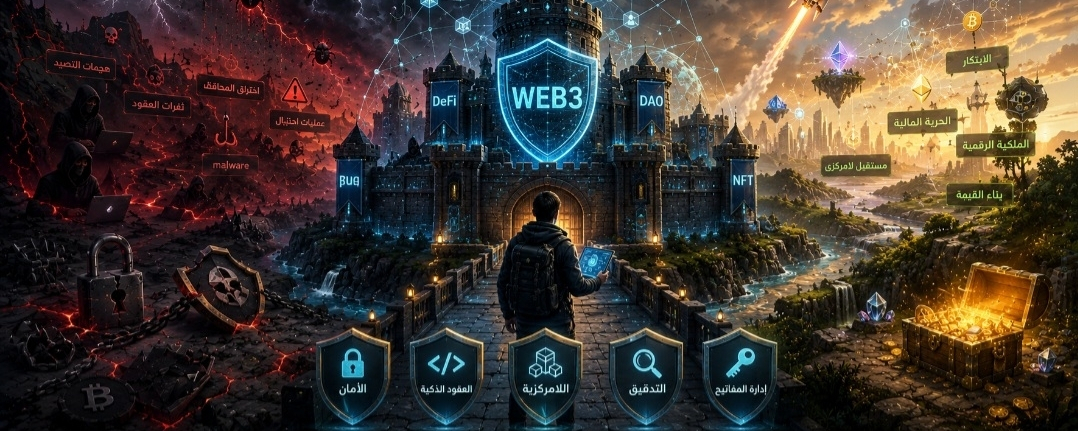
Peace be upon you and the mercy of Allah 🌙
Imagine you entered a highly fortified bank building, but the guard told you that the only key to your vault is a "small paper"—if you lose it, you won’t be able to enter again. This is exactly the Web3 dilemma. We’re building the safest and most advanced financial systems ever, but access to them still depends on a sequence of 12 words 🔑.
In this article, I won’t list boring technical terms. I’ll reveal the hidden threads woven by the biggest minds in crypto to change the rules of the game. We’ll analyze the greatest innovations and the most dangerous landmines 💣. Welcome to the survival guide.
⚡️ 1. The Second Layer: How it broke Ethereum’s limits?
Ethereum—leader of smart contracts—has long been a victim of its own success. And as demand increased, gas fees became expensive, sometimes reaching dozens of dollars for a simple transfer 💸. That’s where second-layer solutions (L2s) come in.
But the question isn’t what it is—it’s how it achieves this magic 🧙♂️. It works like a high-speed train next to the old road 🚄. Instead of recording every transaction directly on the main chain (L1), these networks process thousands of transactions off-chain, then bundle them and send them all at once to Ethereum. Supported by advanced proofs, this approach not only significantly reduces costs, but also massively increases transaction speed.
And the reality is that Vitalik Buterin himself believes that second-layer solutions are an essential part of Ethereum’s scaling strategy. However, you need to note that fees and speed vary depending on which L2 network you use and how congested it is. Fees might drop to a few cents on some networks, with a significant improvement in transaction confirmation speed—but it’s not always consistent ⚠️.
So what’s the result? We’re now in an era where L2s are multiplying, and each one offers specialized solutions. This isn’t just an improvement—it’s a full rebuild of the financial highway from the ground up 🛣️.
🔐 A key made of 12 words: the nuclear weapon you carry in your pocket ☢️
Let’s be bluntly honest. The most dangerous piece of technology in the entire crypto world isn’t a complex algorithm—it’s your digital wallet, specifically the “seed phrase” made of 12 or 24 words. These words are the DNA of your wealth 🧬.
Binance recently talked about the importance of wallets designed to simplify usage while enhancing security—an honorable goal every serious wallet pursues.
Why is this warning so harsh? Because the numbers are terrifying 😱. Hacks and scams have caused losses in the billions of dollars in this sector. A large portion of these losses didn’t come from attacking the blockchain itself, but from compromising users via phishing or neglecting the protection of their private keys 🎣.
The golden rule for staying alive is simple and harsh:
· ❌ Never share your 12 words with anyone, under any circumstances. No technical support, no friend, and not even a Nigerian prince.
· ❌ Do not write it on a device connected to the internet. No digital notebook, and no screenshot.
· ✅ Paper and metal are your only friends 📝🔩. Write it on paper, discuss it on metal, and store it in two different, truly secure places.
Your wallet is your bank 🏦. And you are the bank manager, its guard, and the only client. This isn’t just technology—it’s absolute responsibility.
💰 3. Restaking: the magic of doubling profits or a ticking time bomb? 💣💎
Staking has always been the boring and safe way to earn an annual profit. But what if I told you that you can double your profits by using the very same staked assets? That’s the idea of restaking (Restaking) 🔄.
Restaking aims to maximize returns by using staked assets to secure additional networks. Instead of settling for a modest annual yield, you can “re-deploy” your staked assets to secure new applications and earn extra fees—potentially doubling your return 📈.
This innovation, led by platforms like EigenLayer, opened the door to an entirely new security economy. It recycles capital and makes it work with double efficiency.
But where does the danger lie? ⚠️
This sector is still emerging and carries hidden risks. The technical risks in smart contracts for restaking are high, in addition to the risk of “slashing,” where you can lose part of your originally staked assets if the new operator behaves improperly. Also, this strategy may not be suitable for beginners due to its complexity and added risks. Therefore, when choosing a restaking platform, code auditing and security are the difference between doubling profits and doubling losses 🔎.
Final takeaway:
🧠 We’re building a new financial system. The second layer makes it fast and cheap. Wallets are its personal bodyguards. And restaking is its bold economic engine. But in this world, you are the leader. Without awareness and understanding, these tools become a curse, not a blessing.
If you found this deep technical article useful and clear, share it with people you trust.
🔔 Subscribe now to receive exclusive technical analyses.
📲 Repost this article so the trading and developer community can benefit.
❤️ Like this if you believe that understanding the technology is the most important weapon in this market.
💬 Question of the night:
In your opinion, what is the biggest technical challenge facing Arab users in the crypto world today: understanding L2 solutions, securing a wallet, or assessing the risks of new DeFi products?
Be honest and share your opinion in the comments 👇
#BINANCE #BTC走势分析 #AI #SaylorHintsStrategyBitcoinBuy #EarnFreeCrypto2024

